Alessia Tonoli, Silvia Anselmi, John M. Ward, Helen C. Hailes, Jack W. E. Jeffries
{"title":"Expanding the Enzymatic Toolbox for Carboligation: Increasing the Diversity of the ‘Split’ Transketolase Sequence Space","authors":"Alessia Tonoli, Silvia Anselmi, John M. Ward, Helen C. Hailes, Jack W. E. Jeffries","doi":"10.1002/cbic.202401028","DOIUrl":null,"url":null,"abstract":"<p>Transketolases (TKs) are thiamine diphosphate (ThDP)-dependent enzymes that catalyze the transfer of two-carbon units in a stereoselective manner, making them valuable biocatalysts for sustainable processes. Most known TKs are about 650 amino acids long; however, a second type found in Archaea and many Bacteria consists of two proteins, each of about 300 amino acids. Exploring the unique features and differences of split TKs may help in assessing their potential use in biocatalysis and for uncovering new reactivities. Additionally, it could provide valuable information on how their structure relates to their function, especially compared to full-length TKs. In this study, we significantly expanded the known repertoire of split TKs approximately 14-fold to the best of our knowledge, by identifying and providing accessions of nearly 500 putative split-TK subunit pairs. Moreover, we doubled the number of experimentally produced and tested split TKs by cloning, purifying, and testing ten candidates retrieved from genomes and in-house metagenomes. Interestingly, pQR2809 and pQR2812, derived from hyperthermophilic organisms, showed enhanced thermostability compared to other TK examples in the literature, maintaining partial activity after heating at 90 °C or 100 °C for 1 hour, respectively.</p>","PeriodicalId":140,"journal":{"name":"ChemBioChem","volume":"26 6","pages":""},"PeriodicalIF":2.8000,"publicationDate":"2025-01-30","publicationTypes":"Journal Article","fieldsOfStudy":null,"isOpenAccess":false,"openAccessPdf":"https://onlinelibrary.wiley.com/doi/epdf/10.1002/cbic.202401028","citationCount":"0","resultStr":null,"platform":"Semanticscholar","paperid":null,"PeriodicalName":"ChemBioChem","FirstCategoryId":"99","ListUrlMain":"https://chemistry-europe.onlinelibrary.wiley.com/doi/10.1002/cbic.202401028","RegionNum":4,"RegionCategory":"生物学","ArticlePicture":[],"TitleCN":null,"AbstractTextCN":null,"PMCID":null,"EPubDate":"","PubModel":"","JCR":"Q3","JCRName":"BIOCHEMISTRY & MOLECULAR BIOLOGY","Score":null,"Total":0}
引用次数: 0
Abstract
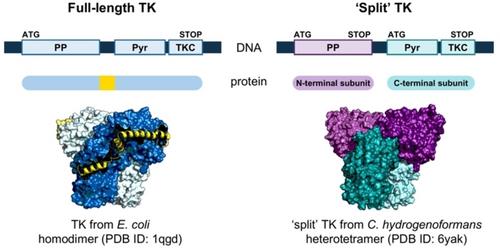
Transketolases (TKs) are thiamine diphosphate (ThDP)-dependent enzymes that catalyze the transfer of two-carbon units in a stereoselective manner, making them valuable biocatalysts for sustainable processes. Most known TKs are about 650 amino acids long; however, a second type found in Archaea and many Bacteria consists of two proteins, each of about 300 amino acids. Exploring the unique features and differences of split TKs may help in assessing their potential use in biocatalysis and for uncovering new reactivities. Additionally, it could provide valuable information on how their structure relates to their function, especially compared to full-length TKs. In this study, we significantly expanded the known repertoire of split TKs approximately 14-fold to the best of our knowledge, by identifying and providing accessions of nearly 500 putative split-TK subunit pairs. Moreover, we doubled the number of experimentally produced and tested split TKs by cloning, purifying, and testing ten candidates retrieved from genomes and in-house metagenomes. Interestingly, pQR2809 and pQR2812, derived from hyperthermophilic organisms, showed enhanced thermostability compared to other TK examples in the literature, maintaining partial activity after heating at 90 °C or 100 °C for 1 hour, respectively.
期刊介绍:
ChemBioChem (Impact Factor 2018: 2.641) publishes important breakthroughs across all areas at the interface of chemistry and biology, including the fields of chemical biology, bioorganic chemistry, bioinorganic chemistry, synthetic biology, biocatalysis, bionanotechnology, and biomaterials. It is published on behalf of Chemistry Europe, an association of 16 European chemical societies, and supported by the Asian Chemical Editorial Society (ACES).





 京公网安备 11010802042870号
京ICP备2023020795号-1
京公网安备 11010802042870号
京ICP备2023020795号-1

 分享
分享
 求助内容:
求助内容: 应助结果提醒方式:
 扫码关注我们
