Markéta Paloncýová, Mariana Valério, Ricardo Nascimento Dos Santos, Petra Kührová, Martin Šrejber, Petra Čechová, Dimitar A Dobchev, Akshay Balsubramani, Pavel Banáš, Vikram Agarwal, Paulo C T Souza, Michal Otyepka
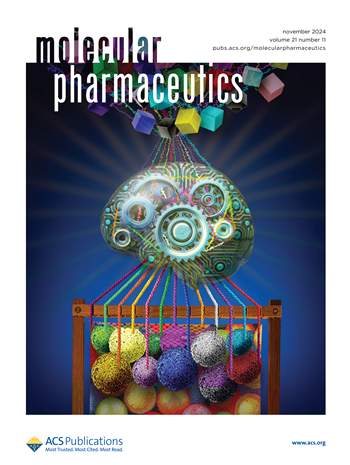
{"title":"Computational Methods for Modeling Lipid-Mediated Active Pharmaceutical Ingredient Delivery.","authors":"Markéta Paloncýová, Mariana Valério, Ricardo Nascimento Dos Santos, Petra Kührová, Martin Šrejber, Petra Čechová, Dimitar A Dobchev, Akshay Balsubramani, Pavel Banáš, Vikram Agarwal, Paulo C T Souza, Michal Otyepka","doi":"10.1021/acs.molpharmaceut.4c00744","DOIUrl":null,"url":null,"abstract":"<p><p>Lipid-mediated delivery of active pharmaceutical ingredients (API) opened new possibilities in advanced therapies. By encapsulating an API into a lipid nanocarrier (LNC), one can safely deliver APIs not soluble in water, those with otherwise strong adverse effects, or very fragile ones such as nucleic acids. However, for the rational design of LNCs, a detailed understanding of the composition-structure-function relationships is missing. This review presents currently available computational methods for LNC investigation, screening, and design. The state-of-the-art physics-based approaches are described, with the focus on molecular dynamics simulations in all-atom and coarse-grained resolution. Their strengths and weaknesses are discussed, highlighting the aspects necessary for obtaining reliable results in the simulations. Furthermore, a machine learning, i.e., data-based learning, approach to the design of lipid-mediated API delivery is introduced. The data produced by the experimental and theoretical approaches provide valuable insights. Processing these data can help optimize the design of LNCs for better performance. In the final section of this Review, state-of-the-art of computer simulations of LNCs are reviewed, specifically addressing the compatibility of experimental and computational insights.</p>","PeriodicalId":52,"journal":{"name":"Molecular Pharmaceutics","volume":" ","pages":"1110-1141"},"PeriodicalIF":4.9000,"publicationDate":"2025-03-03","publicationTypes":"Journal Article","fieldsOfStudy":null,"isOpenAccess":false,"openAccessPdf":"https://www.ncbi.nlm.nih.gov/pmc/articles/PMC11881150/pdf/","citationCount":"0","resultStr":null,"platform":"Semanticscholar","paperid":null,"PeriodicalName":"Molecular Pharmaceutics","FirstCategoryId":"3","ListUrlMain":"https://doi.org/10.1021/acs.molpharmaceut.4c00744","RegionNum":2,"RegionCategory":"医学","ArticlePicture":[],"TitleCN":null,"AbstractTextCN":null,"PMCID":null,"EPubDate":"2025/1/29 0:00:00","PubModel":"Epub","JCR":"Q2","JCRName":"MEDICINE, RESEARCH & EXPERIMENTAL","Score":null,"Total":0}
引用次数: 0
Abstract
Lipid-mediated delivery of active pharmaceutical ingredients (API) opened new possibilities in advanced therapies. By encapsulating an API into a lipid nanocarrier (LNC), one can safely deliver APIs not soluble in water, those with otherwise strong adverse effects, or very fragile ones such as nucleic acids. However, for the rational design of LNCs, a detailed understanding of the composition-structure-function relationships is missing. This review presents currently available computational methods for LNC investigation, screening, and design. The state-of-the-art physics-based approaches are described, with the focus on molecular dynamics simulations in all-atom and coarse-grained resolution. Their strengths and weaknesses are discussed, highlighting the aspects necessary for obtaining reliable results in the simulations. Furthermore, a machine learning, i.e., data-based learning, approach to the design of lipid-mediated API delivery is introduced. The data produced by the experimental and theoretical approaches provide valuable insights. Processing these data can help optimize the design of LNCs for better performance. In the final section of this Review, state-of-the-art of computer simulations of LNCs are reviewed, specifically addressing the compatibility of experimental and computational insights.
期刊介绍:
Molecular Pharmaceutics publishes the results of original research that contributes significantly to the molecular mechanistic understanding of drug delivery and drug delivery systems. The journal encourages contributions describing research at the interface of drug discovery and drug development.
Scientific areas within the scope of the journal include physical and pharmaceutical chemistry, biochemistry and biophysics, molecular and cellular biology, and polymer and materials science as they relate to drug and drug delivery system efficacy. Mechanistic Drug Delivery and Drug Targeting research on modulating activity and efficacy of a drug or drug product is within the scope of Molecular Pharmaceutics. Theoretical and experimental peer-reviewed research articles, communications, reviews, and perspectives are welcomed.




 京公网安备 11010802042870号
京ICP备2023020795号-1
京公网安备 11010802042870号
京ICP备2023020795号-1

 分享
分享
 求助内容:
求助内容: 应助结果提醒方式:
 扫码关注我们
