{"title":"A High-Capacity Manganese-Metal Battery with Dual-Storage Mechanism","authors":"Dongyang Shen, Guili Zhao, Taoli Jiang, Hongxu Liu, Ruihao Luo, Zuodong Zhang, Ziwei Zhang, Jinghao Chen, Jingwen Xu, Yuancheng Feng, Peiyan Tong, Shunxin Tan, Yidi Wang, Zhenshan Lv, Xiangyang Li, Wei Chen","doi":"10.1002/anie.202423921","DOIUrl":null,"url":null,"abstract":"<p>As a promising post lithium-ion-battery candidate, manganese metal battery (MMB) is receiving growing research interests because of its high volumetric capacity, low cost, high safety and high energy-to-price ratio. However, the low energy density, mainly constrained by scarce choices and unsatisfying capacity of cathodes, strictly bottlenecks the development of MMBs. In this work, a new class of cathodes based on novel dual-storage mechanism (DSM) are reported. Working principles of DSM are revealed and deeply understood via ex situ X-ray diffraction and X-ray photoelectron spectroscopy. Besides, a proof-of-concept DSM-based Cu<sub>1.8</sub>S cathode, which shows the highest specific capacity of 220 mAh g<sup>−1</sup> and 97.1 % higher energy density than previously reported cathodes in storing Mn<sup>2+</sup> ions, is presented. The key determinants on DSM and design strategies for next-generation cathodes are revealed via theoretical calculations. This work provides a new class of high-capacity cathode materials for MMBs, which is expected to draw inspirations to further enhance the energy density of MMBs.</p>","PeriodicalId":125,"journal":{"name":"Angewandte Chemie International Edition","volume":"64 15","pages":""},"PeriodicalIF":16.9000,"publicationDate":"2025-01-31","publicationTypes":"Journal Article","fieldsOfStudy":null,"isOpenAccess":false,"openAccessPdf":"","citationCount":"0","resultStr":null,"platform":"Semanticscholar","paperid":null,"PeriodicalName":"Angewandte Chemie International Edition","FirstCategoryId":"92","ListUrlMain":"https://onlinelibrary.wiley.com/doi/10.1002/anie.202423921","RegionNum":1,"RegionCategory":"化学","ArticlePicture":[],"TitleCN":null,"AbstractTextCN":null,"PMCID":null,"EPubDate":"","PubModel":"","JCR":"Q1","JCRName":"CHEMISTRY, MULTIDISCIPLINARY","Score":null,"Total":0}
引用次数: 0
Abstract
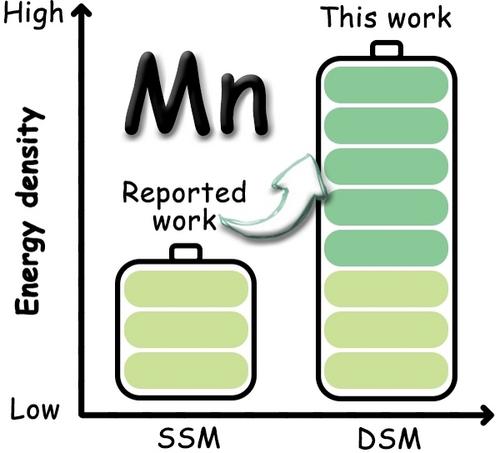
As a promising post lithium-ion-battery candidate, manganese metal battery (MMB) is receiving growing research interests because of its high volumetric capacity, low cost, high safety and high energy-to-price ratio. However, the low energy density, mainly constrained by scarce choices and unsatisfying capacity of cathodes, strictly bottlenecks the development of MMBs. In this work, a new class of cathodes based on novel dual-storage mechanism (DSM) are reported. Working principles of DSM are revealed and deeply understood via ex situ X-ray diffraction and X-ray photoelectron spectroscopy. Besides, a proof-of-concept DSM-based Cu1.8S cathode, which shows the highest specific capacity of 220 mAh g−1 and 97.1 % higher energy density than previously reported cathodes in storing Mn2+ ions, is presented. The key determinants on DSM and design strategies for next-generation cathodes are revealed via theoretical calculations. This work provides a new class of high-capacity cathode materials for MMBs, which is expected to draw inspirations to further enhance the energy density of MMBs.
锰金属电池(MMB)作为后锂离子电池的候选材料,因其高容量、低成本、高安全性和高能量价格比而受到越来越多的研究兴趣。然而,低能量密度,主要是受阴极选择稀缺和容量不理想的限制,严重制约了mmb的发展。本文报道了一类基于新型双存储机制(DSM)的阴极。通过非原位x射线衍射和x射线光电子能谱,揭示并深入了解了DSM的工作原理。此外,还提出了一种基于dsm的Cu1.8S阴极的概念验证,该阴极具有220 mAh g-1的最高比容量和97.1%的能量密度,比先前报道的Mn2+离子阴极高。通过理论计算揭示了DSM和下一代阴极设计策略的关键决定因素。本工作为mmb提供了一类新的高容量正极材料,有望为进一步提高mmb的能量密度提供启示。
期刊介绍:
Angewandte Chemie, a journal of the German Chemical Society (GDCh), maintains a leading position among scholarly journals in general chemistry with an impressive Impact Factor of 16.6 (2022 Journal Citation Reports, Clarivate, 2023). Published weekly in a reader-friendly format, it features new articles almost every day. Established in 1887, Angewandte Chemie is a prominent chemistry journal, offering a dynamic blend of Review-type articles, Highlights, Communications, and Research Articles on a weekly basis, making it unique in the field.



 京公网安备 11010802042870号
京ICP备2023020795号-1
京公网安备 11010802042870号
京ICP备2023020795号-1

 分享
分享
 求助内容:
求助内容: 应助结果提醒方式:
 扫码关注我们
