Nadine Lemaitre, Amélie Dewitte, Faniry Rakotomanimana, David Gooden, Eric Toone, Minoarisoa Rajerison, Pei Zhou, Florent Sebbane
{"title":"Assessing the threat of <i>Yersinia pestis</i> harboring a multi-resistant IncC plasmid and the efficacy of an antibiotic targeting LpxC.","authors":"Nadine Lemaitre, Amélie Dewitte, Faniry Rakotomanimana, David Gooden, Eric Toone, Minoarisoa Rajerison, Pei Zhou, Florent Sebbane","doi":"10.1128/aac.01497-24","DOIUrl":null,"url":null,"abstract":"<p><p>Self-transmissible IncC plasmids rapidly spread multidrug resistance in many medically important pathogens worldwide. A large plasmid of this type (pIP1202, ~80 Kb) has been isolated in a clinical isolate of <i>Yersinia pestis</i>, the agent of plague. Here, we report that pIP1202 was highly stable in <i>Y. pestis-</i>infected mice and fleas and did not reduce <i>Y. pestis</i> virulence in these animals. Although pIP1202 inflicted a fitness cost in fleas (but not in mice) when the insects fed on blood containing a mixture of plasmid-free and plasmid-bearing strains, such a co-infection scenario has never been reported in nature, indicating that pIP1202 could persist in <i>Y. pestis</i> strains. Despite being resistant to commonly used antibiotic treatments, we show that plague caused by <i>Y. pestis</i> harboring the pIP1202 plasmid is effectively cured by LPC-233-a potent inhibitor of the essential LpxC enzyme in the lipid A biosynthetic pathway. Taken as a whole, our data highlight the alarming threat posed by <i>Y. pestis</i> harboring multidrug-resistant IncC plasmids that may persist in wild animals as a reservoir for long periods without antibiotic pressure and illuminate the impact of antibiotics with a novel mode of action against such a biothreat.</p>","PeriodicalId":8152,"journal":{"name":"Antimicrobial Agents and Chemotherapy","volume":" ","pages":"e0149724"},"PeriodicalIF":4.5000,"publicationDate":"2025-03-05","publicationTypes":"Journal Article","fieldsOfStudy":null,"isOpenAccess":false,"openAccessPdf":"https://www.ncbi.nlm.nih.gov/pmc/articles/PMC11881579/pdf/","citationCount":"0","resultStr":null,"platform":"Semanticscholar","paperid":null,"PeriodicalName":"Antimicrobial Agents and Chemotherapy","FirstCategoryId":"3","ListUrlMain":"https://doi.org/10.1128/aac.01497-24","RegionNum":2,"RegionCategory":"医学","ArticlePicture":[],"TitleCN":null,"AbstractTextCN":null,"PMCID":null,"EPubDate":"2025/1/30 0:00:00","PubModel":"Epub","JCR":"Q2","JCRName":"MICROBIOLOGY","Score":null,"Total":0}
引用次数: 0
Abstract
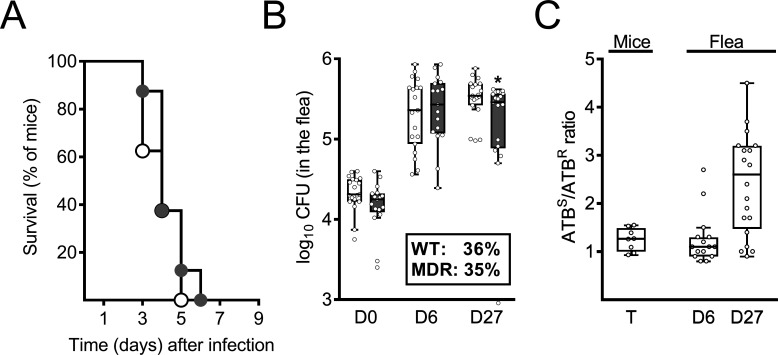
Self-transmissible IncC plasmids rapidly spread multidrug resistance in many medically important pathogens worldwide. A large plasmid of this type (pIP1202, ~80 Kb) has been isolated in a clinical isolate of Yersinia pestis, the agent of plague. Here, we report that pIP1202 was highly stable in Y. pestis-infected mice and fleas and did not reduce Y. pestis virulence in these animals. Although pIP1202 inflicted a fitness cost in fleas (but not in mice) when the insects fed on blood containing a mixture of plasmid-free and plasmid-bearing strains, such a co-infection scenario has never been reported in nature, indicating that pIP1202 could persist in Y. pestis strains. Despite being resistant to commonly used antibiotic treatments, we show that plague caused by Y. pestis harboring the pIP1202 plasmid is effectively cured by LPC-233-a potent inhibitor of the essential LpxC enzyme in the lipid A biosynthetic pathway. Taken as a whole, our data highlight the alarming threat posed by Y. pestis harboring multidrug-resistant IncC plasmids that may persist in wild animals as a reservoir for long periods without antibiotic pressure and illuminate the impact of antibiotics with a novel mode of action against such a biothreat.
期刊介绍:
Antimicrobial Agents and Chemotherapy (AAC) features interdisciplinary studies that build our understanding of the underlying mechanisms and therapeutic applications of antimicrobial and antiparasitic agents and chemotherapy.





 京公网安备 11010802042870号
京ICP备2023020795号-1
京公网安备 11010802042870号
京ICP备2023020795号-1

 分享
分享
 求助内容:
求助内容: 应助结果提醒方式:
 扫码关注我们
