Acceptability, feasibility, and effectiveness of internet-based cognitive behavior therapy for obsessive-compulsive disorder (OCD-NET): a naturalistic pilot trial during the COVID-19 pandemic in a psychiatric outpatient department in Germany.
Elisabeth Kohls, Sabrina Baldofski, Julia Scholl, Oskar Flygare, Lina Lundström, Ursula Beyrich-Kolbus, Marc Steinbrecher, Christian Rück, Christine Rummel-Kluge
{"title":"Acceptability, feasibility, and effectiveness of internet-based cognitive behavior therapy for obsessive-compulsive disorder (OCD-NET): a naturalistic pilot trial during the COVID-19 pandemic in a psychiatric outpatient department in Germany.","authors":"Elisabeth Kohls, Sabrina Baldofski, Julia Scholl, Oskar Flygare, Lina Lundström, Ursula Beyrich-Kolbus, Marc Steinbrecher, Christian Rück, Christine Rummel-Kluge","doi":"10.1186/s12888-025-06519-7","DOIUrl":null,"url":null,"abstract":"<p><strong>Background: </strong>Cognitive behavior therapy (CBT) is the gold-standard treatment for obsessive-compulsive disorder (OCD). However, access to CBT and specialized treatments is often limited. This pilot study describes the implementation of a guided Internet-Based CBT program (ICBT) for individuals seeking treatment for OCD in a psychiatric outpatient department in Leipzig, Germany, during the COVID-19 pandemic. The aim of the study was to investigate the acceptability, feasibility, and effectiveness of the ICBT program for OCD.</p><p><strong>Methods: </strong>In an open, naturalistic pilot trial, N = 57 patients with OCD received a 10-week ICBT program (called \"OCD-NET\"). It consisted of 10 different modules covering psychoeducation, cognitive restructuring, exposure with response prevention, and overall therapist support and guidance through the program. The primary outcome was feasibility and acceptance of the OCD-NET program assessed via recruitment and retention rate, adherence and user satisfaction. Secondary outcomes were OCD symptoms at the end of treatment, assessed using the self-report Obsessive Compulsive Inventory - Revised (OCI-R) and self-rated measures of depressive symptoms, quality of life, self-efficacy, and psychological distress. Additionally, treatment credibility, working alliance, and satisfaction were assessed.</p><p><strong>Results: </strong>On average, participants completed 6.30 (SD = 3.21) modules, and n = 19 (33.9%) participants completed all 10 modules of the program. Overall, n = 45 (78.9%) were treatment completers (minimum 4 modules completed), n = 11 (19.3%) were non-completers, and n = 1 (1.8%) was a dropout. Satisfaction with the program was high, with a majority of participants indicating that they would recommend it to others (n = 56, 98.2%) and that it provided the support they needed (n = 49, 86.0%).Mixed-effect models showed a significant reduction in OCD symptoms (OCI-R), with large within-group effect sizes in both intention-to-treat (ITT) and completer analyses. In ITT analyses, the OCI-R decreased significantly with a within-group effect size of d = 1.13 (95% CI 0.88 - 1.38). At post-treatment, n = 17 (29.8%) participants showed a treatment response on the OCI-R (≥ 40% reduction). The treatment also resulted in statistically significant improvements in depressive symptoms (d = 0.90 [0.65; 1.15]) and self-efficacy (d = -0.27 [-0.53; -0.00]). No significant differences were observed in quality of life (WHOQOL-BREF) or psychological distress (Mini-SCL GSI) scores between baseline and post-treatment, in either the ITT or completer analyses.</p><p><strong>Conclusions: </strong>The OCD-NET program is overall highly acceptable and appears to meet patients' needs in routine care, even under pandemic constraints. ICBT with therapist guidance significantly reduces OCD and depressive symptoms in real world settings. The results also suggest that this ICBT program could be integrated into routine psychiatric outpatient treatments. However, future research should investigate how upscaling and sustainable implementation could be effectively achieved.</p><p><strong>Trial registration: </strong>German Clinical Trials register (DRKS): DRKS00021706, registration date: 15.05.2020.</p>","PeriodicalId":9029,"journal":{"name":"BMC Psychiatry","volume":"25 1","pages":"85"},"PeriodicalIF":3.4000,"publicationDate":"2025-01-30","publicationTypes":"Journal Article","fieldsOfStudy":null,"isOpenAccess":false,"openAccessPdf":"https://www.ncbi.nlm.nih.gov/pmc/articles/PMC11783832/pdf/","citationCount":"0","resultStr":null,"platform":"Semanticscholar","paperid":null,"PeriodicalName":"BMC Psychiatry","FirstCategoryId":"3","ListUrlMain":"https://doi.org/10.1186/s12888-025-06519-7","RegionNum":2,"RegionCategory":"医学","ArticlePicture":[],"TitleCN":null,"AbstractTextCN":null,"PMCID":null,"EPubDate":"","PubModel":"","JCR":"Q2","JCRName":"PSYCHIATRY","Score":null,"Total":0}
引用次数: 0
Abstract
Background: Cognitive behavior therapy (CBT) is the gold-standard treatment for obsessive-compulsive disorder (OCD). However, access to CBT and specialized treatments is often limited. This pilot study describes the implementation of a guided Internet-Based CBT program (ICBT) for individuals seeking treatment for OCD in a psychiatric outpatient department in Leipzig, Germany, during the COVID-19 pandemic. The aim of the study was to investigate the acceptability, feasibility, and effectiveness of the ICBT program for OCD.
Methods: In an open, naturalistic pilot trial, N = 57 patients with OCD received a 10-week ICBT program (called "OCD-NET"). It consisted of 10 different modules covering psychoeducation, cognitive restructuring, exposure with response prevention, and overall therapist support and guidance through the program. The primary outcome was feasibility and acceptance of the OCD-NET program assessed via recruitment and retention rate, adherence and user satisfaction. Secondary outcomes were OCD symptoms at the end of treatment, assessed using the self-report Obsessive Compulsive Inventory - Revised (OCI-R) and self-rated measures of depressive symptoms, quality of life, self-efficacy, and psychological distress. Additionally, treatment credibility, working alliance, and satisfaction were assessed.
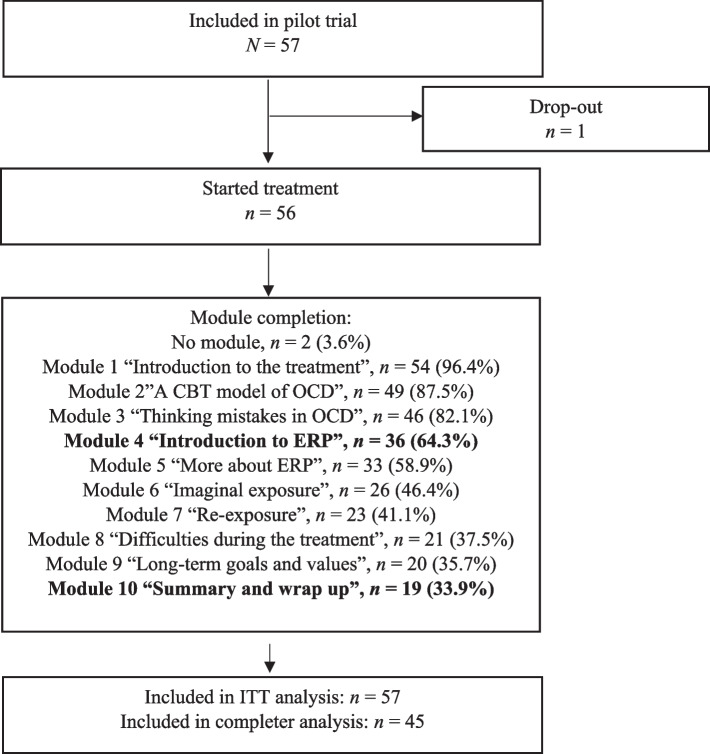
Results: On average, participants completed 6.30 (SD = 3.21) modules, and n = 19 (33.9%) participants completed all 10 modules of the program. Overall, n = 45 (78.9%) were treatment completers (minimum 4 modules completed), n = 11 (19.3%) were non-completers, and n = 1 (1.8%) was a dropout. Satisfaction with the program was high, with a majority of participants indicating that they would recommend it to others (n = 56, 98.2%) and that it provided the support they needed (n = 49, 86.0%).Mixed-effect models showed a significant reduction in OCD symptoms (OCI-R), with large within-group effect sizes in both intention-to-treat (ITT) and completer analyses. In ITT analyses, the OCI-R decreased significantly with a within-group effect size of d = 1.13 (95% CI 0.88 - 1.38). At post-treatment, n = 17 (29.8%) participants showed a treatment response on the OCI-R (≥ 40% reduction). The treatment also resulted in statistically significant improvements in depressive symptoms (d = 0.90 [0.65; 1.15]) and self-efficacy (d = -0.27 [-0.53; -0.00]). No significant differences were observed in quality of life (WHOQOL-BREF) or psychological distress (Mini-SCL GSI) scores between baseline and post-treatment, in either the ITT or completer analyses.
Conclusions: The OCD-NET program is overall highly acceptable and appears to meet patients' needs in routine care, even under pandemic constraints. ICBT with therapist guidance significantly reduces OCD and depressive symptoms in real world settings. The results also suggest that this ICBT program could be integrated into routine psychiatric outpatient treatments. However, future research should investigate how upscaling and sustainable implementation could be effectively achieved.
期刊介绍:
BMC Psychiatry is an open access, peer-reviewed journal that considers articles on all aspects of the prevention, diagnosis and management of psychiatric disorders, as well as related molecular genetics, pathophysiology, and epidemiology.



 京公网安备 11010802042870号
京ICP备2023020795号-1
京公网安备 11010802042870号
京ICP备2023020795号-1

 分享
分享
 求助内容:
求助内容: 应助结果提醒方式:
 扫码关注我们
