{"title":"Carbon monoxide alleviates endotoxin-induced acute lung injury via NADPH oxidase inhibition in macrophages and neutrophils","authors":"Yuki Watabe , Victor Tuan Giam Chuang , Hiromi Sakai , Chihiro Ito , Yuki Enoki , Mitsutomo Kohno , Masaki Otagiri , Kazuaki Matsumoto , Kazuaki Taguchi","doi":"10.1016/j.bcp.2025.116782","DOIUrl":null,"url":null,"abstract":"<div><div>Sepsis is a life-threatening condition caused by severe infection and often complicates acute respiratory distress syndrome (ARDS) and acute lung injury (ALI) due to the collapse of the oxidative and inflammatory balance induced by microbial pathogens, including lipopolysaccharides (LPS). In sepsis-related ARDS/ALI, NADPH oxidase (NOX) and toll-like receptors (TLR) in neutrophils and macrophages are key players in initiating oxidative and inflammatory imbalances. Although NOX and TLR activation has been linked to carbon monoxide (CO), the mechanism by which CO affects sepsis-related ARDS/ALI through NOX and TLR remains unknown. Here, we demonstrate that CO reduces sepsis-related ARDS/ALI by inhibiting NOX in neutrophils and macrophages, which in turn suppresses the production of reactive oxygen species (ROS), TLR4-associated inflammatory responses, and macrophage polarization toward M1-like macrophages. CO-bound hemoglobin vesicle (CO-HbV) therapy, a hemoglobin-based CO donor, exerts a protective effect against LPS-induced ALI by suppressing exaggerated oxidative and inflammatory responses and neutrophil and M1-like macrophage infiltration in the bronchoalveolar lavage fluid (BALF). Through suppression of NOX activity, CO decreased ROS generation, the TLR4/NF-κB signaling pathway, and macrophage polarization toward M1-like macrophages, according to cellular experiments conducted with peripheral neutrophils, BALF cells, and Raw264.7 cells. Moreover, ALI was found to be more severe in <em>Hmox1<sup>+/-</sup></em> mice (mice with decreased endogenous CO production) than in the wild-type mice. Our findings suggest that both endogenously generated and exogenously supplied CO inhibit NOX-associated ROS generation, the TLR4/NF-κB signaling pathway, and macrophage polarization, thereby eliciting antioxidant and anti-inflammatory responses that prevent the onset and progression of LPS-induced ALI.</div></div>","PeriodicalId":8806,"journal":{"name":"Biochemical pharmacology","volume":"233 ","pages":"Article 116782"},"PeriodicalIF":5.6000,"publicationDate":"2025-01-27","publicationTypes":"Journal Article","fieldsOfStudy":null,"isOpenAccess":false,"openAccessPdf":"","citationCount":"0","resultStr":null,"platform":"Semanticscholar","paperid":null,"PeriodicalName":"Biochemical pharmacology","FirstCategoryId":"3","ListUrlMain":"https://www.sciencedirect.com/science/article/pii/S0006295225000449","RegionNum":2,"RegionCategory":"医学","ArticlePicture":[],"TitleCN":null,"AbstractTextCN":null,"PMCID":null,"EPubDate":"","PubModel":"","JCR":"Q1","JCRName":"PHARMACOLOGY & PHARMACY","Score":null,"Total":0}
引用次数: 0
Abstract
Sepsis is a life-threatening condition caused by severe infection and often complicates acute respiratory distress syndrome (ARDS) and acute lung injury (ALI) due to the collapse of the oxidative and inflammatory balance induced by microbial pathogens, including lipopolysaccharides (LPS). In sepsis-related ARDS/ALI, NADPH oxidase (NOX) and toll-like receptors (TLR) in neutrophils and macrophages are key players in initiating oxidative and inflammatory imbalances. Although NOX and TLR activation has been linked to carbon monoxide (CO), the mechanism by which CO affects sepsis-related ARDS/ALI through NOX and TLR remains unknown. Here, we demonstrate that CO reduces sepsis-related ARDS/ALI by inhibiting NOX in neutrophils and macrophages, which in turn suppresses the production of reactive oxygen species (ROS), TLR4-associated inflammatory responses, and macrophage polarization toward M1-like macrophages. CO-bound hemoglobin vesicle (CO-HbV) therapy, a hemoglobin-based CO donor, exerts a protective effect against LPS-induced ALI by suppressing exaggerated oxidative and inflammatory responses and neutrophil and M1-like macrophage infiltration in the bronchoalveolar lavage fluid (BALF). Through suppression of NOX activity, CO decreased ROS generation, the TLR4/NF-κB signaling pathway, and macrophage polarization toward M1-like macrophages, according to cellular experiments conducted with peripheral neutrophils, BALF cells, and Raw264.7 cells. Moreover, ALI was found to be more severe in Hmox1+/- mice (mice with decreased endogenous CO production) than in the wild-type mice. Our findings suggest that both endogenously generated and exogenously supplied CO inhibit NOX-associated ROS generation, the TLR4/NF-κB signaling pathway, and macrophage polarization, thereby eliciting antioxidant and anti-inflammatory responses that prevent the onset and progression of LPS-induced ALI.
期刊介绍:
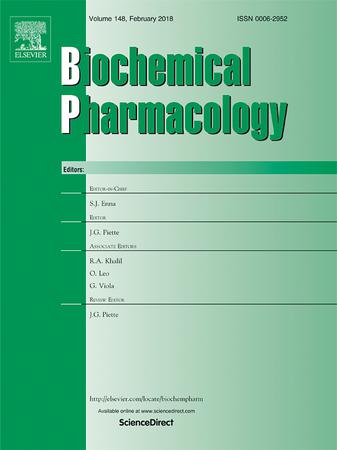
Biochemical Pharmacology publishes original research findings, Commentaries and review articles related to the elucidation of cellular and tissue function(s) at the biochemical and molecular levels, the modification of cellular phenotype(s) by genetic, transcriptional/translational or drug/compound-induced modifications, as well as the pharmacodynamics and pharmacokinetics of xenobiotics and drugs, the latter including both small molecules and biologics.
The journal''s target audience includes scientists engaged in the identification and study of the mechanisms of action of xenobiotics, biologics and drugs and in the drug discovery and development process.
All areas of cellular biology and cellular, tissue/organ and whole animal pharmacology fall within the scope of the journal. Drug classes covered include anti-infectives, anti-inflammatory agents, chemotherapeutics, cardiovascular, endocrinological, immunological, metabolic, neurological and psychiatric drugs, as well as research on drug metabolism and kinetics. While medicinal chemistry is a topic of complimentary interest, manuscripts in this area must contain sufficient biological data to characterize pharmacologically the compounds reported. Submissions describing work focused predominately on chemical synthesis and molecular modeling will not be considered for review.
While particular emphasis is placed on reporting the results of molecular and biochemical studies, research involving the use of tissue and animal models of human pathophysiology and toxicology is of interest to the extent that it helps define drug mechanisms of action, safety and efficacy.




 京公网安备 11010802042870号
京ICP备2023020795号-1
京公网安备 11010802042870号
京ICP备2023020795号-1

 分享
分享
 求助内容:
求助内容: 应助结果提醒方式:
 扫码关注我们
