Anna Howells, Katie Munro, Sarah Foulkes, Atiya Kamal, Jack Haywood, Sophie Russell, Dominic Sparkes, Erika Aquino, Jennie Evans, Dale Weston, Susan Hopkins, Jasmin Islam, Victoria Hall
{"title":"Cohort retention in a pandemic response study: lessons from the SARS-CoV2 Immunity & Reinfection Evaluation (SIREN) study.","authors":"Anna Howells, Katie Munro, Sarah Foulkes, Atiya Kamal, Jack Haywood, Sophie Russell, Dominic Sparkes, Erika Aquino, Jennie Evans, Dale Weston, Susan Hopkins, Jasmin Islam, Victoria Hall","doi":"10.1186/s12874-025-02469-6","DOIUrl":null,"url":null,"abstract":"<p><strong>Background: </strong>SIREN is a healthcare worker cohort study aiming to determine COVID-19 incidence, duration of immunity and vaccine effectiveness across 135 NHS organisations in four UK nations. Conducting an intensive prospective cohort study during a pandemic was challenging. We designed an evolving retention programme, informed by emerging evidence on best practice. This included applying a multifactorial approach, and considering strategies for barrier reduction, community building, follow-up, and tracing. We utilised participant engagement tools underpinned by our Participant Involvement Panel (PIP) and here we evaluate cohort retention over time and identify learnings.</p><p><strong>Methods: </strong>A mixed method evaluation of cohort retention in 12 and 24-month follow-up (June 2020 - March 2023). We described cohort retention by demographics and site, using odds ratios from logistic regression. Withdrawal reasons during this time were collected by survey. We collected participant feedback via cross-sectional online survey conducted October - November 2022, utilising a behavioural science approach. We conducted two focus groups with research teams in February 2023 and conducted thematic analysis exploring cohort retention challenges and facilitators.</p><p><strong>Results: </strong>37,275 (84.7%) participants completed 12-months of follow-up. Of 14,772 participants extending their follow-up to 24 months, 12,635 (85.5%) completed this. Retention increased with age in the 12 (55-64 years vs < 25 years OR = 2.50; 95% CI: 2.19-2.85; p < 0.001) and 24-month (> 65 years vs < 25 years OR = 2.92; 95% CI: 1.78-4.88; p < 0.001) cohorts. Retention was highest in the Asian and Black ethnic groups compared to White in the 12 (OR = 1.38; 95% CI: 1.23-1.56; p < 0.001, and OR = 1.64; 95% CI: 1.30-2.08; p < 0.001) and 24-month (OR = 1.78; 95% CI: 1.42-2.25; p < 0.001, and OR = 2.12; 95% CI: 1.41-3.35; p < 0.001) cohort. Among participants withdrawing, the median time in follow-up at withdrawal was 7 months (IQR: 4-10 months) within the 12-month cohort and 19 months within the 24-month cohort (IQR: 16-22 months). The top three reasons for participant withdrawal were workload, leaving site employment and medical reasons. Themes identified from focus-groups included: the need to monitor and understand participant motivation over time, the necessity of inclusive and comprehensive communication, the importance of acknowledging participant contributions, building collaboration with local research teams, and investing in the research team skillset.</p><p><strong>Conclusion: </strong>Participant retention in the SIREN study remained high over 24-months of intensive follow-up, demonstrating that large cohort studies are feasible as a pandemic research tool. Our evaluation suggests it is possible to maintain an engaged cohort of healthcare workers (HCWs) during an acute pandemic response phase. The insights gained from this population group are important, as a highly exposed group fulfilling an essential pandemic response and patient care function. The success of the cohort study overall, as well as the specific population group retained, offer useful insight for pandemic preparedness planning and healthcare worker studies.</p>","PeriodicalId":9114,"journal":{"name":"BMC Medical Research Methodology","volume":"25 1","pages":"27"},"PeriodicalIF":3.4000,"publicationDate":"2025-01-30","publicationTypes":"Journal Article","fieldsOfStudy":null,"isOpenAccess":false,"openAccessPdf":"https://www.ncbi.nlm.nih.gov/pmc/articles/PMC11783804/pdf/","citationCount":"0","resultStr":null,"platform":"Semanticscholar","paperid":null,"PeriodicalName":"BMC Medical Research Methodology","FirstCategoryId":"3","ListUrlMain":"https://doi.org/10.1186/s12874-025-02469-6","RegionNum":3,"RegionCategory":"医学","ArticlePicture":[],"TitleCN":null,"AbstractTextCN":null,"PMCID":null,"EPubDate":"","PubModel":"","JCR":"Q1","JCRName":"HEALTH CARE SCIENCES & SERVICES","Score":null,"Total":0}
引用次数: 0
Abstract
Background: SIREN is a healthcare worker cohort study aiming to determine COVID-19 incidence, duration of immunity and vaccine effectiveness across 135 NHS organisations in four UK nations. Conducting an intensive prospective cohort study during a pandemic was challenging. We designed an evolving retention programme, informed by emerging evidence on best practice. This included applying a multifactorial approach, and considering strategies for barrier reduction, community building, follow-up, and tracing. We utilised participant engagement tools underpinned by our Participant Involvement Panel (PIP) and here we evaluate cohort retention over time and identify learnings.
Methods: A mixed method evaluation of cohort retention in 12 and 24-month follow-up (June 2020 - March 2023). We described cohort retention by demographics and site, using odds ratios from logistic regression. Withdrawal reasons during this time were collected by survey. We collected participant feedback via cross-sectional online survey conducted October - November 2022, utilising a behavioural science approach. We conducted two focus groups with research teams in February 2023 and conducted thematic analysis exploring cohort retention challenges and facilitators.
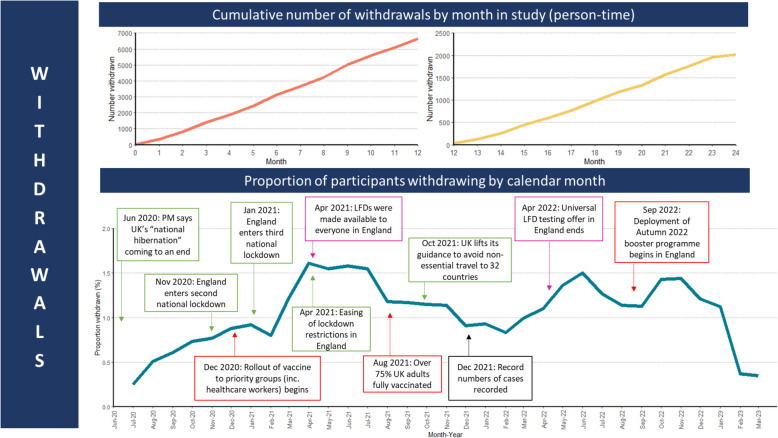
Results: 37,275 (84.7%) participants completed 12-months of follow-up. Of 14,772 participants extending their follow-up to 24 months, 12,635 (85.5%) completed this. Retention increased with age in the 12 (55-64 years vs < 25 years OR = 2.50; 95% CI: 2.19-2.85; p < 0.001) and 24-month (> 65 years vs < 25 years OR = 2.92; 95% CI: 1.78-4.88; p < 0.001) cohorts. Retention was highest in the Asian and Black ethnic groups compared to White in the 12 (OR = 1.38; 95% CI: 1.23-1.56; p < 0.001, and OR = 1.64; 95% CI: 1.30-2.08; p < 0.001) and 24-month (OR = 1.78; 95% CI: 1.42-2.25; p < 0.001, and OR = 2.12; 95% CI: 1.41-3.35; p < 0.001) cohort. Among participants withdrawing, the median time in follow-up at withdrawal was 7 months (IQR: 4-10 months) within the 12-month cohort and 19 months within the 24-month cohort (IQR: 16-22 months). The top three reasons for participant withdrawal were workload, leaving site employment and medical reasons. Themes identified from focus-groups included: the need to monitor and understand participant motivation over time, the necessity of inclusive and comprehensive communication, the importance of acknowledging participant contributions, building collaboration with local research teams, and investing in the research team skillset.
Conclusion: Participant retention in the SIREN study remained high over 24-months of intensive follow-up, demonstrating that large cohort studies are feasible as a pandemic research tool. Our evaluation suggests it is possible to maintain an engaged cohort of healthcare workers (HCWs) during an acute pandemic response phase. The insights gained from this population group are important, as a highly exposed group fulfilling an essential pandemic response and patient care function. The success of the cohort study overall, as well as the specific population group retained, offer useful insight for pandemic preparedness planning and healthcare worker studies.
期刊介绍:
BMC Medical Research Methodology is an open access journal publishing original peer-reviewed research articles in methodological approaches to healthcare research. Articles on the methodology of epidemiological research, clinical trials and meta-analysis/systematic review are particularly encouraged, as are empirical studies of the associations between choice of methodology and study outcomes. BMC Medical Research Methodology does not aim to publish articles describing scientific methods or techniques: these should be directed to the BMC journal covering the relevant biomedical subject area.




 京公网安备 11010802042870号
京ICP备2023020795号-1
京公网安备 11010802042870号
京ICP备2023020795号-1

 分享
分享
 求助内容:
求助内容: 应助结果提醒方式:
 扫码关注我们
