Development and validation of a novel risk-predicted model for early sepsis-associated acute kidney injury in critically ill patients: a retrospective cohort study.
Cong-Cong Zhao, Zi-Han Nan, Bo Li, Yan-Ling Yin, Kun Zhang, Li-Xia Liu, Zhen-Jie Hu
{"title":"Development and validation of a novel risk-predicted model for early sepsis-associated acute kidney injury in critically ill patients: a retrospective cohort study.","authors":"Cong-Cong Zhao, Zi-Han Nan, Bo Li, Yan-Ling Yin, Kun Zhang, Li-Xia Liu, Zhen-Jie Hu","doi":"10.1136/bmjopen-2024-088404","DOIUrl":null,"url":null,"abstract":"<p><strong>Objectives: </strong>This study aimed to develop a prediction model for the detection of early sepsis-associated acute kidney injury (SA-AKI), which is defined as AKI diagnosed within 48 hours of a sepsis diagnosis.</p><p><strong>Design: </strong>A retrospective study design was employed. It is not linked to a clinical trial. Data for patients with sepsis included in the development cohort were extracted from the Medical Information Mart for Intensive Care IV (MIMIC-IV) database. The least absolute shrinkage and selection operator regression method was used to screen the risk factors, and the final screened risk factors were constructed into four machine learning models to determine an optimal model. External validation was performed using another single-centre intensive care unit (ICU) database.</p><p><strong>Setting: </strong>Data for the development cohort were obtained from the MIMIC-IV 2.0 database, which is a large publicly available database that contains information on patients admitted to the ICUs of Beth Israel Deaconess Medical Center in Boston, Massachusetts, USA, from 2008 to 2019. The external validation cohort was generated from a single-centre ICU database from China.</p><p><strong>Participants: </strong>A total of 7179 critically ill patients with sepsis were included in the development cohort and 269 patients with sepsis were included in the external validation cohort.</p><p><strong>Results: </strong>A total of 12 risk factors (age, weight, atrial fibrillation, chronic coronary syndrome, central venous pressure, urine output, temperature, lactate, pH, difference in alveolar-arterial oxygen pressure, prothrombin time and mechanical ventilation) were included in the final prediction model. The gradient boosting machine model showed the best performance, and the areas under the receiver operating characteristic curve of the model in the development cohort, internal validation cohort and external validation cohort were 0.794, 0.725 and 0.707, respectively. Additionally, to aid interpretation and clinical application, SHapley Additive exPlanations techniques and a web version calculation were applied.</p><p><strong>Conclusions: </strong>This web-based clinical prediction model represents a reliable tool for predicting early SA-AKI in critically ill patients with sepsis. The model was externally validated using another ICU cohort and exhibited good predictive ability. Additional validation is needed to support the utility and implementation of this model.</p>","PeriodicalId":9158,"journal":{"name":"BMJ Open","volume":"15 1","pages":"e088404"},"PeriodicalIF":2.3000,"publicationDate":"2025-01-28","publicationTypes":"Journal Article","fieldsOfStudy":null,"isOpenAccess":false,"openAccessPdf":"https://www.ncbi.nlm.nih.gov/pmc/articles/PMC11781090/pdf/","citationCount":"0","resultStr":null,"platform":"Semanticscholar","paperid":null,"PeriodicalName":"BMJ Open","FirstCategoryId":"3","ListUrlMain":"https://doi.org/10.1136/bmjopen-2024-088404","RegionNum":3,"RegionCategory":"医学","ArticlePicture":[],"TitleCN":null,"AbstractTextCN":null,"PMCID":null,"EPubDate":"","PubModel":"","JCR":"Q1","JCRName":"MEDICINE, GENERAL & INTERNAL","Score":null,"Total":0}
引用次数: 0
Abstract
Objectives: This study aimed to develop a prediction model for the detection of early sepsis-associated acute kidney injury (SA-AKI), which is defined as AKI diagnosed within 48 hours of a sepsis diagnosis.
Design: A retrospective study design was employed. It is not linked to a clinical trial. Data for patients with sepsis included in the development cohort were extracted from the Medical Information Mart for Intensive Care IV (MIMIC-IV) database. The least absolute shrinkage and selection operator regression method was used to screen the risk factors, and the final screened risk factors were constructed into four machine learning models to determine an optimal model. External validation was performed using another single-centre intensive care unit (ICU) database.
Setting: Data for the development cohort were obtained from the MIMIC-IV 2.0 database, which is a large publicly available database that contains information on patients admitted to the ICUs of Beth Israel Deaconess Medical Center in Boston, Massachusetts, USA, from 2008 to 2019. The external validation cohort was generated from a single-centre ICU database from China.
Participants: A total of 7179 critically ill patients with sepsis were included in the development cohort and 269 patients with sepsis were included in the external validation cohort.
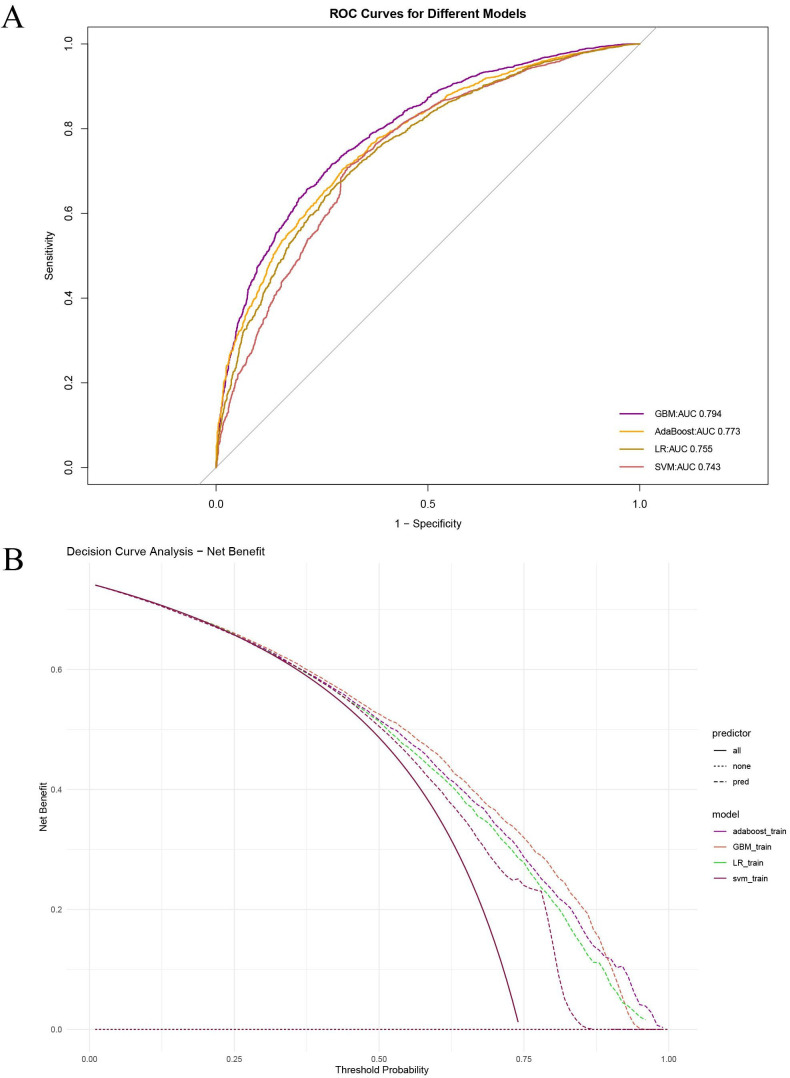
Results: A total of 12 risk factors (age, weight, atrial fibrillation, chronic coronary syndrome, central venous pressure, urine output, temperature, lactate, pH, difference in alveolar-arterial oxygen pressure, prothrombin time and mechanical ventilation) were included in the final prediction model. The gradient boosting machine model showed the best performance, and the areas under the receiver operating characteristic curve of the model in the development cohort, internal validation cohort and external validation cohort were 0.794, 0.725 and 0.707, respectively. Additionally, to aid interpretation and clinical application, SHapley Additive exPlanations techniques and a web version calculation were applied.
Conclusions: This web-based clinical prediction model represents a reliable tool for predicting early SA-AKI in critically ill patients with sepsis. The model was externally validated using another ICU cohort and exhibited good predictive ability. Additional validation is needed to support the utility and implementation of this model.
目的:本研究旨在建立早期脓毒症相关急性肾损伤(SA-AKI)检测的预测模型,SA-AKI定义为脓毒症诊断后48小时内诊断出的AKI。设计:采用回顾性研究设计。它与临床试验无关。纳入研究队列的脓毒症患者的数据来自重症监护医学信息市场IV (MIMIC-IV)数据库。采用最小绝对收缩法和选择算子回归法对风险因素进行筛选,最终筛选出的风险因素构建为4个机器学习模型,确定最优模型。使用另一个单中心重症监护病房(ICU)数据库进行外部验证。环境:研究队列的数据来自MIMIC-IV 2.0数据库,该数据库是一个大型公开数据库,包含2008年至2019年美国马萨诸塞州波士顿Beth Israel Deaconess医疗中心icu收治的患者信息。外部验证队列来自中国的单中心ICU数据库。参与者:共有7179名重症脓毒症患者被纳入开发队列,269名脓毒症患者被纳入外部验证队列。结果:12个危险因素(年龄、体重、房颤、慢性冠状动脉综合征、中心静脉压、尿量、体温、乳酸、pH、肺泡-动脉氧压差、凝血酶原时间、机械通气)被纳入最终的预测模型。梯度增强机模型表现最好,该模型在开发队列、内部验证队列和外部验证队列的受试者工作特征曲线下面积分别为0.794、0.725和0.707。此外,为了帮助解释和临床应用,应用了SHapley加性解释技术和网页版本计算。结论:该基于网络的临床预测模型是预测危重脓毒症患者早期SA-AKI的可靠工具。该模型通过另一个ICU队列进行了外部验证,显示出良好的预测能力。需要额外的验证来支持该模型的实用程序和实现。
期刊介绍:
BMJ Open is an online, open access journal, dedicated to publishing medical research from all disciplines and therapeutic areas. The journal publishes all research study types, from study protocols to phase I trials to meta-analyses, including small or specialist studies. Publishing procedures are built around fully open peer review and continuous publication, publishing research online as soon as the article is ready.





 京公网安备 11010802042870号
京ICP备2023020795号-1
京公网安备 11010802042870号
京ICP备2023020795号-1

 分享
分享
 求助内容:
求助内容: 应助结果提醒方式:
 扫码关注我们
