{"title":"The association between gestational selective serotonin reuptake inhibitor (SSRI) treatment and newborn thyroid screen: a large-scale cohort study.","authors":"Orian Raviv, Yael Lebenthal, Michal Yackobovitch-Gavan, Eyal Cohen-Sela, Shlomo Almashanu, Ronella Marom, Jacky Herzlich, Liran Hiersch, Avivit Brener","doi":"10.1186/s12887-025-05452-8","DOIUrl":null,"url":null,"abstract":"<p><strong>Background: </strong>The diagnosis of depression or anxiety treated by SSRIs has become relatively common in women of childbearing age. However, the impact of gestational SSRI treatment on newborn thyroid function is lacking. We explored the impact of gestational SSRI treatment on newborn thyroid function as measured by the National Newborn Screening (NBS) Program and identified contributory factors.</p><p><strong>Methods: </strong>An observational large-scale study of mother-infant dyads of liveborn infants delivered between 2011 and 2022. The Israeli NBS Program thyroid dataset [total thyroxine (TT4) obtained between 36-72 h after delivery] was linked with the electronic medical records of mothers and their infants born at Lis Maternity and Women's Hospital, to generate a unified database. The MDClone big data platform was utilized to extract maternal, perinatal, and neonatal characteristics from the medical records of mother-infant dyads. Only term liveborn infants born to mothers without documented thyroid disease and/or chronic medication administration, except for SSRIs, were included in order to minimize potential confounding effects on the infant's thyroid function. Group stratification relied on the documentation of gestational SSRIs treatment. The variables of interest were maternal, pregnancy, delivery, and perinatal characteristics of the mother-infant dyads. Multivariable forward linear regression model was applied to evaluate explanatory variables for newborn total thyroxine (TT4) levels.</p><p><strong>Results: </strong>Out of 105,928 infant-mother dyads, 2321(2.2%) mothers had been treated with SSRIs during pregnancy. The SSRI-treated mothers were older (34.8 ± 4.7 vs 32.6 ± 4.8 years, p < 0.001) and had a higher pre-pregnancy body mass index (23.4 ± 4.5 vs 22.7 ± 4.1, p < 0.001), but similar mean weight gain (13 kg) during pregnancy. Cesarean delivery was more common among SSRI-treated mothers than in the general population (p < 0.001). Infants of SSRI-treated mothers had lower WHO-classified birthweight z-scores (-0.25 ± 0.93 vs -0.04 ± 0.92, p < 0.001) and a higher rate of small-for-gestational-age infants (13.4% vs 8.2%, p < 0.001). A multivariable forward linear regression model revealed that SSRI treatment during pregnancy was not a significant contributor to TT4 levels (p = 0.497).</p><p><strong>Conclusions: </strong>SSRI treatment during pregnancy had no direct effect upon the newborn's adaptation of the hypothalamic-pituitary-thyroidal axis, but several other maternal and delivery characteristics were revealed to possibly impact newborn thyroid function.</p>","PeriodicalId":9144,"journal":{"name":"BMC Pediatrics","volume":"25 1","pages":"74"},"PeriodicalIF":2.0000,"publicationDate":"2025-01-29","publicationTypes":"Journal Article","fieldsOfStudy":null,"isOpenAccess":false,"openAccessPdf":"https://www.ncbi.nlm.nih.gov/pmc/articles/PMC11776241/pdf/","citationCount":"0","resultStr":null,"platform":"Semanticscholar","paperid":null,"PeriodicalName":"BMC Pediatrics","FirstCategoryId":"3","ListUrlMain":"https://doi.org/10.1186/s12887-025-05452-8","RegionNum":3,"RegionCategory":"医学","ArticlePicture":[],"TitleCN":null,"AbstractTextCN":null,"PMCID":null,"EPubDate":"","PubModel":"","JCR":"Q2","JCRName":"PEDIATRICS","Score":null,"Total":0}
引用次数: 0
Abstract
Background: The diagnosis of depression or anxiety treated by SSRIs has become relatively common in women of childbearing age. However, the impact of gestational SSRI treatment on newborn thyroid function is lacking. We explored the impact of gestational SSRI treatment on newborn thyroid function as measured by the National Newborn Screening (NBS) Program and identified contributory factors.
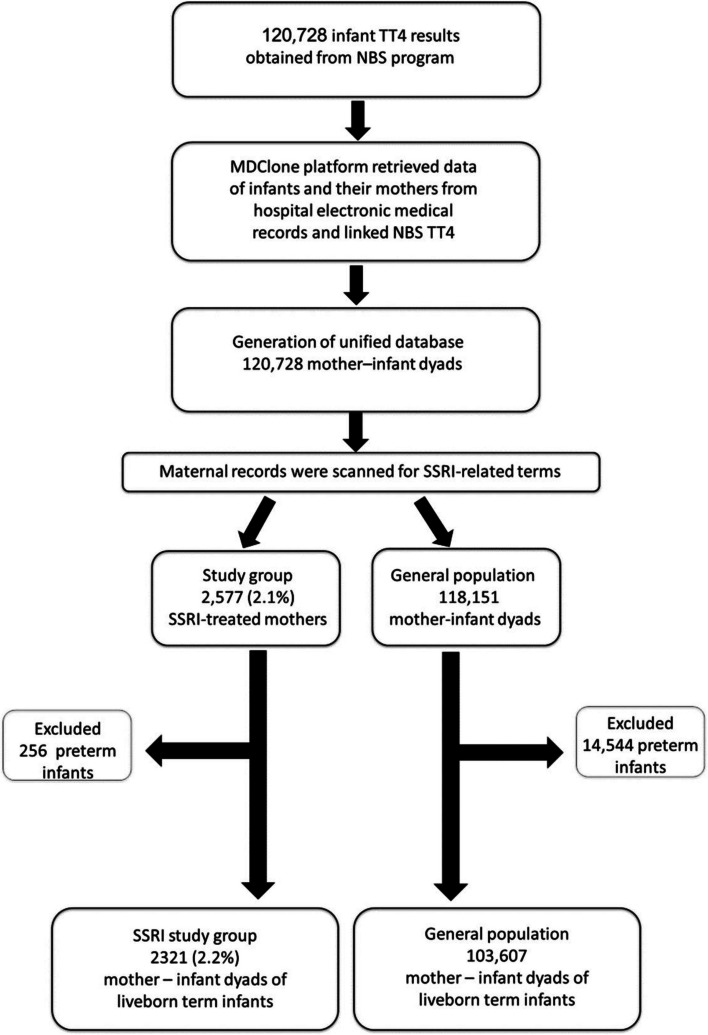
Methods: An observational large-scale study of mother-infant dyads of liveborn infants delivered between 2011 and 2022. The Israeli NBS Program thyroid dataset [total thyroxine (TT4) obtained between 36-72 h after delivery] was linked with the electronic medical records of mothers and their infants born at Lis Maternity and Women's Hospital, to generate a unified database. The MDClone big data platform was utilized to extract maternal, perinatal, and neonatal characteristics from the medical records of mother-infant dyads. Only term liveborn infants born to mothers without documented thyroid disease and/or chronic medication administration, except for SSRIs, were included in order to minimize potential confounding effects on the infant's thyroid function. Group stratification relied on the documentation of gestational SSRIs treatment. The variables of interest were maternal, pregnancy, delivery, and perinatal characteristics of the mother-infant dyads. Multivariable forward linear regression model was applied to evaluate explanatory variables for newborn total thyroxine (TT4) levels.
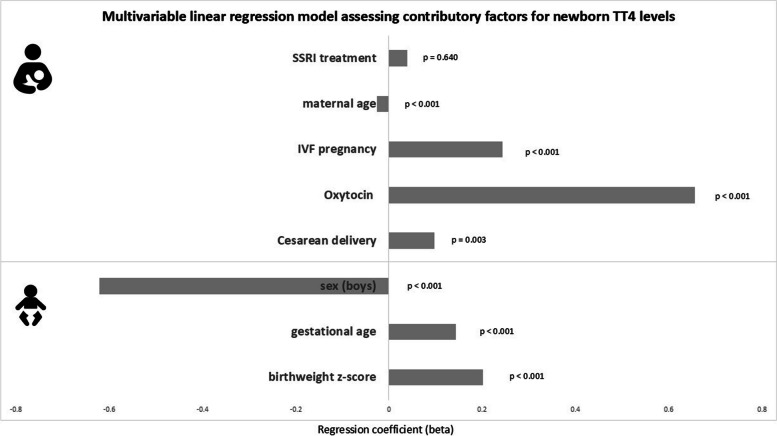
Results: Out of 105,928 infant-mother dyads, 2321(2.2%) mothers had been treated with SSRIs during pregnancy. The SSRI-treated mothers were older (34.8 ± 4.7 vs 32.6 ± 4.8 years, p < 0.001) and had a higher pre-pregnancy body mass index (23.4 ± 4.5 vs 22.7 ± 4.1, p < 0.001), but similar mean weight gain (13 kg) during pregnancy. Cesarean delivery was more common among SSRI-treated mothers than in the general population (p < 0.001). Infants of SSRI-treated mothers had lower WHO-classified birthweight z-scores (-0.25 ± 0.93 vs -0.04 ± 0.92, p < 0.001) and a higher rate of small-for-gestational-age infants (13.4% vs 8.2%, p < 0.001). A multivariable forward linear regression model revealed that SSRI treatment during pregnancy was not a significant contributor to TT4 levels (p = 0.497).
Conclusions: SSRI treatment during pregnancy had no direct effect upon the newborn's adaptation of the hypothalamic-pituitary-thyroidal axis, but several other maternal and delivery characteristics were revealed to possibly impact newborn thyroid function.
期刊介绍:
BMC Pediatrics is an open access journal publishing peer-reviewed research articles in all aspects of health care in neonates, children and adolescents, as well as related molecular genetics, pathophysiology, and epidemiology.




 京公网安备 11010802042870号
京ICP备2023020795号-1
京公网安备 11010802042870号
京ICP备2023020795号-1

 分享
分享
 求助内容:
求助内容: 应助结果提醒方式:
 扫码关注我们
