Inferring demographic and selective histories from population genomic data using a 2-step approach in species with coding-sparse genomes: an application to human data.
{"title":"Inferring demographic and selective histories from population genomic data using a 2-step approach in species with coding-sparse genomes: an application to human data.","authors":"Vivak Soni, Jeffrey D Jensen","doi":"10.1093/g3journal/jkaf019","DOIUrl":null,"url":null,"abstract":"<p><p>The demographic history of a population, and the distribution of fitness effects (DFE) of newly arising mutations in functional genomic regions, are fundamental factors dictating both genetic variation and evolutionary trajectories. Although both demographic and DFE inference has been performed extensively in humans, these approaches have generally either been limited to simple demographic models involving a single population, or, where a complex population history has been inferred, without accounting for the potentially confounding effects of selection at linked sites. Taking advantage of the coding-sparse nature of the genome, we propose a 2-step approach in which coalescent simulations are first used to infer a complex multi-population demographic model, utilizing large non-functional regions that are likely free from the effects of background selection. We then use forward-in-time simulations to perform DFE inference in functional regions, conditional on the complex demography inferred and utilizing expected background selection effects in the estimation procedure. Throughout, recombination and mutation rate maps were used to account for the underlying empirical rate heterogeneity across the human genome. Importantly, within this framework it is possible to utilize and fit multiple aspects of the data, and this inference scheme represents a generalized approach for such large-scale inference in species with coding-sparse genomes.</p>","PeriodicalId":12468,"journal":{"name":"G3: Genes|Genomes|Genetics","volume":" ","pages":""},"PeriodicalIF":2.2000,"publicationDate":"2025-04-17","publicationTypes":"Journal Article","fieldsOfStudy":null,"isOpenAccess":false,"openAccessPdf":"https://www.ncbi.nlm.nih.gov/pmc/articles/PMC12005166/pdf/","citationCount":"0","resultStr":null,"platform":"Semanticscholar","paperid":null,"PeriodicalName":"G3: Genes|Genomes|Genetics","FirstCategoryId":"99","ListUrlMain":"https://doi.org/10.1093/g3journal/jkaf019","RegionNum":3,"RegionCategory":"生物学","ArticlePicture":[],"TitleCN":null,"AbstractTextCN":null,"PMCID":null,"EPubDate":"","PubModel":"","JCR":"Q3","JCRName":"GENETICS & HEREDITY","Score":null,"Total":0}
引用次数: 0
Abstract
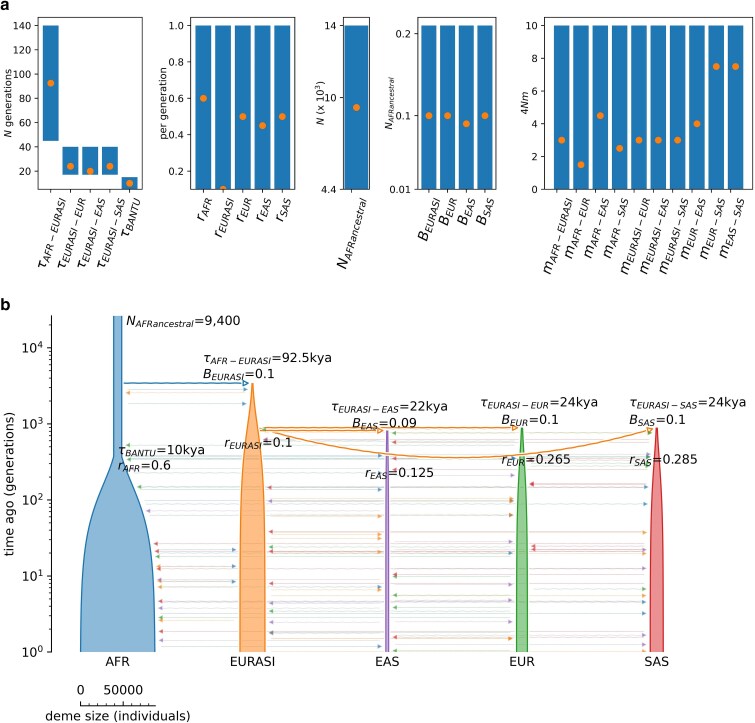
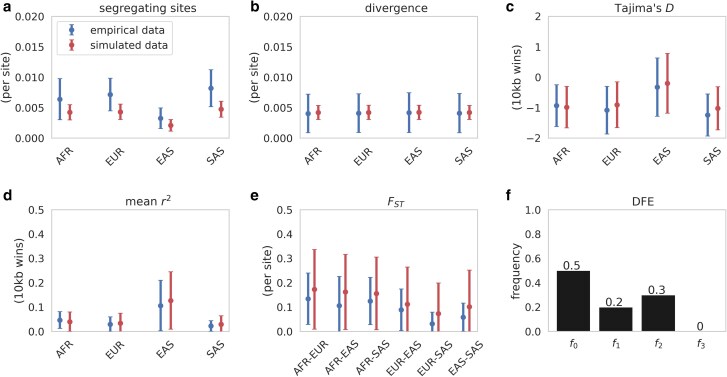
The demographic history of a population, and the distribution of fitness effects (DFE) of newly arising mutations in functional genomic regions, are fundamental factors dictating both genetic variation and evolutionary trajectories. Although both demographic and DFE inference has been performed extensively in humans, these approaches have generally either been limited to simple demographic models involving a single population, or, where a complex population history has been inferred, without accounting for the potentially confounding effects of selection at linked sites. Taking advantage of the coding-sparse nature of the genome, we propose a 2-step approach in which coalescent simulations are first used to infer a complex multi-population demographic model, utilizing large non-functional regions that are likely free from the effects of background selection. We then use forward-in-time simulations to perform DFE inference in functional regions, conditional on the complex demography inferred and utilizing expected background selection effects in the estimation procedure. Throughout, recombination and mutation rate maps were used to account for the underlying empirical rate heterogeneity across the human genome. Importantly, within this framework it is possible to utilize and fit multiple aspects of the data, and this inference scheme represents a generalized approach for such large-scale inference in species with coding-sparse genomes.
期刊介绍:
G3: Genes, Genomes, Genetics provides a forum for the publication of high‐quality foundational research, particularly research that generates useful genetic and genomic information such as genome maps, single gene studies, genome‐wide association and QTL studies, as well as genome reports, mutant screens, and advances in methods and technology. The Editorial Board of G3 believes that rapid dissemination of these data is the necessary foundation for analysis that leads to mechanistic insights.
G3, published by the Genetics Society of America, meets the critical and growing need of the genetics community for rapid review and publication of important results in all areas of genetics. G3 offers the opportunity to publish the puzzling finding or to present unpublished results that may not have been submitted for review and publication due to a perceived lack of a potential high-impact finding. G3 has earned the DOAJ Seal, which is a mark of certification for open access journals, awarded by DOAJ to journals that achieve a high level of openness, adhere to Best Practice and high publishing standards.




 京公网安备 11010802042870号
京ICP备2023020795号-1
京公网安备 11010802042870号
京ICP备2023020795号-1

 分享
分享
 求助内容:
求助内容: 应助结果提醒方式:
 扫码关注我们
