{"title":"Comparative analysis of left bundle branch area pacing in patients with and without a history of open-heart surgery","authors":"Yasumasa Nohno MD, Ryosuke Kozu MD, Kii Ito MD, Yuta Chikazawa MD, Shusaku Maruyama MD, Tomoya Hasegawa MD, Hiromi Tsuchiya MD, Takahiro Tachibana MD, Hikaru Kimura MD, Yoshikazu Yazaki MD, PhD","doi":"10.1002/joa3.70010","DOIUrl":null,"url":null,"abstract":"<div>\n \n \n <section>\n \n <h3> Background</h3>\n \n <p>Left bundle branch area pacing (LBBAP) is widely performed in routine clinical practice. Achieving LBBAP requires deep insertion of the lead into the interventricular septum. LBBAP may be challenging in patients with a history of open-heart surgery (OHS) because of myocardial fibrosis associated with surgical trauma. This study aimed to report the feasibility and safety of performing LBBAP in patients with a history of OHS.</p>\n </section>\n \n <section>\n \n <h3> Methods</h3>\n \n <p>This retrospective analysis included patients who underwent successful LBBAP between November 2020 and September 2024, with approval from our institutional review board. LBBAP was performed using a 3830 SelectSecure lead, and pacing parameters were assessed before and after implantation.</p>\n </section>\n \n <section>\n \n <h3> Results</h3>\n \n <p>One hundred patients were analyzed, including 26 in the OHS group and 74 in the non-OHS group. The success rates of LBBAP were 84.6% in the OHS group and 90.5% in the non-OHS group (<i>p =</i> 0.375). Notably, the number of LBBAP lead placements was higher in the OHS group (3.0 ± 2.1 vs. 2.0 ± 1.4, <i>p =</i> 0.017). The left ventricular activation time in lead V6 was comparable between the groups at implantation (73.6 ± 13.3 ms vs. 75.6 ± 12.1 ms, <i>p =</i> 0.522). The QRS duration was significantly wider in the OHS group at implantation (131.3 ± 14.6 vs. 121.1 ± 12.3 ms, <i>p =</i> 0.002), but parameters remained stable at 1 year.</p>\n </section>\n \n <section>\n \n <h3> Conclusions</h3>\n \n <p>LBBAP in patients with a history of OHS may present a slightly higher level of technical difficulty, but it is both feasible and safe.</p>\n </section>\n </div>","PeriodicalId":15174,"journal":{"name":"Journal of Arrhythmia","volume":"41 1","pages":""},"PeriodicalIF":1.7000,"publicationDate":"2025-01-30","publicationTypes":"Journal Article","fieldsOfStudy":null,"isOpenAccess":false,"openAccessPdf":"https://www.ncbi.nlm.nih.gov/pmc/articles/PMC11780717/pdf/","citationCount":"0","resultStr":null,"platform":"Semanticscholar","paperid":null,"PeriodicalName":"Journal of Arrhythmia","FirstCategoryId":"1085","ListUrlMain":"https://onlinelibrary.wiley.com/doi/10.1002/joa3.70010","RegionNum":0,"RegionCategory":null,"ArticlePicture":[],"TitleCN":null,"AbstractTextCN":null,"PMCID":null,"EPubDate":"","PubModel":"","JCR":"Q2","JCRName":"CARDIAC & CARDIOVASCULAR SYSTEMS","Score":null,"Total":0}
引用次数: 0
Abstract
Background
Left bundle branch area pacing (LBBAP) is widely performed in routine clinical practice. Achieving LBBAP requires deep insertion of the lead into the interventricular septum. LBBAP may be challenging in patients with a history of open-heart surgery (OHS) because of myocardial fibrosis associated with surgical trauma. This study aimed to report the feasibility and safety of performing LBBAP in patients with a history of OHS.
Methods
This retrospective analysis included patients who underwent successful LBBAP between November 2020 and September 2024, with approval from our institutional review board. LBBAP was performed using a 3830 SelectSecure lead, and pacing parameters were assessed before and after implantation.
Results
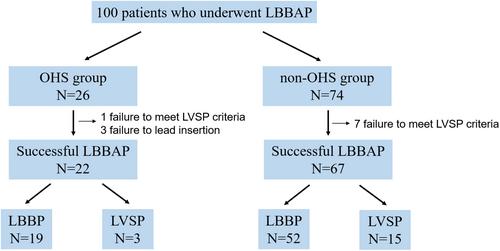
One hundred patients were analyzed, including 26 in the OHS group and 74 in the non-OHS group. The success rates of LBBAP were 84.6% in the OHS group and 90.5% in the non-OHS group (p = 0.375). Notably, the number of LBBAP lead placements was higher in the OHS group (3.0 ± 2.1 vs. 2.0 ± 1.4, p = 0.017). The left ventricular activation time in lead V6 was comparable between the groups at implantation (73.6 ± 13.3 ms vs. 75.6 ± 12.1 ms, p = 0.522). The QRS duration was significantly wider in the OHS group at implantation (131.3 ± 14.6 vs. 121.1 ± 12.3 ms, p = 0.002), but parameters remained stable at 1 year.
Conclusions
LBBAP in patients with a history of OHS may present a slightly higher level of technical difficulty, but it is both feasible and safe.
背景:左束支区起搏(LBBAP)在常规临床实践中被广泛应用。实现LBBAP需要将导联深度插入室间隔。LBBAP对于有心内直视手术(OHS)病史的患者可能具有挑战性,因为心肌纤维化与手术创伤相关。本研究旨在报告对有OHS病史的患者实施LBBAP的可行性和安全性。方法:本回顾性分析纳入了2020年11月至2024年9月期间成功接受LBBAP的患者,并获得了我们机构审查委员会的批准。使用3830 SelectSecure导联进行LBBAP,并在植入前后评估起搏参数。结果:共分析100例患者,其中OHS组26例,非OHS组74例。OHS组LBBAP的成功率为84.6%,非OHS组为90.5% (p = 0.375)。值得注意的是,OHS组LBBAP导联放置次数更高(3.0±2.1比2.0±1.4,p = 0.017)。两组左心室激活时间比较,分别为73.6±13.3 ms和75.6±12.1 ms, p = 0.522。OHS组在植入时QRS持续时间(131.3±14.6 ms vs 121.1±12.3 ms, p = 0.002)明显更宽,但参数在1年内保持稳定。结论:有OHS病史的患者行LBBAP手术技术难度略高,但可行且安全。




 京公网安备 11010802042870号
京ICP备2023020795号-1
京公网安备 11010802042870号
京ICP备2023020795号-1

 分享
分享
 求助内容:
求助内容: 应助结果提醒方式:
 扫码关注我们
