Predictive Value of Preoperative Nutritional Risk Index for Screw Loosening After Lumbar Interbody Fusion in Elderly Patients With Lumbar Spine Diseases.
Youwei Ai, Qian Chen, Li Li, Juehan Wang, Ce Zhu, Hong Ding, Yongdi Wang, Zhuojie Xiao, Yuting Zhan, Yueming Song, Ganjun Feng, Limin Liu
{"title":"Predictive Value of Preoperative Nutritional Risk Index for Screw Loosening After Lumbar Interbody Fusion in Elderly Patients With Lumbar Spine Diseases.","authors":"Youwei Ai, Qian Chen, Li Li, Juehan Wang, Ce Zhu, Hong Ding, Yongdi Wang, Zhuojie Xiao, Yuting Zhan, Yueming Song, Ganjun Feng, Limin Liu","doi":"10.1111/os.14369","DOIUrl":null,"url":null,"abstract":"<p><strong>Objective: </strong>Pedicle screw loosening is one of the common complications in elderly patients undergoing transforaminal lumbar interbody fusion (TLIF) for lumbar spine disease. Malnutrition, prevalent among elderly patients, has been shown to be associated with increased complications. The Geriatric Nutritional Risk Index (GNRI) serves as a simple indicator of nutritional status. However, the relationship between malnutrition, particularly GNRI, and pedicle screw loosening has not been adequately investigated. This study aims to investigate the relationship between GNRI and pedicle screw loosening following TLIF to guide the perioperative nutritional management of patients and prevent postoperative complications.</p><p><strong>Methods: </strong>A retrospective review was conducted on clinical data from patients who underwent single-level TLIF between 2014 and 2022. Data collection encompassed patient demographics, preoperative laboratory parameters, surgery-related data, perioperative radiographic data, and patient-reported outcomes were comprehensively documented. All patients were followed up for a minimum of 12 months. The relationship between GNRI and pedicle screw loosening was evaluated by univariate and multivariate Cox regression analysis, restricted cubic spline (RCS) analysis, receiver operating characteristic (ROC) analysis, and Kaplan-Meier survival analysis.</p><p><strong>Results: </strong>A total of 426 patients were included in the study. The rate of pedicle screw loosening rate was 16.4% at a minimum follow-up of 12 months. Patients with pedicle screw loosening exhibited significantly lower GNRI (89.0 ± 8.0 vs. 99.2 ± 9.3, p < 0.001) and volumetric bone mineral density measured by quantitative computed tomography (QCT-vBMD) (84.2 [interquartile range (IQR) 79.6-92.2] vs. 104.0 [IQR 88.2-126.0] mg/cm<sup>3</sup>, p < 0.001) compared with those in the non-loosening group. Multivariate Cox regression analysis identified sex (hazard ratio [HR] 1.433, 95% confidence interval [CI] 0.714-2.876, p = 0.027), age (HR 1.062, 95% CI 1.014-1.113, p = 0.012), GNRI (HR 0.841, 95% CI 0.711-0.994, p = 0.043), and QCT-vBMD (HR 0.982, 95% CI 0.967-0.997, p = 0.019) as independent risk factors for screw loosening. RCS analysis showed that GNRI was negatively correlated with screw loosening (p < 0.0001). The area under the curve (AUC) for the GNRI in predicting pedicle screw loosening was 0.794, with a cut-off value of 95.590 (sensitivity, 85.7%; specificity 65.2%). Kaplan-Meier survival analysis identified that the lower-level GNRI group exhibited a higher cumulative incidence of screw loosening (log-rank test, p < 0.0001).</p><p><strong>Conclusion: </strong>The GNRI was an independent risk factor for postoperative screw loosening in elderly patients undergoing TLIF for lumbar spine disease. Preoperative GNRI may potentially serve as a valuable tool in predicting postoperative screw loosening in elderly patients undergoing TLIF.</p>","PeriodicalId":19566,"journal":{"name":"Orthopaedic Surgery","volume":" ","pages":"1152-1161"},"PeriodicalIF":2.1000,"publicationDate":"2025-04-01","publicationTypes":"Journal Article","fieldsOfStudy":null,"isOpenAccess":false,"openAccessPdf":"https://www.ncbi.nlm.nih.gov/pmc/articles/PMC11962288/pdf/","citationCount":"0","resultStr":null,"platform":"Semanticscholar","paperid":null,"PeriodicalName":"Orthopaedic Surgery","FirstCategoryId":"3","ListUrlMain":"https://doi.org/10.1111/os.14369","RegionNum":2,"RegionCategory":"医学","ArticlePicture":[],"TitleCN":null,"AbstractTextCN":null,"PMCID":null,"EPubDate":"2025/1/30 0:00:00","PubModel":"Epub","JCR":"Q2","JCRName":"ORTHOPEDICS","Score":null,"Total":0}
引用次数: 0
Abstract
Objective: Pedicle screw loosening is one of the common complications in elderly patients undergoing transforaminal lumbar interbody fusion (TLIF) for lumbar spine disease. Malnutrition, prevalent among elderly patients, has been shown to be associated with increased complications. The Geriatric Nutritional Risk Index (GNRI) serves as a simple indicator of nutritional status. However, the relationship between malnutrition, particularly GNRI, and pedicle screw loosening has not been adequately investigated. This study aims to investigate the relationship between GNRI and pedicle screw loosening following TLIF to guide the perioperative nutritional management of patients and prevent postoperative complications.
Methods: A retrospective review was conducted on clinical data from patients who underwent single-level TLIF between 2014 and 2022. Data collection encompassed patient demographics, preoperative laboratory parameters, surgery-related data, perioperative radiographic data, and patient-reported outcomes were comprehensively documented. All patients were followed up for a minimum of 12 months. The relationship between GNRI and pedicle screw loosening was evaluated by univariate and multivariate Cox regression analysis, restricted cubic spline (RCS) analysis, receiver operating characteristic (ROC) analysis, and Kaplan-Meier survival analysis.
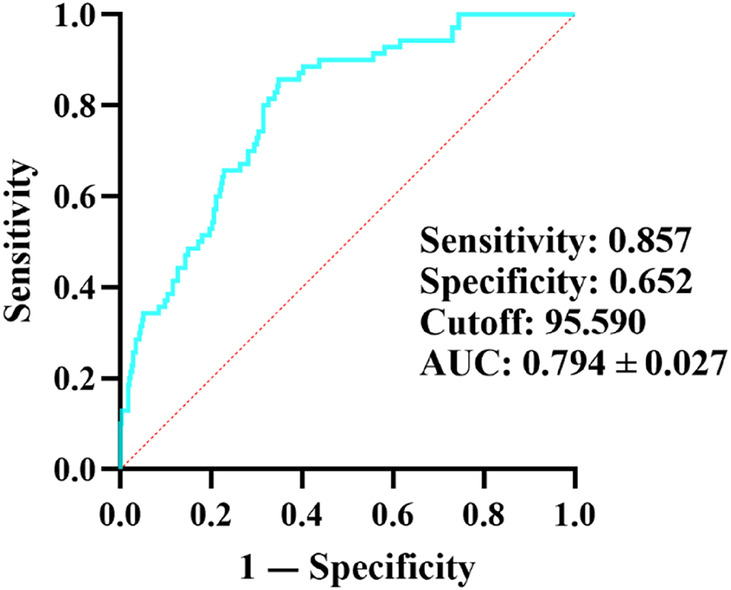
Results: A total of 426 patients were included in the study. The rate of pedicle screw loosening rate was 16.4% at a minimum follow-up of 12 months. Patients with pedicle screw loosening exhibited significantly lower GNRI (89.0 ± 8.0 vs. 99.2 ± 9.3, p < 0.001) and volumetric bone mineral density measured by quantitative computed tomography (QCT-vBMD) (84.2 [interquartile range (IQR) 79.6-92.2] vs. 104.0 [IQR 88.2-126.0] mg/cm3, p < 0.001) compared with those in the non-loosening group. Multivariate Cox regression analysis identified sex (hazard ratio [HR] 1.433, 95% confidence interval [CI] 0.714-2.876, p = 0.027), age (HR 1.062, 95% CI 1.014-1.113, p = 0.012), GNRI (HR 0.841, 95% CI 0.711-0.994, p = 0.043), and QCT-vBMD (HR 0.982, 95% CI 0.967-0.997, p = 0.019) as independent risk factors for screw loosening. RCS analysis showed that GNRI was negatively correlated with screw loosening (p < 0.0001). The area under the curve (AUC) for the GNRI in predicting pedicle screw loosening was 0.794, with a cut-off value of 95.590 (sensitivity, 85.7%; specificity 65.2%). Kaplan-Meier survival analysis identified that the lower-level GNRI group exhibited a higher cumulative incidence of screw loosening (log-rank test, p < 0.0001).
Conclusion: The GNRI was an independent risk factor for postoperative screw loosening in elderly patients undergoing TLIF for lumbar spine disease. Preoperative GNRI may potentially serve as a valuable tool in predicting postoperative screw loosening in elderly patients undergoing TLIF.
目的:椎弓根螺钉松动是老年腰椎疾病行椎间孔腰椎椎间融合术(TLIF)的常见并发症之一。在老年患者中普遍存在的营养不良已被证明与并发症的增加有关。老年人营养风险指数(GNRI)是营养状况的一个简单指标。然而,营养不良,特别是GNRI与椎弓根螺钉松动之间的关系尚未得到充分的研究。本研究旨在探讨GNRI与TLIF术后椎弓根螺钉松动的关系,以指导患者围术期营养管理,预防术后并发症。方法:回顾性分析2014 - 2022年单期TLIF患者的临床资料。数据收集包括患者人口统计学、术前实验室参数、手术相关数据、围手术期放射学数据和患者报告的结果。所有患者至少随访12个月。通过单因素和多因素Cox回归分析、限制性三次样条(RCS)分析、受试者工作特征(ROC)分析和Kaplan-Meier生存分析评估GNRI与椎弓根螺钉松动的关系。结果:共纳入426例患者。至少随访12个月,椎弓根螺钉松动率为16.4%。椎弓根螺钉松动的患者GNRI明显低于前者(89.0±8.0 vs. 99.2±9.3,p < 0.05, p < 0.05)。结论:GNRI是老年腰椎疾病行TLIF术后螺钉松动的独立危险因素。术前GNRI可能作为预测老年TLIF患者术后螺钉松动的有价值的工具。
期刊介绍:
Orthopaedic Surgery (OS) is the official journal of the Chinese Orthopaedic Association, focusing on all aspects of orthopaedic technique and surgery.
The journal publishes peer-reviewed articles in the following categories: Original Articles, Clinical Articles, Review Articles, Guidelines, Editorials, Commentaries, Surgical Techniques, Case Reports and Meeting Reports.





 京公网安备 11010802042870号
京ICP备2023020795号-1
京公网安备 11010802042870号
京ICP备2023020795号-1

 分享
分享
 求助内容:
求助内容: 应助结果提醒方式:
 扫码关注我们
