Jingjing Wei, Guozhong Tao, Junlin Liu, Bomi Framroze, Karl G Sylvester
{"title":"Protective effect of soluble protein hydrolysate against H<sub>2</sub>O<sub>2</sub>‑induced intestinal injury: An interventional study.","authors":"Jingjing Wei, Guozhong Tao, Junlin Liu, Bomi Framroze, Karl G Sylvester","doi":"10.3892/mmr.2025.13450","DOIUrl":null,"url":null,"abstract":"<p><p>The present study aimed to investigate whether soluble protein hydrolysate (SPH) protects against intestinal oxidative stress injury. An <i>in vitro</i> lactate dehydrogenase assay was used to assess the cytotoxicity and protective effect of SPH. For <i>in vivo</i> assessment, friend virus B NIH Jackson mouse pups aged 21 days were administered with 5% w/v soluble protein hydrolysate (SPH) through drinking water for 14 days and then luminally injected with 0.3% or 0.6% H<sub>2</sub>O<sub>2</sub>. Thereafter, the fecal samples of mice were collected, and the mice were sacrificed. Intestinal epithelial injury was assessed, and the expressions of 84 oxidative stress‑related genes in intestinal tissues was determined. SPH prophylactically protected against H<sub>2</sub>O<sub>2</sub>‑induced oxidative stress injury in human intestinal epithelial cells. An animal model of oxidative stress‑induced intestinal injury was established using 0.3 and 0.6% H<sub>2</sub>O<sub>2</sub>. SPH treatment reduced oxidative stress (0.3% H<sub>2</sub>O<sub>2</sub>)‑induced gut injury in mice. As no accelerated body growth was observed in SPH‑treated mice, it was hypothesized that the underlying protective mechanism of SPH is not related to nutrient oversupply. Treatment with SPH upregulated five oxidative protective genes that were not consistent between the sexes. Some antioxidative genes, including ferritin heavy polypeptide‑1 (<i>Fth1</i>), heme oxygenase‑1 (<i>Hmox1</i>), NAD(P)H dehydrogenase quinone 1 (<i>Nqo1</i>) and superoxide dismutase 1 (<i>Sod1</i>), were commonly upregulated in both male and female mice. Overall, an antioxidative protective effect was observed following SPH treatment, which may be attributed to the upregulation of genes that protect against oxidative damage. The findings of the present study highlight the promising potential of SPH as a functional food for alleviating intestinal oxidative stress injury.</p>","PeriodicalId":18818,"journal":{"name":"Molecular medicine reports","volume":"31 4","pages":""},"PeriodicalIF":3.5000,"publicationDate":"2025-04-01","publicationTypes":"Journal Article","fieldsOfStudy":null,"isOpenAccess":false,"openAccessPdf":"https://www.ncbi.nlm.nih.gov/pmc/articles/PMC11811813/pdf/","citationCount":"0","resultStr":null,"platform":"Semanticscholar","paperid":null,"PeriodicalName":"Molecular medicine reports","FirstCategoryId":"3","ListUrlMain":"https://doi.org/10.3892/mmr.2025.13450","RegionNum":3,"RegionCategory":"医学","ArticlePicture":[],"TitleCN":null,"AbstractTextCN":null,"PMCID":null,"EPubDate":"2025/1/31 0:00:00","PubModel":"Epub","JCR":"Q2","JCRName":"MEDICINE, RESEARCH & EXPERIMENTAL","Score":null,"Total":0}
引用次数: 0
Abstract
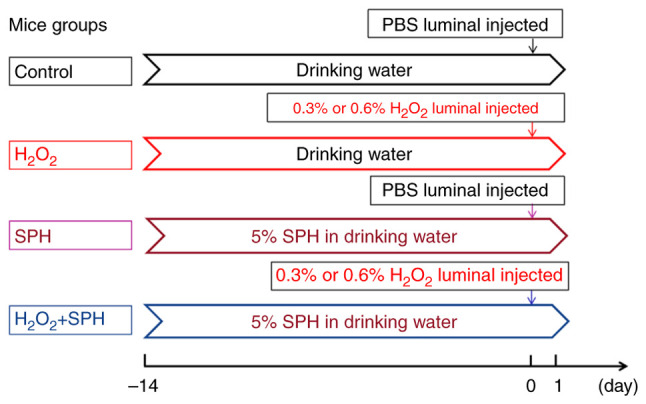
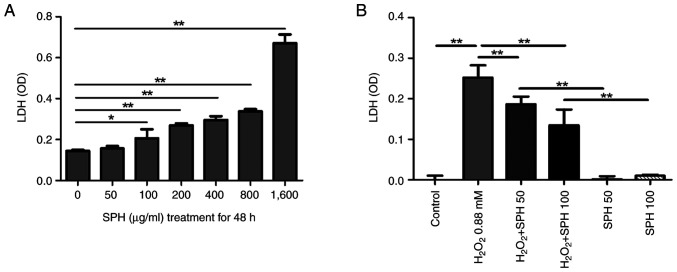
The present study aimed to investigate whether soluble protein hydrolysate (SPH) protects against intestinal oxidative stress injury. An in vitro lactate dehydrogenase assay was used to assess the cytotoxicity and protective effect of SPH. For in vivo assessment, friend virus B NIH Jackson mouse pups aged 21 days were administered with 5% w/v soluble protein hydrolysate (SPH) through drinking water for 14 days and then luminally injected with 0.3% or 0.6% H2O2. Thereafter, the fecal samples of mice were collected, and the mice were sacrificed. Intestinal epithelial injury was assessed, and the expressions of 84 oxidative stress‑related genes in intestinal tissues was determined. SPH prophylactically protected against H2O2‑induced oxidative stress injury in human intestinal epithelial cells. An animal model of oxidative stress‑induced intestinal injury was established using 0.3 and 0.6% H2O2. SPH treatment reduced oxidative stress (0.3% H2O2)‑induced gut injury in mice. As no accelerated body growth was observed in SPH‑treated mice, it was hypothesized that the underlying protective mechanism of SPH is not related to nutrient oversupply. Treatment with SPH upregulated five oxidative protective genes that were not consistent between the sexes. Some antioxidative genes, including ferritin heavy polypeptide‑1 (Fth1), heme oxygenase‑1 (Hmox1), NAD(P)H dehydrogenase quinone 1 (Nqo1) and superoxide dismutase 1 (Sod1), were commonly upregulated in both male and female mice. Overall, an antioxidative protective effect was observed following SPH treatment, which may be attributed to the upregulation of genes that protect against oxidative damage. The findings of the present study highlight the promising potential of SPH as a functional food for alleviating intestinal oxidative stress injury.
期刊介绍:
Molecular Medicine Reports is a monthly, peer-reviewed journal available in print and online, that includes studies devoted to molecular medicine, underscoring aspects including pharmacology, pathology, genetics, neurosciences, infectious diseases, molecular cardiology and molecular surgery. In vitro and in vivo studies of experimental model systems pertaining to the mechanisms of a variety of diseases offer researchers the necessary tools and knowledge with which to aid the diagnosis and treatment of human diseases.





 京公网安备 11010802042870号
京ICP备2023020795号-1
京公网安备 11010802042870号
京ICP备2023020795号-1

 分享
分享
 求助内容:
求助内容: 应助结果提醒方式:
 扫码关注我们
