Marius L Smits, Casper Webers, Mirte van Dooren, Elien A M Mahler, Johanna E Vriezekolk, Astrid van Tubergen
{"title":"Barriers and facilitators to treat-to-target in axial spondyloarthritis in clinical practice: a mixed methods study.","authors":"Marius L Smits, Casper Webers, Mirte van Dooren, Elien A M Mahler, Johanna E Vriezekolk, Astrid van Tubergen","doi":"10.1007/s00296-025-05795-6","DOIUrl":null,"url":null,"abstract":"<p><p>This study aimed to explore the perceptions of patients and rheumatologists about a treat-to-target (T2T) strategy in axial spondyloarthritis (axSpA) and identify the barriers and facilitators to its implementation in clinical practice. A mixed methods design was applied. Patients with axSpA who visited the outpatient clinic with active disease (AxSpA Disease Activity Score [ASDAS] ≥ 2.1), but did not receive a treatment adjustment, were identified. These patient cases were discussed in individual semi-structured interviews with the respective treating rheumatologists, and a subgroup of these patients was also interviewed. In parallel, all interviewed participants completed a quantitative survey. Qualitative and quantitative data were analysed thematically and descriptively, respectively. Twenty-three patients were discussed with 11 rheumatologists, and 16 of these patients were interviewed personally. Barriers to T2T included challenges in the measurement of inflammatory disease activity using the ASDAS, and numerous patient-related factors such as concern about treatment adaptations. The limited number of viable treatment options and scarce amount of evidence supporting T2T in axSpA, as well as logistical challenges, were additional obstacles. Facilitators included patients' broad knowledge about axSpA, rheumatologists' awareness of T2T recommendations, and positive doctor-patient relationships with the application of shared decision-making. Moreover, a supporting infrastructure, such as one with high accessibility to the outpatient clinic between scheduled visits, was considered necessary for the application of a T2T strategy. In conclusion, numerous barriers and facilitators to the implementation of a T2T strategy in axSpA are present, which need to be considered when applying this treatment approach in clinical practice.</p>","PeriodicalId":21322,"journal":{"name":"Rheumatology International","volume":"45 2","pages":"41"},"PeriodicalIF":2.9000,"publicationDate":"2025-01-31","publicationTypes":"Journal Article","fieldsOfStudy":null,"isOpenAccess":false,"openAccessPdf":"https://www.ncbi.nlm.nih.gov/pmc/articles/PMC11785688/pdf/","citationCount":"0","resultStr":null,"platform":"Semanticscholar","paperid":null,"PeriodicalName":"Rheumatology International","FirstCategoryId":"3","ListUrlMain":"https://doi.org/10.1007/s00296-025-05795-6","RegionNum":3,"RegionCategory":"医学","ArticlePicture":[],"TitleCN":null,"AbstractTextCN":null,"PMCID":null,"EPubDate":"","PubModel":"","JCR":"Q2","JCRName":"RHEUMATOLOGY","Score":null,"Total":0}
引用次数: 0
Abstract
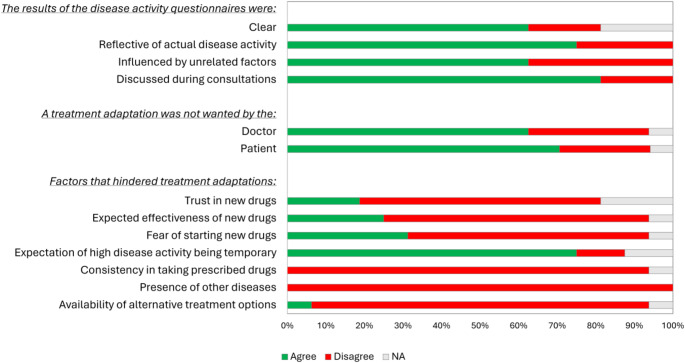
This study aimed to explore the perceptions of patients and rheumatologists about a treat-to-target (T2T) strategy in axial spondyloarthritis (axSpA) and identify the barriers and facilitators to its implementation in clinical practice. A mixed methods design was applied. Patients with axSpA who visited the outpatient clinic with active disease (AxSpA Disease Activity Score [ASDAS] ≥ 2.1), but did not receive a treatment adjustment, were identified. These patient cases were discussed in individual semi-structured interviews with the respective treating rheumatologists, and a subgroup of these patients was also interviewed. In parallel, all interviewed participants completed a quantitative survey. Qualitative and quantitative data were analysed thematically and descriptively, respectively. Twenty-three patients were discussed with 11 rheumatologists, and 16 of these patients were interviewed personally. Barriers to T2T included challenges in the measurement of inflammatory disease activity using the ASDAS, and numerous patient-related factors such as concern about treatment adaptations. The limited number of viable treatment options and scarce amount of evidence supporting T2T in axSpA, as well as logistical challenges, were additional obstacles. Facilitators included patients' broad knowledge about axSpA, rheumatologists' awareness of T2T recommendations, and positive doctor-patient relationships with the application of shared decision-making. Moreover, a supporting infrastructure, such as one with high accessibility to the outpatient clinic between scheduled visits, was considered necessary for the application of a T2T strategy. In conclusion, numerous barriers and facilitators to the implementation of a T2T strategy in axSpA are present, which need to be considered when applying this treatment approach in clinical practice.
期刊介绍:
RHEUMATOLOGY INTERNATIONAL is an independent journal reflecting world-wide progress in the research, diagnosis and treatment of the various rheumatic diseases. It is designed to serve researchers and clinicians in the field of rheumatology.
RHEUMATOLOGY INTERNATIONAL will cover all modern trends in clinical research as well as in the management of rheumatic diseases. Special emphasis will be given to public health issues related to rheumatic diseases, applying rheumatology research to clinical practice, epidemiology of rheumatic diseases, diagnostic tests for rheumatic diseases, patient reported outcomes (PROs) in rheumatology and evidence on education of rheumatology. Contributions to these topics will appear in the form of original publications, short communications, editorials, and reviews. "Letters to the editor" will be welcome as an enhancement to discussion. Basic science research, including in vitro or animal studies, is discouraged to submit, as we will only review studies on humans with an epidemological or clinical perspective. Case reports without a proper review of the literatura (Case-based Reviews) will not be published. Every effort will be made to ensure speed of publication while maintaining a high standard of contents and production.
Manuscripts submitted for publication must contain a statement to the effect that all human studies have been reviewed by the appropriate ethics committee and have therefore been performed in accordance with the ethical standards laid down in an appropriate version of the 1964 Declaration of Helsinki. It should also be stated clearly in the text that all persons gave their informed consent prior to their inclusion in the study. Details that might disclose the identity of the subjects under study should be omitted.




 京公网安备 11010802042870号
京ICP备2023020795号-1
京公网安备 11010802042870号
京ICP备2023020795号-1

 分享
分享
 求助内容:
求助内容: 应助结果提醒方式:
 扫码关注我们
