Ji Jiang, Yuan Tian, Xiaoyang Wu, Mingze Zeng, Chengheng Wu, Dan Wei, Hongrong Luo, Jing Sun, Jie Ding and Hongsong Fan
{"title":"Temperature and light dual-responsive hydrogels for anti-inflammation and wound repair monitoring†","authors":"Ji Jiang, Yuan Tian, Xiaoyang Wu, Mingze Zeng, Chengheng Wu, Dan Wei, Hongrong Luo, Jing Sun, Jie Ding and Hongsong Fan","doi":"10.1039/D4TB02555E","DOIUrl":null,"url":null,"abstract":"<p >Wound healing is a complex and dynamic biological process that requires meticulous management to ensure optimal outcomes. Traditional wound dressings, such as gauze and bandages, although commonly used, often fall short in their frequent need for replacement, lack of real-time monitoring and absence of anti-inflammatory and antibacterial properties, which can lead to increased risk of infection and delayed healing. Here, we address these limitations by introducing an innovative hydrogel dressing, named PHDNN6, to combine wireless Bluetooth temperature monitoring and light-triggered nitric oxide (NO) release to enhance wound healing and management. The PHDNN6 hydrogel is based on a poly(<em>N</em>-isopropylacrylamide) (PNIPAM) matrix, integrated with methacrylated and dopamine-grafted hyaluronic acid (HA–MA–DA), which allows the dressing to be highly responsive to changes in wound temperature, enabling continuous and real-time monitoring of the wound microenvironment wirelessly. Besides, PHDNN6 is embedded with photothermal polydopamine nanoparticles (PDA NPs) that are loaded with a NO donor, <em>N</em>,<em>N</em>′-di-<em>sec</em>-butyl-<em>N</em>,<em>N</em>′-dinitroso-1,4-phenylenediamine (BNN6). When exposed to near-infrared (NIR) laser irradiation, these PDA@BNN6 nanoparticles release NO to provide potent antibacterial and anti-inflammatory effects. The integration of continuous wireless temperature monitoring with NO release within a single hydrogel dressing represents a significant advancement in clinical wound care. This dual-functional platform not only provides real-time diagnostic capabilities but also offers therapeutic interventions to manage wound infections and promote tissue regeneration. Our research highlights the potential of PHDNN6 to revolutionize wound management by offering a comprehensive solution that addresses both the diagnostic and therapeutic needs in wound healing.</p>","PeriodicalId":83,"journal":{"name":"Journal of Materials Chemistry B","volume":" 8","pages":" 2855-2870"},"PeriodicalIF":6.1000,"publicationDate":"2025-01-25","publicationTypes":"Journal Article","fieldsOfStudy":null,"isOpenAccess":false,"openAccessPdf":"","citationCount":"0","resultStr":null,"platform":"Semanticscholar","paperid":null,"PeriodicalName":"Journal of Materials Chemistry B","FirstCategoryId":"1","ListUrlMain":"https://pubs.rsc.org/en/content/articlelanding/2025/tb/d4tb02555e","RegionNum":3,"RegionCategory":"医学","ArticlePicture":[],"TitleCN":null,"AbstractTextCN":null,"PMCID":null,"EPubDate":"","PubModel":"","JCR":"Q1","JCRName":"MATERIALS SCIENCE, BIOMATERIALS","Score":null,"Total":0}
引用次数: 0
Abstract
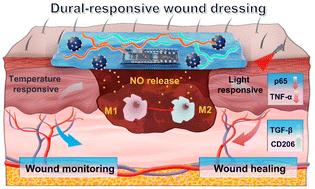
Wound healing is a complex and dynamic biological process that requires meticulous management to ensure optimal outcomes. Traditional wound dressings, such as gauze and bandages, although commonly used, often fall short in their frequent need for replacement, lack of real-time monitoring and absence of anti-inflammatory and antibacterial properties, which can lead to increased risk of infection and delayed healing. Here, we address these limitations by introducing an innovative hydrogel dressing, named PHDNN6, to combine wireless Bluetooth temperature monitoring and light-triggered nitric oxide (NO) release to enhance wound healing and management. The PHDNN6 hydrogel is based on a poly(N-isopropylacrylamide) (PNIPAM) matrix, integrated with methacrylated and dopamine-grafted hyaluronic acid (HA–MA–DA), which allows the dressing to be highly responsive to changes in wound temperature, enabling continuous and real-time monitoring of the wound microenvironment wirelessly. Besides, PHDNN6 is embedded with photothermal polydopamine nanoparticles (PDA NPs) that are loaded with a NO donor, N,N′-di-sec-butyl-N,N′-dinitroso-1,4-phenylenediamine (BNN6). When exposed to near-infrared (NIR) laser irradiation, these PDA@BNN6 nanoparticles release NO to provide potent antibacterial and anti-inflammatory effects. The integration of continuous wireless temperature monitoring with NO release within a single hydrogel dressing represents a significant advancement in clinical wound care. This dual-functional platform not only provides real-time diagnostic capabilities but also offers therapeutic interventions to manage wound infections and promote tissue regeneration. Our research highlights the potential of PHDNN6 to revolutionize wound management by offering a comprehensive solution that addresses both the diagnostic and therapeutic needs in wound healing.
期刊介绍:
Journal of Materials Chemistry A, B & C cover high quality studies across all fields of materials chemistry. The journals focus on those theoretical or experimental studies that report new understanding, applications, properties and synthesis of materials. Journal of Materials Chemistry A, B & C are separated by the intended application of the material studied. Broadly, applications in energy and sustainability are of interest to Journal of Materials Chemistry A, applications in biology and medicine are of interest to Journal of Materials Chemistry B, and applications in optical, magnetic and electronic devices are of interest to Journal of Materials Chemistry C.Journal of Materials Chemistry B is a Transformative Journal and Plan S compliant. Example topic areas within the scope of Journal of Materials Chemistry B are listed below. This list is neither exhaustive nor exclusive:
Antifouling coatings
Biocompatible materials
Bioelectronics
Bioimaging
Biomimetics
Biomineralisation
Bionics
Biosensors
Diagnostics
Drug delivery
Gene delivery
Immunobiology
Nanomedicine
Regenerative medicine & Tissue engineering
Scaffolds
Soft robotics
Stem cells
Therapeutic devices



 京公网安备 11010802042870号
京ICP备2023020795号-1
京公网安备 11010802042870号
京ICP备2023020795号-1

 分享
分享
 求助内容:
求助内容: 应助结果提醒方式:
 扫码关注我们
