Cristiane Rabelo Lisboa, Josimare Aparecida Otoni Spira, Eline Lima Borges
{"title":"Self-care concept for people with elimination ostomy: a scoping review.","authors":"Cristiane Rabelo Lisboa, Josimare Aparecida Otoni Spira, Eline Lima Borges","doi":"10.1590/1980-220X-REEUSP-2024-0041en","DOIUrl":null,"url":null,"abstract":"<p><strong>Objective: </strong>To analyze the literature for terminology, classifications, and factors influencing the adoption of self-care in people with an elimination ostomy.</p><p><strong>Method: </strong>Scoping review, according to JBI methodology and, for structuring the article, the extension of the PRISMA checklist. The search included studies from 2018 to 2023, in four databases, with specific descriptors and alternative terms. Two reviewers selected the sample based on inclusion/exclusion criteria, using the software Rayyan®. The protocol was registered in the Open Science Framework.</p><p><strong>Results: </strong>Eight studies were included, which presented differences in the scope of the concept and classification of self-care. Names such as capacity, index, and level were used. Four tools were identified for assessing self-care. The factors that positively influenced self-care were female sex, being young, married, higher education level, pasty effluent, demarcation, social support, and education. Those influencing negatively were stress, complications, and inadequate care.</p><p><strong>Conclusion: </strong>The concept of self-care for people with elimination ostomies is not standardized and is most often reduced to procedural self-care.</p>","PeriodicalId":94195,"journal":{"name":"Revista da Escola de Enfermagem da U S P","volume":"58 ","pages":"e20240041"},"PeriodicalIF":0.0000,"publicationDate":"2024-12-20","publicationTypes":"Journal Article","fieldsOfStudy":null,"isOpenAccess":false,"openAccessPdf":"https://www.ncbi.nlm.nih.gov/pmc/articles/PMC11702974/pdf/","citationCount":"0","resultStr":null,"platform":"Semanticscholar","paperid":null,"PeriodicalName":"Revista da Escola de Enfermagem da U S P","FirstCategoryId":"1085","ListUrlMain":"https://doi.org/10.1590/1980-220X-REEUSP-2024-0041en","RegionNum":0,"RegionCategory":null,"ArticlePicture":[],"TitleCN":null,"AbstractTextCN":null,"PMCID":null,"EPubDate":"2024/1/1 0:00:00","PubModel":"eCollection","JCR":"","JCRName":"","Score":null,"Total":0}
引用次数: 0
Abstract
Objective: To analyze the literature for terminology, classifications, and factors influencing the adoption of self-care in people with an elimination ostomy.
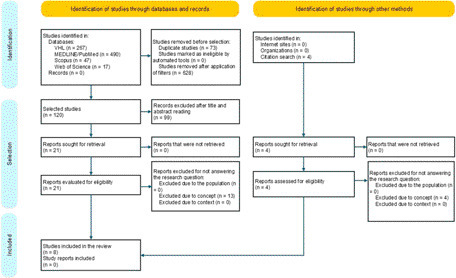
Method: Scoping review, according to JBI methodology and, for structuring the article, the extension of the PRISMA checklist. The search included studies from 2018 to 2023, in four databases, with specific descriptors and alternative terms. Two reviewers selected the sample based on inclusion/exclusion criteria, using the software Rayyan®. The protocol was registered in the Open Science Framework.
Results: Eight studies were included, which presented differences in the scope of the concept and classification of self-care. Names such as capacity, index, and level were used. Four tools were identified for assessing self-care. The factors that positively influenced self-care were female sex, being young, married, higher education level, pasty effluent, demarcation, social support, and education. Those influencing negatively were stress, complications, and inadequate care.
Conclusion: The concept of self-care for people with elimination ostomies is not standardized and is most often reduced to procedural self-care.





 京公网安备 11010802042870号
京ICP备2023020795号-1
京公网安备 11010802042870号
京ICP备2023020795号-1

 分享
分享

 求助内容:
求助内容: 应助结果提醒方式:
 扫码关注我们
