Tsai-Wei Lin, Baicheng Mei, Sarit Dutta, Kenneth S. Schweizer, Charles E. Sing
{"title":"Molecular Dynamics Simulation and Theoretical Analysis of Structural Relaxation, Bond Exchange Dynamics, and Glass Transition in Vitrimers","authors":"Tsai-Wei Lin, Baicheng Mei, Sarit Dutta, Kenneth S. Schweizer, Charles E. Sing","doi":"10.1021/acs.macromol.4c02659","DOIUrl":null,"url":null,"abstract":"Vitrimers are a class of polymer networks featuring dynamic covalent cross-links that can undergo associative bond exchange. There has been recent interest in these materials due to their promise as recyclable thermosets or self-healing polymers because of the ability of vitrimer networks to rearrange at the molecular level and undergo macroscopic flow. However, the practical use of these materials often occurs in the supercooled regime or glassy state, where the implications of dynamic bonds are complicated by the interplay between slow activated segmental dynamics, cross-link (i.e., bond-exchange) kinetics, and ultimately material properties. In this paper, we combine coarse-grained molecular dynamics simulation and microscopic statistical mechanical theory to understand how cross-linking kinetics affect material dynamics and how this couples to segmental relaxation of the polymeric network strands across a spectrum of length and time scales, especially in the supercooled regime. We characterize the Kuhn segmental alpha relaxation time and bond exchange time for vitrimer systems across various cross-link densities, temperatures, and bond exchange rates. Simulation and theory both exhibit a bending-up behavior for bond exchange time upon cooling, suggesting a coupling between bond exchange dynamics and segmental relaxation that intensifies with faster bond exchange kinetics. We also found bond exchange dynamics have an impact on Kuhn segment alpha relaxation time, which is most significant at higher cross-link densities. Both these effects are most prominent when the bond exchange time is similar to the Kuhn segment alpha relaxation time, and the resulting coupling of these two relaxation processes is tied to both the probability of a free end to find a bonded pair and the time scale of the constraints imposed by the dynamic cross-links. This relationship is reflected by a cross-link dependence of a theoretical parameter which represents the quantitative degree of coupling between bond exchange and segmental dynamics. Overall, the combination of simulation and theory clarifies the intricate interaction between bond kinetics and segmental relaxation and demonstrates the ability to provide molecular-level insights into vitrimer dynamics over a wide temperature range.","PeriodicalId":51,"journal":{"name":"Macromolecules","volume":"6 1","pages":""},"PeriodicalIF":5.2000,"publicationDate":"2025-01-30","publicationTypes":"Journal Article","fieldsOfStudy":null,"isOpenAccess":false,"openAccessPdf":"","citationCount":"0","resultStr":null,"platform":"Semanticscholar","paperid":null,"PeriodicalName":"Macromolecules","FirstCategoryId":"92","ListUrlMain":"https://doi.org/10.1021/acs.macromol.4c02659","RegionNum":1,"RegionCategory":"化学","ArticlePicture":[],"TitleCN":null,"AbstractTextCN":null,"PMCID":null,"EPubDate":"","PubModel":"","JCR":"Q1","JCRName":"POLYMER SCIENCE","Score":null,"Total":0}
引用次数: 0
Abstract
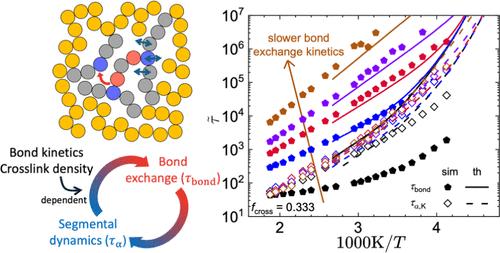
Vitrimers are a class of polymer networks featuring dynamic covalent cross-links that can undergo associative bond exchange. There has been recent interest in these materials due to their promise as recyclable thermosets or self-healing polymers because of the ability of vitrimer networks to rearrange at the molecular level and undergo macroscopic flow. However, the practical use of these materials often occurs in the supercooled regime or glassy state, where the implications of dynamic bonds are complicated by the interplay between slow activated segmental dynamics, cross-link (i.e., bond-exchange) kinetics, and ultimately material properties. In this paper, we combine coarse-grained molecular dynamics simulation and microscopic statistical mechanical theory to understand how cross-linking kinetics affect material dynamics and how this couples to segmental relaxation of the polymeric network strands across a spectrum of length and time scales, especially in the supercooled regime. We characterize the Kuhn segmental alpha relaxation time and bond exchange time for vitrimer systems across various cross-link densities, temperatures, and bond exchange rates. Simulation and theory both exhibit a bending-up behavior for bond exchange time upon cooling, suggesting a coupling between bond exchange dynamics and segmental relaxation that intensifies with faster bond exchange kinetics. We also found bond exchange dynamics have an impact on Kuhn segment alpha relaxation time, which is most significant at higher cross-link densities. Both these effects are most prominent when the bond exchange time is similar to the Kuhn segment alpha relaxation time, and the resulting coupling of these two relaxation processes is tied to both the probability of a free end to find a bonded pair and the time scale of the constraints imposed by the dynamic cross-links. This relationship is reflected by a cross-link dependence of a theoretical parameter which represents the quantitative degree of coupling between bond exchange and segmental dynamics. Overall, the combination of simulation and theory clarifies the intricate interaction between bond kinetics and segmental relaxation and demonstrates the ability to provide molecular-level insights into vitrimer dynamics over a wide temperature range.
期刊介绍:
Macromolecules publishes original, fundamental, and impactful research on all aspects of polymer science. Topics of interest include synthesis (e.g., controlled polymerizations, polymerization catalysis, post polymerization modification, new monomer structures and polymer architectures, and polymerization mechanisms/kinetics analysis); phase behavior, thermodynamics, dynamic, and ordering/disordering phenomena (e.g., self-assembly, gelation, crystallization, solution/melt/solid-state characteristics); structure and properties (e.g., mechanical and rheological properties, surface/interfacial characteristics, electronic and transport properties); new state of the art characterization (e.g., spectroscopy, scattering, microscopy, rheology), simulation (e.g., Monte Carlo, molecular dynamics, multi-scale/coarse-grained modeling), and theoretical methods. Renewable/sustainable polymers, polymer networks, responsive polymers, electro-, magneto- and opto-active macromolecules, inorganic polymers, charge-transporting polymers (ion-containing, semiconducting, and conducting), nanostructured polymers, and polymer composites are also of interest. Typical papers published in Macromolecules showcase important and innovative concepts, experimental methods/observations, and theoretical/computational approaches that demonstrate a fundamental advance in the understanding of polymers.



 京公网安备 11010802042870号
京ICP备2023020795号-1
京公网安备 11010802042870号
京ICP备2023020795号-1

 分享
分享
 求助内容:
求助内容: 应助结果提醒方式:
 扫码关注我们
