Martin Hänsel, Heinz Reichmann, Antje Haehner, Henning Schmitz-Peiffer, Hauke Schneider
{"title":"Hippocampal dysfunction after autoimmune encephalitis depending on the antibody type.","authors":"Martin Hänsel, Heinz Reichmann, Antje Haehner, Henning Schmitz-Peiffer, Hauke Schneider","doi":"10.1007/s00415-024-12742-1","DOIUrl":null,"url":null,"abstract":"<p><strong>Background: </strong>Comprehensive neurocognitive function analyses of autoimmune encephalitis (AE) patients, especially long-term ones, are rare. This study aims to measure cognitive function in patients diagnosed with AE.</p><p><strong>Methods: </strong>This case-control study included AE patients (n = 11) with antibodies against NMDA receptor (NMDAR) (n = 4), VGKC (n = 3), GAD (3), and one antibody-negative patient. The control group contained 12 pneumococcal meningo-encephalitis patients (PC). Subgroup analyses compared AE patients with and without NMDAR antibodies. Neurocognitive tests were performed to evaluate verbal and visual memory, face recognition, attentional capacity, incidental learning capacity, and overall cognitive function (Montreal cognitive assessment, MoCA). Limbic structural involvement was assessed through magnetic resonance imaging (MRI). Statistical analyses investigated correlations between antibody status, results of neurocognitive tests, and MRI findings.</p><p><strong>Results: </strong>Follow-up (AE vs. PC) was 33 (11-95) vs. 96 (26-132) months after diagnosis. Neurocognitive functions were normal in both AE and PC groups in all tests except face recognition, which was pathological in both groups. The overall/recognition/long-delay visual memory (p = 0.009/0.008/0.005) and incidental learning (p = 0.017) scores were significantly higher in NMDAR patients compared to non-NMDAR patients. Non-NMDAR patients with right-sided limbic MRI pathologies had significantly lower overall/recognition/long-delay visual memory (p = 0.006/0.044/0.024) and incidental learning (p = 0.009) scores compared to NMDAR patients.</p><p><strong>Conclusions: </strong>We observed mainly normal neurocognitive functions after autoimmune and bacterial encephalitis. However, compared to NMDAR patients, patients with non-NMDAR autoimmune encephalitis showed a significant and material-specific association between a right-sided hippocampal lesion and limitations in figural-mnestic and incidental learning capacities. Neurocognitive functions in AE patients should be further evaluated prospectively and in more detail.</p>","PeriodicalId":16558,"journal":{"name":"Journal of Neurology","volume":"272 2","pages":"175"},"PeriodicalIF":4.6000,"publicationDate":"2025-02-01","publicationTypes":"Journal Article","fieldsOfStudy":null,"isOpenAccess":false,"openAccessPdf":"https://www.ncbi.nlm.nih.gov/pmc/articles/PMC11787161/pdf/","citationCount":"0","resultStr":null,"platform":"Semanticscholar","paperid":null,"PeriodicalName":"Journal of Neurology","FirstCategoryId":"3","ListUrlMain":"https://doi.org/10.1007/s00415-024-12742-1","RegionNum":2,"RegionCategory":"医学","ArticlePicture":[],"TitleCN":null,"AbstractTextCN":null,"PMCID":null,"EPubDate":"","PubModel":"","JCR":"Q1","JCRName":"CLINICAL NEUROLOGY","Score":null,"Total":0}
引用次数: 0
Abstract
Background: Comprehensive neurocognitive function analyses of autoimmune encephalitis (AE) patients, especially long-term ones, are rare. This study aims to measure cognitive function in patients diagnosed with AE.
Methods: This case-control study included AE patients (n = 11) with antibodies against NMDA receptor (NMDAR) (n = 4), VGKC (n = 3), GAD (3), and one antibody-negative patient. The control group contained 12 pneumococcal meningo-encephalitis patients (PC). Subgroup analyses compared AE patients with and without NMDAR antibodies. Neurocognitive tests were performed to evaluate verbal and visual memory, face recognition, attentional capacity, incidental learning capacity, and overall cognitive function (Montreal cognitive assessment, MoCA). Limbic structural involvement was assessed through magnetic resonance imaging (MRI). Statistical analyses investigated correlations between antibody status, results of neurocognitive tests, and MRI findings.
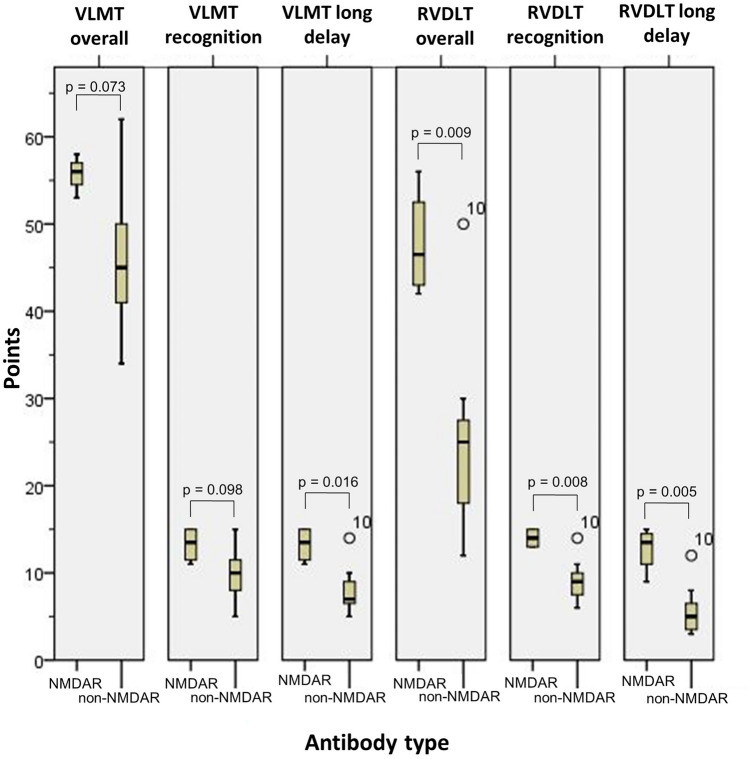
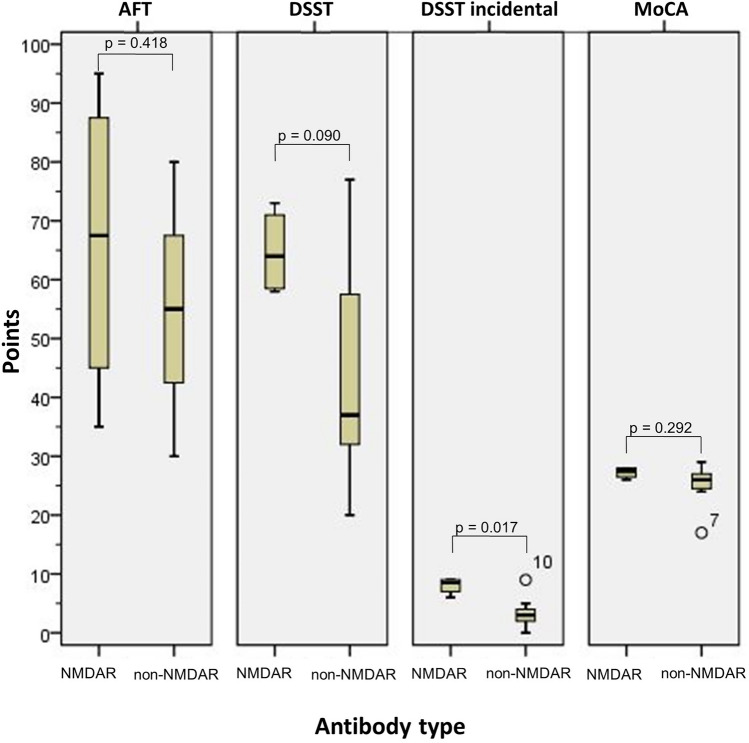
Results: Follow-up (AE vs. PC) was 33 (11-95) vs. 96 (26-132) months after diagnosis. Neurocognitive functions were normal in both AE and PC groups in all tests except face recognition, which was pathological in both groups. The overall/recognition/long-delay visual memory (p = 0.009/0.008/0.005) and incidental learning (p = 0.017) scores were significantly higher in NMDAR patients compared to non-NMDAR patients. Non-NMDAR patients with right-sided limbic MRI pathologies had significantly lower overall/recognition/long-delay visual memory (p = 0.006/0.044/0.024) and incidental learning (p = 0.009) scores compared to NMDAR patients.
Conclusions: We observed mainly normal neurocognitive functions after autoimmune and bacterial encephalitis. However, compared to NMDAR patients, patients with non-NMDAR autoimmune encephalitis showed a significant and material-specific association between a right-sided hippocampal lesion and limitations in figural-mnestic and incidental learning capacities. Neurocognitive functions in AE patients should be further evaluated prospectively and in more detail.
期刊介绍:
The Journal of Neurology is an international peer-reviewed journal which provides a source for publishing original communications and reviews on clinical neurology covering the whole field.
In addition, Letters to the Editors serve as a forum for clinical cases and the exchange of ideas which highlight important new findings. A section on Neurological progress serves to summarise the major findings in certain fields of neurology. Commentaries on new developments in clinical neuroscience, which may be commissioned or submitted, are published as editorials.
Every neurologist interested in the current diagnosis and treatment of neurological disorders needs access to the information contained in this valuable journal.




 京公网安备 11010802042870号
京ICP备2023020795号-1
京公网安备 11010802042870号
京ICP备2023020795号-1

 分享
分享
 求助内容:
求助内容: 应助结果提醒方式:
 扫码关注我们
