{"title":"Stimulus-activated ribonuclease targeting chimeras for tumor microenvironment activated cancer therapy","authors":"Yuqi Zhang, Jinfeng Zhu, Ling Qiu, Zhengzhong Lv, Zhongsheng Zhao, Xingxiang Ren, Yirui Guo, Yan Chen, Miao Li, Yurong Fan, Zhixin Han, Yiming Feng, Haibin Shi","doi":"10.1038/s41467-025-56691-3","DOIUrl":null,"url":null,"abstract":"<p>RNA degradation using ribonuclease targeting chimeras (RiboTACs) is a promising approach for cancer therapy. However, potential off-target degradation is a serious issue. Here, a RiboTAC is designed for tumor microenvironment triggered activation. The tumor microenvironment activated RiboTAC (TaRiboTAC) incorporates two pre-miR-21 binders, a near-infrared fluorophore IR780, an RGD targeting peptide and a phenylboronic acid caged ribonuclease recruiter. The caged ribonuclease recruiter is embedded in the molecule and exposed in acidic pH, the phenylboronic acid cage is removed by H<sub>2</sub>O<sub>2</sub> making the TaRiboTAC responsive to the acidic and high H<sub>2</sub>O<sub>2</sub> levels in the tumor microenvironment. It is shown the TaRiboTAC targets tumor tissue and degrades pre-miR-21. The degradation of pre-miR-21 by TaRiboTACs significantly increases the radiotherapeutic susceptibility of cancer cells achieving efficient suppression of human lung adenocarcinoma A549 tumors in living mice.</p>","PeriodicalId":19066,"journal":{"name":"Nature Communications","volume":"31 3 1","pages":""},"PeriodicalIF":15.7000,"publicationDate":"2025-02-03","publicationTypes":"Journal Article","fieldsOfStudy":null,"isOpenAccess":false,"openAccessPdf":"","citationCount":"0","resultStr":null,"platform":"Semanticscholar","paperid":null,"PeriodicalName":"Nature Communications","FirstCategoryId":"103","ListUrlMain":"https://doi.org/10.1038/s41467-025-56691-3","RegionNum":1,"RegionCategory":"综合性期刊","ArticlePicture":[],"TitleCN":null,"AbstractTextCN":null,"PMCID":null,"EPubDate":"","PubModel":"","JCR":"Q1","JCRName":"MULTIDISCIPLINARY SCIENCES","Score":null,"Total":0}
引用次数: 0
Abstract
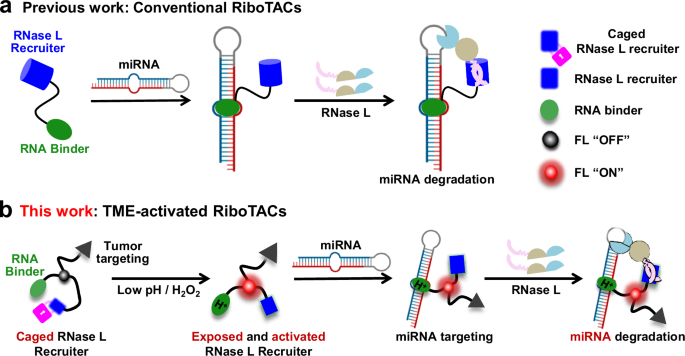
RNA degradation using ribonuclease targeting chimeras (RiboTACs) is a promising approach for cancer therapy. However, potential off-target degradation is a serious issue. Here, a RiboTAC is designed for tumor microenvironment triggered activation. The tumor microenvironment activated RiboTAC (TaRiboTAC) incorporates two pre-miR-21 binders, a near-infrared fluorophore IR780, an RGD targeting peptide and a phenylboronic acid caged ribonuclease recruiter. The caged ribonuclease recruiter is embedded in the molecule and exposed in acidic pH, the phenylboronic acid cage is removed by H2O2 making the TaRiboTAC responsive to the acidic and high H2O2 levels in the tumor microenvironment. It is shown the TaRiboTAC targets tumor tissue and degrades pre-miR-21. The degradation of pre-miR-21 by TaRiboTACs significantly increases the radiotherapeutic susceptibility of cancer cells achieving efficient suppression of human lung adenocarcinoma A549 tumors in living mice.
期刊介绍:
Nature Communications, an open-access journal, publishes high-quality research spanning all areas of the natural sciences. Papers featured in the journal showcase significant advances relevant to specialists in each respective field. With a 2-year impact factor of 16.6 (2022) and a median time of 8 days from submission to the first editorial decision, Nature Communications is committed to rapid dissemination of research findings. As a multidisciplinary journal, it welcomes contributions from biological, health, physical, chemical, Earth, social, mathematical, applied, and engineering sciences, aiming to highlight important breakthroughs within each domain.



 京公网安备 11010802042870号
京ICP备2023020795号-1
京公网安备 11010802042870号
京ICP备2023020795号-1

 分享
分享
 求助内容:
求助内容: 应助结果提醒方式:
 扫码关注我们
