Tianshu Zhang, Pengcheng Zhang, Jie Liu, Lifang Zhang, Yiwei Zheng, Xiaowei Shen, Yijun Qian, Xi Zhou, Jinqiu Zhou, Tao Qian, Chenglin Yan
{"title":"Regulation of Coordination Chemistry To Accelerate Na+ Transfer Kinetics of Polyanionic Cathodes for Ultrastable Sodium-Ion Batteries","authors":"Tianshu Zhang, Pengcheng Zhang, Jie Liu, Lifang Zhang, Yiwei Zheng, Xiaowei Shen, Yijun Qian, Xi Zhou, Jinqiu Zhou, Tao Qian, Chenglin Yan","doi":"10.1021/acs.nanolett.4c04913","DOIUrl":null,"url":null,"abstract":"Alluaudite-type iron-based sulfate structure (Na<sub>2+2<i>x</i></sub>Fe<sub>2–<i>x</i></sub>(SO<sub>4</sub>)<sub>3</sub>) has attracted wide attention due to its high working voltage and low cost. However, their practical application is hindered by challenges such as limited reversible capacity and sluggish transfer kinetics. Herein, we proposed an anion substitution strategy to optimize iron-based sulfate cathode materials. The electrochemical characterization and theoretical calculations confirmed a reduction in the migration barrier of Na<sup>+</sup> ions in various pathways. Besides, fluorine weakened the electron density of the crystal plane, thereby impeding the continuous side reaction of the electrolyte. As expected, the NFSF cathode can exhibit a capacity of 121.5 mAh g<sup>–1</sup> at 12 mA g<sup>–1</sup> and keep a high retention of 78.8% after 1000 cycles at 600 mA g<sup>–1</sup>. In addition, the NFSF-based cathode and hard carbon (HC)-based anode were assembled into a laboratory-scale pouch cell to demonstrate the electrochemical performance and practical applications.","PeriodicalId":53,"journal":{"name":"Nano Letters","volume":"39 1","pages":""},"PeriodicalIF":9.1000,"publicationDate":"2025-02-03","publicationTypes":"Journal Article","fieldsOfStudy":null,"isOpenAccess":false,"openAccessPdf":"","citationCount":"0","resultStr":null,"platform":"Semanticscholar","paperid":null,"PeriodicalName":"Nano Letters","FirstCategoryId":"88","ListUrlMain":"https://doi.org/10.1021/acs.nanolett.4c04913","RegionNum":1,"RegionCategory":"材料科学","ArticlePicture":[],"TitleCN":null,"AbstractTextCN":null,"PMCID":null,"EPubDate":"","PubModel":"","JCR":"Q1","JCRName":"CHEMISTRY, MULTIDISCIPLINARY","Score":null,"Total":0}
引用次数: 0
Abstract
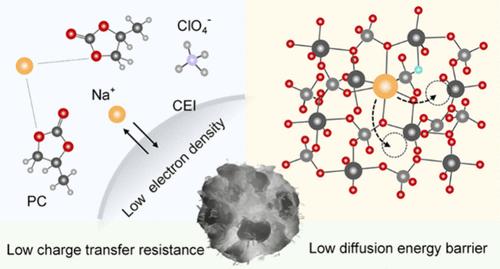
Alluaudite-type iron-based sulfate structure (Na2+2xFe2–x(SO4)3) has attracted wide attention due to its high working voltage and low cost. However, their practical application is hindered by challenges such as limited reversible capacity and sluggish transfer kinetics. Herein, we proposed an anion substitution strategy to optimize iron-based sulfate cathode materials. The electrochemical characterization and theoretical calculations confirmed a reduction in the migration barrier of Na+ ions in various pathways. Besides, fluorine weakened the electron density of the crystal plane, thereby impeding the continuous side reaction of the electrolyte. As expected, the NFSF cathode can exhibit a capacity of 121.5 mAh g–1 at 12 mA g–1 and keep a high retention of 78.8% after 1000 cycles at 600 mA g–1. In addition, the NFSF-based cathode and hard carbon (HC)-based anode were assembled into a laboratory-scale pouch cell to demonstrate the electrochemical performance and practical applications.
冲积型铁基硫酸盐结构(Na2+ 2xFe2-x (SO4)3)因其工作电压高、成本低而受到广泛关注。然而,它们的实际应用受到诸如有限的可逆容量和缓慢的传递动力学等挑战的阻碍。在此,我们提出了一种阴离子取代策略来优化铁基硫酸盐正极材料。电化学表征和理论计算证实了Na+离子在各种途径中的迁移屏障降低。此外,氟削弱了晶体平面的电子密度,从而阻碍了电解质的连续副反应。正如预期的那样,NFSF阴极在12 mA g-1下的容量为121.5 mAh g-1,在600 mA g-1下循环1000次后保持78.8%的高保留率。此外,将nfsf基阴极和硬碳(HC)基阳极组装成实验室规模的袋状电池,以展示其电化学性能和实际应用。
期刊介绍:
Nano Letters serves as a dynamic platform for promptly disseminating original results in fundamental, applied, and emerging research across all facets of nanoscience and nanotechnology. A pivotal criterion for inclusion within Nano Letters is the convergence of at least two different areas or disciplines, ensuring a rich interdisciplinary scope. The journal is dedicated to fostering exploration in diverse areas, including:
- Experimental and theoretical findings on physical, chemical, and biological phenomena at the nanoscale
- Synthesis, characterization, and processing of organic, inorganic, polymer, and hybrid nanomaterials through physical, chemical, and biological methodologies
- Modeling and simulation of synthetic, assembly, and interaction processes
- Realization of integrated nanostructures and nano-engineered devices exhibiting advanced performance
- Applications of nanoscale materials in living and environmental systems
Nano Letters is committed to advancing and showcasing groundbreaking research that intersects various domains, fostering innovation and collaboration in the ever-evolving field of nanoscience and nanotechnology.



 京公网安备 11010802042870号
京ICP备2023020795号-1
京公网安备 11010802042870号
京ICP备2023020795号-1

 分享
分享
 求助内容:
求助内容: 应助结果提醒方式:
 扫码关注我们
