Corrosion Inhibition Effect and Mechanism of Eco-Friendly Corrosion Inhibitors on Mild Steel in Simulated Concrete Pore Solution: Experimental and Theoretical Studies
{"title":"Corrosion Inhibition Effect and Mechanism of Eco-Friendly Corrosion Inhibitors on Mild Steel in Simulated Concrete Pore Solution: Experimental and Theoretical Studies","authors":"Minghui Jiang, Xiao Liu, Yurui Xu, Shiyu Li, Xiangju Liu, Xiaokai Niu, Lei Lu, Xinru Sun, Zhitian Xie, Ziming Wang, Su-ping Cui","doi":"10.1021/acssuschemeng.4c08318","DOIUrl":null,"url":null,"abstract":"Natural biobased materials, which can be obtained from crustacean exoskeletons, angelica sinensis, vanilla beans, amino acids, etc., have significant potential as eco-friendly corrosion inhibitors. In this study, several eco-friendly materials (chitosan (CTS), ferulic acid (FA), cysteine (Cys), and methionine (Met)) were proposed as corrosion inhibitors to improve the corrosion resistance of steel. Their inhibition effects and mechanisms in simulated concrete pore (SCP) solution were evaluated by electrochemical, surface measurements, quantum chemical (QC) calculations, and molecular dynamics (MD) simulations. The results showed that these inhibitors effectively improved the corrosion resistance of steel, especially for CTS (with a maximum inhibition efficiency of 92.6%). The adsorption of these inhibitors followed Langmuir and Freundlich adsorption isotherms, revealing the physical–chemical mixed adsorption modes. Surface characterization techniques revealed that the protective layers formed by these inhibitors could effectively inhibit the corrosion of the steel. QC calculations and MD simulations further confirmed the experimental results. Performance of cement mortar measurements revealed that these four inhibitors exhibited no effect on the workability of fresh mortar and improved the strength of mortar specimens, with a maximum increase in the compressive strength of 11.18%. This study is of great significance to improving the durability of reinforced concrete in the future.","PeriodicalId":25,"journal":{"name":"ACS Sustainable Chemistry & Engineering","volume":"10 1","pages":""},"PeriodicalIF":7.3000,"publicationDate":"2025-02-03","publicationTypes":"Journal Article","fieldsOfStudy":null,"isOpenAccess":false,"openAccessPdf":"","citationCount":"0","resultStr":null,"platform":"Semanticscholar","paperid":null,"PeriodicalName":"ACS Sustainable Chemistry & Engineering","FirstCategoryId":"92","ListUrlMain":"https://doi.org/10.1021/acssuschemeng.4c08318","RegionNum":1,"RegionCategory":"化学","ArticlePicture":[],"TitleCN":null,"AbstractTextCN":null,"PMCID":null,"EPubDate":"","PubModel":"","JCR":"Q1","JCRName":"CHEMISTRY, MULTIDISCIPLINARY","Score":null,"Total":0}
引用次数: 0
Abstract
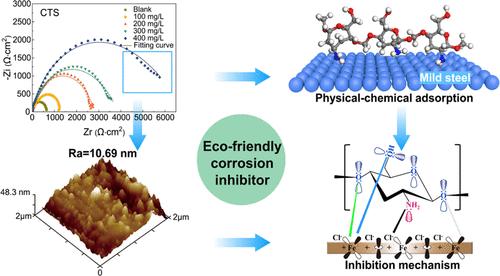
Natural biobased materials, which can be obtained from crustacean exoskeletons, angelica sinensis, vanilla beans, amino acids, etc., have significant potential as eco-friendly corrosion inhibitors. In this study, several eco-friendly materials (chitosan (CTS), ferulic acid (FA), cysteine (Cys), and methionine (Met)) were proposed as corrosion inhibitors to improve the corrosion resistance of steel. Their inhibition effects and mechanisms in simulated concrete pore (SCP) solution were evaluated by electrochemical, surface measurements, quantum chemical (QC) calculations, and molecular dynamics (MD) simulations. The results showed that these inhibitors effectively improved the corrosion resistance of steel, especially for CTS (with a maximum inhibition efficiency of 92.6%). The adsorption of these inhibitors followed Langmuir and Freundlich adsorption isotherms, revealing the physical–chemical mixed adsorption modes. Surface characterization techniques revealed that the protective layers formed by these inhibitors could effectively inhibit the corrosion of the steel. QC calculations and MD simulations further confirmed the experimental results. Performance of cement mortar measurements revealed that these four inhibitors exhibited no effect on the workability of fresh mortar and improved the strength of mortar specimens, with a maximum increase in the compressive strength of 11.18%. This study is of great significance to improving the durability of reinforced concrete in the future.
期刊介绍:
ACS Sustainable Chemistry & Engineering is a prestigious weekly peer-reviewed scientific journal published by the American Chemical Society. Dedicated to advancing the principles of green chemistry and green engineering, it covers a wide array of research topics including green chemistry, green engineering, biomass, alternative energy, and life cycle assessment.
The journal welcomes submissions in various formats, including Letters, Articles, Features, and Perspectives (Reviews), that address the challenges of sustainability in the chemical enterprise and contribute to the advancement of sustainable practices. Join us in shaping the future of sustainable chemistry and engineering.



 京公网安备 11010802042870号
京ICP备2023020795号-1
京公网安备 11010802042870号
京ICP备2023020795号-1

 分享
分享
 求助内容:
求助内容: 应助结果提醒方式:
 扫码关注我们
