{"title":"Recent Advances in Direct Synthesis of 2,5-Furandicarboxylic Acid from Carbohydrates","authors":"Xing-Long Li, Rui Zhu, Hua-Jian Xu","doi":"10.1021/acssuschemeng.4c09659","DOIUrl":null,"url":null,"abstract":"2,5-Furandicarboxylic acid (FDCA), a pivotal oxidation product derived from the biomass platform molecule 5-hydroxymethylfurfural (HMF), has garnered considerable attention for its extensive potential applications across a wide array of industries, including food packaging, electronics, automotive manufacturing, and textiles. Currently, the production of FDCA relies heavily on high-purity HMF, which facilitates excellent product yields. However, the inherent sensitivity of HMF to pH fluctuations and environmental factors such as light, heat, and oxygen posed considerable challenges, as these conditions could readily lead to its degradation. Additionally, the high costs associated with HMF production and purification further complicated the synthesis process. In light of these issues, there is growing research interest and practical value in developing processes that enable the direct synthesis of FDCA from carbohydrates without the need for intermediate purification steps. Nevertheless, the inevitable formation of humins during the reaction process posed substantial obstacles to achieving this goal. This review systematically summarizes recent advances in the direct conversion of carbohydrates, such as fructose, glucose, polysaccharides, and aldaric acids, into FDCA without requiring highly purified intermediates. The review delves into various catalytic systems, elucidating the reaction mechanisms and pathways involving key intermediates such as HMF, 2,5-diformylfuran (DFF), 5-acetoxymethylfurfural (AMF), 5-chloromethylfurfural (CMF), and 5-alkoxymethylfurfural (RMF). Additionally, this review highlights the advantages of these catalytic systems while also considering their optimization potential. Furthermore, the review incorporates sustainability assessments and technical–economic analyses of FDCA production, emphasizing the importance of evaluating both environmental impacts and economic viability. By integrating these analyses, the review aims to identify pathways that not only enhance the efficiency and cost-effectiveness of FDCA production but also align with sustainability goals. Ultimately, this review provides innovative solutions and insights designed to advance highly selective synthetic pathways and develop cost-effective purification methods for FDCA, thereby paving the way for more sustainable and efficient industrial applications. This comprehensive approach ensures that the production processes are not only economically feasible but also environmentally responsible, promoting a shift toward greener industrial practices.","PeriodicalId":25,"journal":{"name":"ACS Sustainable Chemistry & Engineering","volume":"5 1","pages":""},"PeriodicalIF":7.3000,"publicationDate":"2025-02-03","publicationTypes":"Journal Article","fieldsOfStudy":null,"isOpenAccess":false,"openAccessPdf":"","citationCount":"0","resultStr":null,"platform":"Semanticscholar","paperid":null,"PeriodicalName":"ACS Sustainable Chemistry & Engineering","FirstCategoryId":"92","ListUrlMain":"https://doi.org/10.1021/acssuschemeng.4c09659","RegionNum":1,"RegionCategory":"化学","ArticlePicture":[],"TitleCN":null,"AbstractTextCN":null,"PMCID":null,"EPubDate":"","PubModel":"","JCR":"Q1","JCRName":"CHEMISTRY, MULTIDISCIPLINARY","Score":null,"Total":0}
引用次数: 0
Abstract
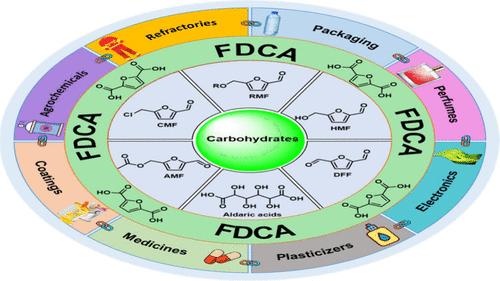
2,5-Furandicarboxylic acid (FDCA), a pivotal oxidation product derived from the biomass platform molecule 5-hydroxymethylfurfural (HMF), has garnered considerable attention for its extensive potential applications across a wide array of industries, including food packaging, electronics, automotive manufacturing, and textiles. Currently, the production of FDCA relies heavily on high-purity HMF, which facilitates excellent product yields. However, the inherent sensitivity of HMF to pH fluctuations and environmental factors such as light, heat, and oxygen posed considerable challenges, as these conditions could readily lead to its degradation. Additionally, the high costs associated with HMF production and purification further complicated the synthesis process. In light of these issues, there is growing research interest and practical value in developing processes that enable the direct synthesis of FDCA from carbohydrates without the need for intermediate purification steps. Nevertheless, the inevitable formation of humins during the reaction process posed substantial obstacles to achieving this goal. This review systematically summarizes recent advances in the direct conversion of carbohydrates, such as fructose, glucose, polysaccharides, and aldaric acids, into FDCA without requiring highly purified intermediates. The review delves into various catalytic systems, elucidating the reaction mechanisms and pathways involving key intermediates such as HMF, 2,5-diformylfuran (DFF), 5-acetoxymethylfurfural (AMF), 5-chloromethylfurfural (CMF), and 5-alkoxymethylfurfural (RMF). Additionally, this review highlights the advantages of these catalytic systems while also considering their optimization potential. Furthermore, the review incorporates sustainability assessments and technical–economic analyses of FDCA production, emphasizing the importance of evaluating both environmental impacts and economic viability. By integrating these analyses, the review aims to identify pathways that not only enhance the efficiency and cost-effectiveness of FDCA production but also align with sustainability goals. Ultimately, this review provides innovative solutions and insights designed to advance highly selective synthetic pathways and develop cost-effective purification methods for FDCA, thereby paving the way for more sustainable and efficient industrial applications. This comprehensive approach ensures that the production processes are not only economically feasible but also environmentally responsible, promoting a shift toward greener industrial practices.
期刊介绍:
ACS Sustainable Chemistry & Engineering is a prestigious weekly peer-reviewed scientific journal published by the American Chemical Society. Dedicated to advancing the principles of green chemistry and green engineering, it covers a wide array of research topics including green chemistry, green engineering, biomass, alternative energy, and life cycle assessment.
The journal welcomes submissions in various formats, including Letters, Articles, Features, and Perspectives (Reviews), that address the challenges of sustainability in the chemical enterprise and contribute to the advancement of sustainable practices. Join us in shaping the future of sustainable chemistry and engineering.



 京公网安备 11010802042870号
京ICP备2023020795号-1
京公网安备 11010802042870号
京ICP备2023020795号-1

 分享
分享
 求助内容:
求助内容: 应助结果提醒方式:
 扫码关注我们
