{"title":"Mechanically Robust 3D Flexible Electrodes via Embedding Conductive Nanomaterials in the Surface of Polymer Networks","authors":"Sangmok Kim, Dongwoo Yoo, Joonwon Kim","doi":"10.1002/smtd.202401839","DOIUrl":null,"url":null,"abstract":"<p>3D flexible electrodes are essential to implement flexible pressure sensors in various flexible electronic applications. Conventional methods for fabricating these electrodes include electroless deposition, spray coating, and incorporating conductive nanomaterials into a polymer matrix. However, the electrodes fabricated using these methods are characterized by poor adhesion between the conductive layer and polymer surface and fail to maintain intrinsic mechanical properties of the polymer, such as elastic modulus and ductility. Herein, a transfer method in which conductive nanomaterials are embedded into the surface of polymer networks via optimal surface energy control is proposed, such as reducing adhesion between the mold and nanomaterials. This method induces mechanical interlocking between the surface of polymer networks and conductive nanomaterials, firmly anchoring them onto the polymer network surface. Moreover, the intrinsic mechanical properties of the fabricated 3D flexible electrodes remain unchanged. Flexible capacitive sensors prepared using the resulting electrodes exhibit a stable sensing performance (ΔC<sub>0,5000</sub>/C<sub>0</sub> = 0.169%) even under repetitive pressure conditions (5000 cycles at 70 kPa). The proposed robust 3D flexible electrode fabrication method presents a promising strategy for the future development of flexible pressure sensors.</p>","PeriodicalId":229,"journal":{"name":"Small Methods","volume":"9 7","pages":""},"PeriodicalIF":9.1000,"publicationDate":"2025-02-02","publicationTypes":"Journal Article","fieldsOfStudy":null,"isOpenAccess":false,"openAccessPdf":"","citationCount":"0","resultStr":null,"platform":"Semanticscholar","paperid":null,"PeriodicalName":"Small Methods","FirstCategoryId":"88","ListUrlMain":"https://onlinelibrary.wiley.com/doi/10.1002/smtd.202401839","RegionNum":2,"RegionCategory":"材料科学","ArticlePicture":[],"TitleCN":null,"AbstractTextCN":null,"PMCID":null,"EPubDate":"","PubModel":"","JCR":"Q1","JCRName":"CHEMISTRY, PHYSICAL","Score":null,"Total":0}
引用次数: 0
Abstract
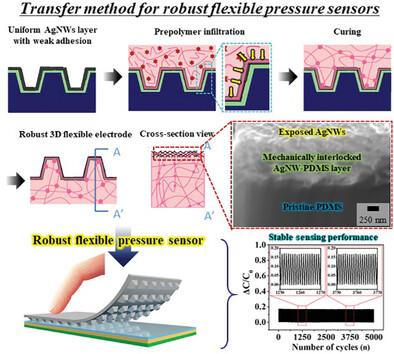
3D flexible electrodes are essential to implement flexible pressure sensors in various flexible electronic applications. Conventional methods for fabricating these electrodes include electroless deposition, spray coating, and incorporating conductive nanomaterials into a polymer matrix. However, the electrodes fabricated using these methods are characterized by poor adhesion between the conductive layer and polymer surface and fail to maintain intrinsic mechanical properties of the polymer, such as elastic modulus and ductility. Herein, a transfer method in which conductive nanomaterials are embedded into the surface of polymer networks via optimal surface energy control is proposed, such as reducing adhesion between the mold and nanomaterials. This method induces mechanical interlocking between the surface of polymer networks and conductive nanomaterials, firmly anchoring them onto the polymer network surface. Moreover, the intrinsic mechanical properties of the fabricated 3D flexible electrodes remain unchanged. Flexible capacitive sensors prepared using the resulting electrodes exhibit a stable sensing performance (ΔC0,5000/C0 = 0.169%) even under repetitive pressure conditions (5000 cycles at 70 kPa). The proposed robust 3D flexible electrode fabrication method presents a promising strategy for the future development of flexible pressure sensors.
Small MethodsMaterials Science-General Materials Science
CiteScore
17.40
自引率
1.60%
发文量
347
期刊介绍:
Small Methods is a multidisciplinary journal that publishes groundbreaking research on methods relevant to nano- and microscale research. It welcomes contributions from the fields of materials science, biomedical science, chemistry, and physics, showcasing the latest advancements in experimental techniques.
With a notable 2022 Impact Factor of 12.4 (Journal Citation Reports, Clarivate Analytics, 2023), Small Methods is recognized for its significant impact on the scientific community.
The online ISSN for Small Methods is 2366-9608.





 京公网安备 11010802042870号
京ICP备2023020795号-1
京公网安备 11010802042870号
京ICP备2023020795号-1

 分享
分享
 求助内容:
求助内容: 应助结果提醒方式:
 扫码关注我们
