Comparison of lifetime attributable risk of post-irradiation secondary cancer of boron neutron capture therapy, proton beam therapy, and X-ray therapy for pediatric and adolescent and young adult patients
{"title":"Comparison of lifetime attributable risk of post-irradiation secondary cancer of boron neutron capture therapy, proton beam therapy, and X-ray therapy for pediatric and adolescent and young adult patients","authors":"Shunsuke Suzuki , Shintaro Shiba , Hiroki Tanaka , Masashi Yamanaka , Kazuki Matsumoto , Koichi Tokuuye , Motoko Omura","doi":"10.1016/j.ctro.2025.100921","DOIUrl":null,"url":null,"abstract":"<div><h3>Background and purpose</h3><div>This study aimed to compare the post-irradiation secondary cancer rates of boron neutron capture therapy (BNCT), proton beam therapy (PBT), and X-ray therapy (XT) in pediatric and Adolescent and Young Adult (AYA) patients with intracranial lesions.</div></div><div><h3>Materials and methods</h3><div>BNCT, PBT, and XT plans were optimized for nine pediatric and AYA patients with intracranial lesions. The BNCT dose calculation results were biologically effective dose converted. Lifetime attributable risk (LAR) was calculated using a calculation model proposed by Schneider <em>et al.</em> Statistical analysis was performed using log-linear model with mixed effects. Organs included in the radiation field were the brain, bones, and soft tissue. The difference in LAR between the three treatments for each organ and the number needed to treat (NNT), as an indicator of the number of cases required to achieve the effect of suppressing the occurrence of secondary cancers, was calculated and evaluated.</div></div><div><h3>Results</h3><div>Statistically significant differences between BNCT vs PBT and XT were confirmed for the brain, bone, soft tissue, and cumulative (P < 0.0001). Significant differences were also observed in PBT and XT, with P < 0.0001 for brain and cumulative, P = 0.0002 for bone, and P = 0.0281 for soft tissue. The cumulative NNT for BNCT vs. PBT, BNCT vs. XT, and PBT vs. XT were 162, 78.6, and 153, respectively.</div></div><div><h3>Conclusion</h3><div>BNCT had a significantly lower LAR compared to PBT and XT. These findings suggest the usefulness of BNCT in pediatric and AYA patients with brain tumors from the perspective of post-irradiation secondary cancer.</div></div>","PeriodicalId":10342,"journal":{"name":"Clinical and Translational Radiation Oncology","volume":"51 ","pages":"Article 100921"},"PeriodicalIF":2.7000,"publicationDate":"2025-03-01","publicationTypes":"Journal Article","fieldsOfStudy":null,"isOpenAccess":false,"openAccessPdf":"https://www.ncbi.nlm.nih.gov/pmc/articles/PMC11786841/pdf/","citationCount":"0","resultStr":null,"platform":"Semanticscholar","paperid":null,"PeriodicalName":"Clinical and Translational Radiation Oncology","FirstCategoryId":"3","ListUrlMain":"https://www.sciencedirect.com/science/article/pii/S2405630825000114","RegionNum":3,"RegionCategory":"医学","ArticlePicture":[],"TitleCN":null,"AbstractTextCN":null,"PMCID":null,"EPubDate":"2025/1/12 0:00:00","PubModel":"Epub","JCR":"Q3","JCRName":"ONCOLOGY","Score":null,"Total":0}
引用次数: 0
Abstract
Background and purpose
This study aimed to compare the post-irradiation secondary cancer rates of boron neutron capture therapy (BNCT), proton beam therapy (PBT), and X-ray therapy (XT) in pediatric and Adolescent and Young Adult (AYA) patients with intracranial lesions.
Materials and methods
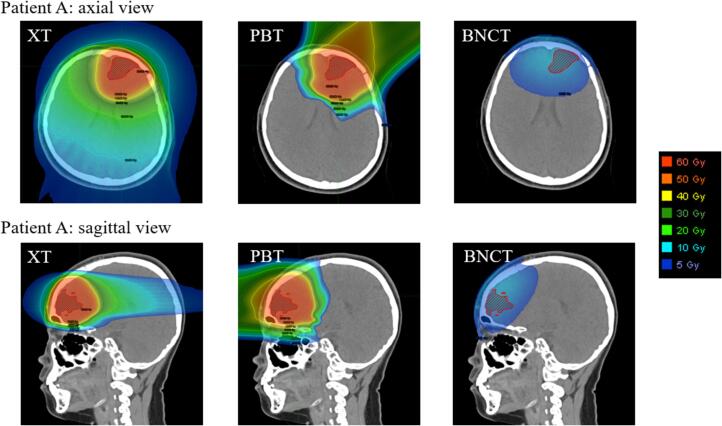
BNCT, PBT, and XT plans were optimized for nine pediatric and AYA patients with intracranial lesions. The BNCT dose calculation results were biologically effective dose converted. Lifetime attributable risk (LAR) was calculated using a calculation model proposed by Schneider et al. Statistical analysis was performed using log-linear model with mixed effects. Organs included in the radiation field were the brain, bones, and soft tissue. The difference in LAR between the three treatments for each organ and the number needed to treat (NNT), as an indicator of the number of cases required to achieve the effect of suppressing the occurrence of secondary cancers, was calculated and evaluated.
Results
Statistically significant differences between BNCT vs PBT and XT were confirmed for the brain, bone, soft tissue, and cumulative (P < 0.0001). Significant differences were also observed in PBT and XT, with P < 0.0001 for brain and cumulative, P = 0.0002 for bone, and P = 0.0281 for soft tissue. The cumulative NNT for BNCT vs. PBT, BNCT vs. XT, and PBT vs. XT were 162, 78.6, and 153, respectively.
Conclusion
BNCT had a significantly lower LAR compared to PBT and XT. These findings suggest the usefulness of BNCT in pediatric and AYA patients with brain tumors from the perspective of post-irradiation secondary cancer.




 京公网安备 11010802042870号
京ICP备2023020795号-1
京公网安备 11010802042870号
京ICP备2023020795号-1

 分享
分享
 求助内容:
求助内容: 应助结果提醒方式:
 扫码关注我们
