Osamah Alsulimani, Salah A Yousief, Raghad A Al-Dabbagh, Esraa A Attar, Dalea M Bukhary, Hamad Algamaiah, Khadija Musawa, Awatif Subahi, Samar H Abuzinadah, Abdulrahman J Alhaddad, Waleed M S Alqahtani, Abdel Naser M Emam, Mohammad A Alqhtani, Ahmed M Elmarakby
{"title":"The Effect of Chewing Simulation on Flexural Strength of Different Lithium Disilicate Ceramics.","authors":"Osamah Alsulimani, Salah A Yousief, Raghad A Al-Dabbagh, Esraa A Attar, Dalea M Bukhary, Hamad Algamaiah, Khadija Musawa, Awatif Subahi, Samar H Abuzinadah, Abdulrahman J Alhaddad, Waleed M S Alqahtani, Abdel Naser M Emam, Mohammad A Alqhtani, Ahmed M Elmarakby","doi":"10.2147/CCIDE.S504292","DOIUrl":null,"url":null,"abstract":"<p><strong>Background: </strong>Improved Lithium Disilicate Ceramic has been highly valued in dentistry for over two decades, owing to its durability and aesthetic qualities, making it a preferred choice for both anterior and posterior crowns.</p><p><strong>Objective: </strong>This study aimed to evaluate the flexural strength of two types of lithium disilicate blocks post-chewing simulation.</p><p><strong>Materials and methods: </strong>Seventy-six lithium disilicate specimens were utilized in this study. They were divided into two primary groups (n=38) based on two brands: IPS Emax CAD LT (Ivoclar Vivadent) designated as (E), and Initial Lisi LT/B1 (GC America) designated as (L). Each primary group was further split into two subgroups (n=19) based on surface treatment: group E into (E0 & E1) and group L into (L0 & L1). Half of the specimens were subjected to flexural testing without chewing simulation cycles and designated as (E0 and L0), while the remainder were tested after 24×10<sup>4</sup> cycles of chewing simulation and designated as (E1 and L1). The ceramic surfaces were examined using SEM before and after loading.</p><p><strong>Statistical analysis: </strong>Data were gathered, organized, and subjected to Shapiro-Wilk's and Levene's tests (p-value < 0.05), followed by analysis with Brown-Forsythe two-way ANOVA and Tamhane's post hoc tests to assess group differences (p-value <0.05).</p><p><strong>Results: </strong>There were significant statistical differences in the flexural strength values between the different brand groups before and after chewing simulation (p-value < 0.05). The IPS Emax CAD group showed values approximately twice that of the Initial Lisi group (307.2-310.5 MPa ± 48.5-67 vs 148.1-158.5 MPa ± 24.6-25.6).</p><p><strong>Conclusion: </strong>Within the limitation of the current study, the following may be concluded: 1. The study's findings suggest that Initial Lisi blocks should not be used for posterior teeth restorations. 2. This study can provide valuable insights for dental professionals to make informed decisions about which material is most appropriate for various clinical situations.</p>","PeriodicalId":10445,"journal":{"name":"Clinical, Cosmetic and Investigational Dentistry","volume":"17 ","pages":"67-76"},"PeriodicalIF":1.8000,"publicationDate":"2025-01-28","publicationTypes":"Journal Article","fieldsOfStudy":null,"isOpenAccess":false,"openAccessPdf":"https://www.ncbi.nlm.nih.gov/pmc/articles/PMC11786796/pdf/","citationCount":"0","resultStr":null,"platform":"Semanticscholar","paperid":null,"PeriodicalName":"Clinical, Cosmetic and Investigational Dentistry","FirstCategoryId":"1085","ListUrlMain":"https://doi.org/10.2147/CCIDE.S504292","RegionNum":0,"RegionCategory":null,"ArticlePicture":[],"TitleCN":null,"AbstractTextCN":null,"PMCID":null,"EPubDate":"2025/1/1 0:00:00","PubModel":"eCollection","JCR":"Q3","JCRName":"DENTISTRY, ORAL SURGERY & MEDICINE","Score":null,"Total":0}
引用次数: 0
Abstract
Background: Improved Lithium Disilicate Ceramic has been highly valued in dentistry for over two decades, owing to its durability and aesthetic qualities, making it a preferred choice for both anterior and posterior crowns.
Objective: This study aimed to evaluate the flexural strength of two types of lithium disilicate blocks post-chewing simulation.
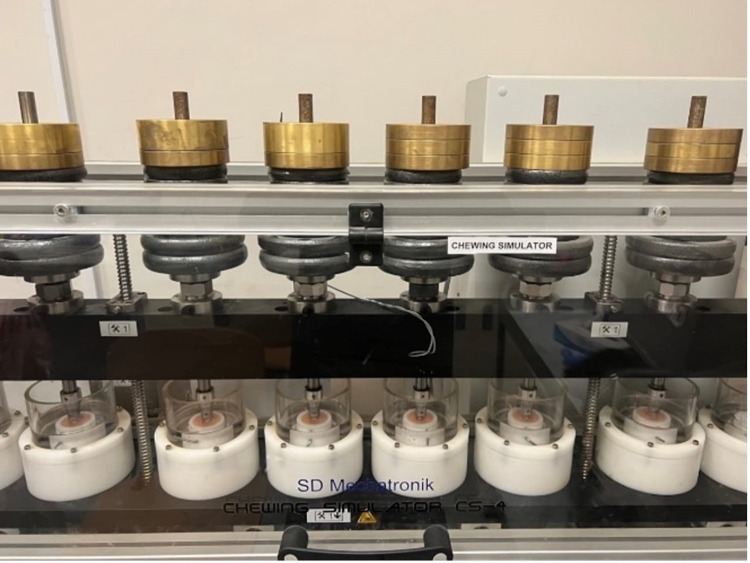
Materials and methods: Seventy-six lithium disilicate specimens were utilized in this study. They were divided into two primary groups (n=38) based on two brands: IPS Emax CAD LT (Ivoclar Vivadent) designated as (E), and Initial Lisi LT/B1 (GC America) designated as (L). Each primary group was further split into two subgroups (n=19) based on surface treatment: group E into (E0 & E1) and group L into (L0 & L1). Half of the specimens were subjected to flexural testing without chewing simulation cycles and designated as (E0 and L0), while the remainder were tested after 24×104 cycles of chewing simulation and designated as (E1 and L1). The ceramic surfaces were examined using SEM before and after loading.
Statistical analysis: Data were gathered, organized, and subjected to Shapiro-Wilk's and Levene's tests (p-value < 0.05), followed by analysis with Brown-Forsythe two-way ANOVA and Tamhane's post hoc tests to assess group differences (p-value <0.05).
Results: There were significant statistical differences in the flexural strength values between the different brand groups before and after chewing simulation (p-value < 0.05). The IPS Emax CAD group showed values approximately twice that of the Initial Lisi group (307.2-310.5 MPa ± 48.5-67 vs 148.1-158.5 MPa ± 24.6-25.6).
Conclusion: Within the limitation of the current study, the following may be concluded: 1. The study's findings suggest that Initial Lisi blocks should not be used for posterior teeth restorations. 2. This study can provide valuable insights for dental professionals to make informed decisions about which material is most appropriate for various clinical situations.






 京公网安备 11010802042870号
京ICP备2023020795号-1
京公网安备 11010802042870号
京ICP备2023020795号-1

 分享
分享
 求助内容:
求助内容: 应助结果提醒方式:
 扫码关注我们
