Vikas Gaur, Gaurav Maggu, Khushboo Bairwa, Suprakash Chaudhury, Sana Dhamija, Tahoora Ali
{"title":"Artificial intelligence in suicide prevention: Utilizing deep learning approach for early detection.","authors":"Vikas Gaur, Gaurav Maggu, Khushboo Bairwa, Suprakash Chaudhury, Sana Dhamija, Tahoora Ali","doi":"10.4103/ipj.ipj_20_24","DOIUrl":null,"url":null,"abstract":"<p><strong>Background: </strong>Suicide among students is increasing in India and is a matter of grave concern. Early identification of students contemplating suicide would facilitate emergency intervention and may save precious lives.</p><p><strong>Aim: </strong>Our primary objective was to construct an artificial intelligence (AI) model employing an artificial neural network (ANN) architecture to predict students at risk of suicidal tendencies. This initiative was prompted by the necessity to implement a proactive and technologically driven strategy for identifying competitive exam-bound students facing heightened vulnerability. The aim was to facilitate timely interventions aimed at reducing the risk of self-harm.</p><p><strong>Materials and methods: </strong>An AI model utilizing ANNs is devised for suicide risk prediction among exam-stressed students. A 33-feature input layer is curated based on literature and expert insights, with binary features assigned weighted values. A rigorous hyperparameter optimization approach using the Optuna library to select the most effective neural network model. Ridge regression was used to determine bias or variance in the dataset. Training and testing of the model are conducted using fictional and simulated profiles, respectively, and model performance is assessed through statistical metrics and the Cohen's Kappa coefficient, benchmarked against expert evaluations.</p><p><strong>Result: </strong>The AI model demonstrates exceptional predictive capabilities for suicide risk assessment among competitive exam students. Quantitative Metrics: The model's accuracy of 98% aligns predictions with outcomes, distinguishing risk categories. Precision at 100% identifies cases within predicted risks, minimizing false positives. A recall of 97% identifies true risk cases, highlighting sensitivity. F1 Score: The model's F1 score of 98% balances precision and recall, indicating overall performance. Cohen's Kappa: With a coefficient of 1.00, the model's substantial agreement with experts underscores its consistent classifications.</p><p><strong>Conclusion: </strong>The study introduces an AI model utilizing ANNs for suicide risk prediction among stressed students. High precision, recall, and accuracy align with expert evaluations, highlighting its promise for timely risk identification. The model's efficiency in evaluating large populations swiftly indicates its clinical potential. Refinement and real-world validation remain future considerations.</p>","PeriodicalId":13534,"journal":{"name":"Industrial Psychiatry Journal","volume":"33 2","pages":"226-233"},"PeriodicalIF":0.0000,"publicationDate":"2024-07-01","publicationTypes":"Journal Article","fieldsOfStudy":null,"isOpenAccess":false,"openAccessPdf":"https://www.ncbi.nlm.nih.gov/pmc/articles/PMC11784676/pdf/","citationCount":"0","resultStr":null,"platform":"Semanticscholar","paperid":null,"PeriodicalName":"Industrial Psychiatry Journal","FirstCategoryId":"1085","ListUrlMain":"https://doi.org/10.4103/ipj.ipj_20_24","RegionNum":0,"RegionCategory":null,"ArticlePicture":[],"TitleCN":null,"AbstractTextCN":null,"PMCID":null,"EPubDate":"2024/10/29 0:00:00","PubModel":"Epub","JCR":"","JCRName":"","Score":null,"Total":0}
引用次数: 0
Abstract
Background: Suicide among students is increasing in India and is a matter of grave concern. Early identification of students contemplating suicide would facilitate emergency intervention and may save precious lives.
Aim: Our primary objective was to construct an artificial intelligence (AI) model employing an artificial neural network (ANN) architecture to predict students at risk of suicidal tendencies. This initiative was prompted by the necessity to implement a proactive and technologically driven strategy for identifying competitive exam-bound students facing heightened vulnerability. The aim was to facilitate timely interventions aimed at reducing the risk of self-harm.
Materials and methods: An AI model utilizing ANNs is devised for suicide risk prediction among exam-stressed students. A 33-feature input layer is curated based on literature and expert insights, with binary features assigned weighted values. A rigorous hyperparameter optimization approach using the Optuna library to select the most effective neural network model. Ridge regression was used to determine bias or variance in the dataset. Training and testing of the model are conducted using fictional and simulated profiles, respectively, and model performance is assessed through statistical metrics and the Cohen's Kappa coefficient, benchmarked against expert evaluations.
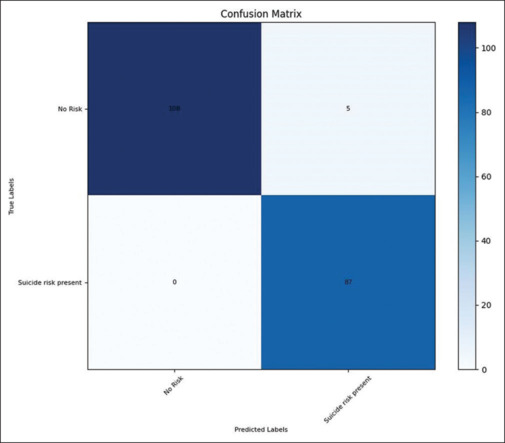
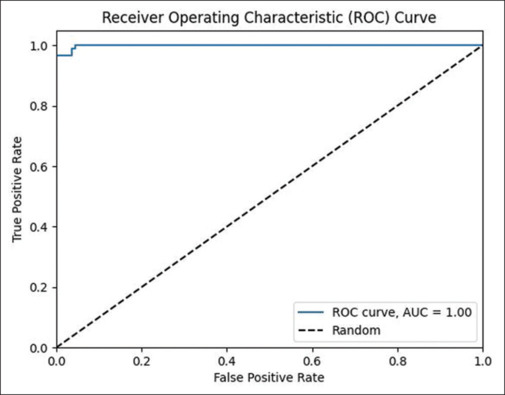
Result: The AI model demonstrates exceptional predictive capabilities for suicide risk assessment among competitive exam students. Quantitative Metrics: The model's accuracy of 98% aligns predictions with outcomes, distinguishing risk categories. Precision at 100% identifies cases within predicted risks, minimizing false positives. A recall of 97% identifies true risk cases, highlighting sensitivity. F1 Score: The model's F1 score of 98% balances precision and recall, indicating overall performance. Cohen's Kappa: With a coefficient of 1.00, the model's substantial agreement with experts underscores its consistent classifications.
Conclusion: The study introduces an AI model utilizing ANNs for suicide risk prediction among stressed students. High precision, recall, and accuracy align with expert evaluations, highlighting its promise for timely risk identification. The model's efficiency in evaluating large populations swiftly indicates its clinical potential. Refinement and real-world validation remain future considerations.




 京公网安备 11010802042870号
京ICP备2023020795号-1
京公网安备 11010802042870号
京ICP备2023020795号-1

 分享
分享

 求助内容:
求助内容: 应助结果提醒方式:
 扫码关注我们
