{"title":"Computerized cognitive retraining (ReadON.ai) among children diagnosed with attention deficit hyperactivity disorder.","authors":"Jagriti Grover, Sampurna Chakraborty, Rushi, Sonia Puar","doi":"10.4103/ipj.ipj_259_24","DOIUrl":null,"url":null,"abstract":"<p><strong>Background: </strong>ADHD affects 8% of children and adolescents globally, marked by significant deficits in cognitive abilities, which leads to various emotional, behavioral, and adjustment issues. Traditional methods like medication and behavior therapy fall short in managing ADHD's cognitive domains, urging the adoption of innovative approaches like cognitive training programs specifically adopting the emerging technology such as ReadON.ai. However, the precise influence of computerized cognitive retraining on ADHD remains understudied.</p><p><strong>Aim: </strong>To study the feasibility of computerized cognitive retraining (ReadON.ai) in enhancing cognitive abilities in children diagnosed with attention deficit hyperactivity disorder.</p><p><strong>Materials and methods: </strong>The study employs a pre- and post-intervention design including six participants (7-11 years), diagnosed with ADHD according to DSM-5 criteria. Each participant underwent 30 hours of computerized cognitive retraining (ReadON.ai) over ten weeks, targeting attention and concentration, working memory, memory and learning, perceptual abilities, and reasoning skills. Assessments before and after intervention included tools like Conners' 4<sup>TM</sup> Parent version and ReadON.ai CSA. Statistical analysis was conducted using IBM SPSS version 28.</p><p><strong>Results: </strong>Paired <i>t</i>-test results revealed a significant difference in pre-test and post-test means of attention and concentration (t = -6.873, <i>P</i> < 0.001), working memory (t = -5.771, <i>P</i> < 0.001), learning and memory (t = -12.491, <i>P</i> < 0.001), perception (t = 14.398, <i>P</i> < 0.004), reasoning (t = -3.464, <i>P</i> < 0.018), hyperactivity (t = 11.073, <i>P</i> < 0.001), impulsivity (t = 11.948, <i>P</i> < 0.001), emotional dysregulation (t = 8.242, <i>P</i> < 0.001), anxious thoughts (t = 2.67 <i>P</i> = 0.219), depressed mood (t = 2.924, <i>P</i> = 0.020), school work (t = 7.387, <i>P</i> = 0.001) and peer interaction (t = 4.632, <i>P</i> = 0.006) with medium to large effect size.</p><p><strong>Conclusion: </strong>Computerized cognitive retraining through ReadON.ai is feasible in enhancing cognitive abilities like attention and concentration, working memory, memory and learning, perception, and reasoning among children with ADHD.</p>","PeriodicalId":13534,"journal":{"name":"Industrial Psychiatry Journal","volume":"33 2","pages":"346-353"},"PeriodicalIF":0.0000,"publicationDate":"2024-07-01","publicationTypes":"Journal Article","fieldsOfStudy":null,"isOpenAccess":false,"openAccessPdf":"https://www.ncbi.nlm.nih.gov/pmc/articles/PMC11784689/pdf/","citationCount":"0","resultStr":null,"platform":"Semanticscholar","paperid":null,"PeriodicalName":"Industrial Psychiatry Journal","FirstCategoryId":"1085","ListUrlMain":"https://doi.org/10.4103/ipj.ipj_259_24","RegionNum":0,"RegionCategory":null,"ArticlePicture":[],"TitleCN":null,"AbstractTextCN":null,"PMCID":null,"EPubDate":"2024/12/17 0:00:00","PubModel":"Epub","JCR":"","JCRName":"","Score":null,"Total":0}
引用次数: 0
Abstract
Background: ADHD affects 8% of children and adolescents globally, marked by significant deficits in cognitive abilities, which leads to various emotional, behavioral, and adjustment issues. Traditional methods like medication and behavior therapy fall short in managing ADHD's cognitive domains, urging the adoption of innovative approaches like cognitive training programs specifically adopting the emerging technology such as ReadON.ai. However, the precise influence of computerized cognitive retraining on ADHD remains understudied.
Aim: To study the feasibility of computerized cognitive retraining (ReadON.ai) in enhancing cognitive abilities in children diagnosed with attention deficit hyperactivity disorder.
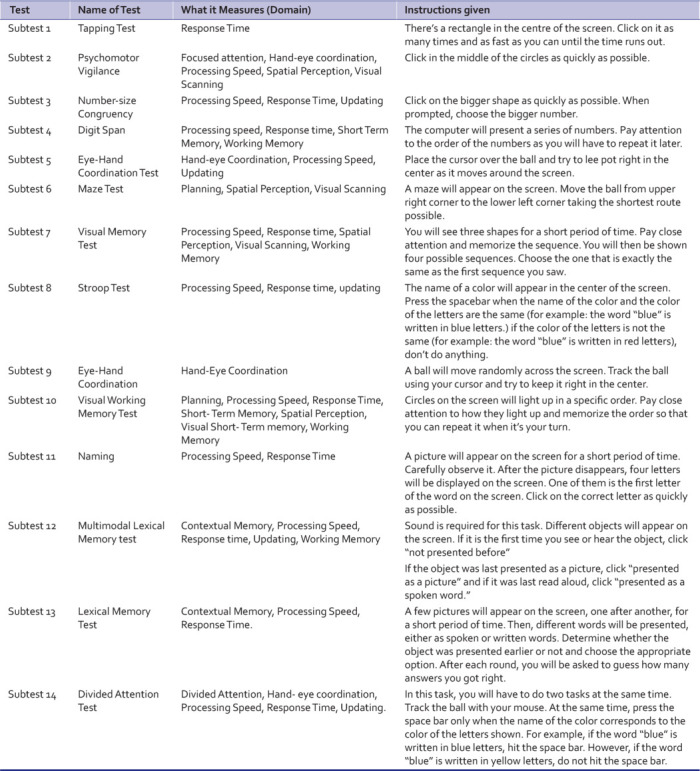
Materials and methods: The study employs a pre- and post-intervention design including six participants (7-11 years), diagnosed with ADHD according to DSM-5 criteria. Each participant underwent 30 hours of computerized cognitive retraining (ReadON.ai) over ten weeks, targeting attention and concentration, working memory, memory and learning, perceptual abilities, and reasoning skills. Assessments before and after intervention included tools like Conners' 4TM Parent version and ReadON.ai CSA. Statistical analysis was conducted using IBM SPSS version 28.
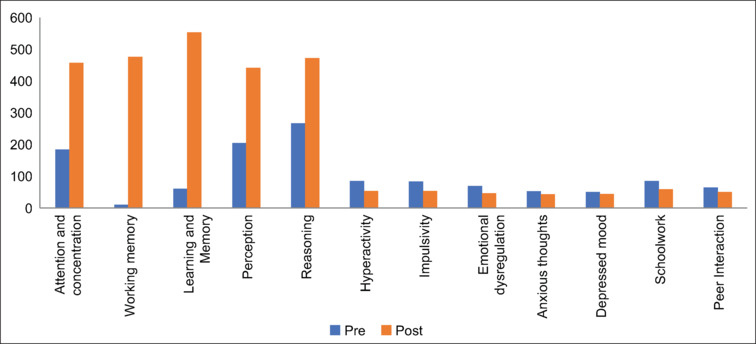
Results: Paired t-test results revealed a significant difference in pre-test and post-test means of attention and concentration (t = -6.873, P < 0.001), working memory (t = -5.771, P < 0.001), learning and memory (t = -12.491, P < 0.001), perception (t = 14.398, P < 0.004), reasoning (t = -3.464, P < 0.018), hyperactivity (t = 11.073, P < 0.001), impulsivity (t = 11.948, P < 0.001), emotional dysregulation (t = 8.242, P < 0.001), anxious thoughts (t = 2.67 P = 0.219), depressed mood (t = 2.924, P = 0.020), school work (t = 7.387, P = 0.001) and peer interaction (t = 4.632, P = 0.006) with medium to large effect size.
Conclusion: Computerized cognitive retraining through ReadON.ai is feasible in enhancing cognitive abilities like attention and concentration, working memory, memory and learning, perception, and reasoning among children with ADHD.




 京公网安备 11010802042870号
京ICP备2023020795号-1
京公网安备 11010802042870号
京ICP备2023020795号-1

 分享
分享

 求助内容:
求助内容: 应助结果提醒方式:
 扫码关注我们
