Javad Roodgar-Saffari, Vajiheh Zarrinpour, Mohammad Mahdi Forghanifard
{"title":"SiRNA-mediated Silencing of the RPS19 Gene Induces Apoptosis and Inhibits Cell Cycle Progression in Chronic Myeloid Leukemia Cells.","authors":"Javad Roodgar-Saffari, Vajiheh Zarrinpour, Mohammad Mahdi Forghanifard","doi":"10.22088/IJMCM.BUMS.13.4.436","DOIUrl":null,"url":null,"abstract":"<p><p>This research delves into the therapeutic implications of utilizing small interfering RNA (siRNA) to target the ribosomal protein S19 (RPS19) gene in chronic myeloid leukemia (CML) using the K562 cell line model. The primary objective was to investigate how gene silencing affects apoptosis promotion and cell cycle arrest. The study employed bioinformatics tools and databases to explore the interactions involving RPS19 and neighboring proteins. Subsequently, siRNA-mediated gene silencing was utilized to suppress RPS19 expression in K-562 cells, with assessments conducted on cell cycle progression and apoptosis through flow cytometry analysis. Furthermore, real-time PCR was employed to evaluate the expression levels of RPS19, along with the closely associated RPS16 and RPS18 genes. Silencing the RPS19 gene in siRNA-transfected K-562 cells led to an increase in apoptotic cells by over 20%, with a significant accumulation in the sub-G1 and G1 phases. Additionally, the knockdown of RPS19 resulted in a 75% decrease in RPS16 expression and a 50% decrease in RPS18 expression. These results demonstrate the therapeutic potential of targeting RPS19 in CML cells, suggesting a promising approach for precise treatment strategies in leukemia and potentially other types of cancer.</p>","PeriodicalId":14152,"journal":{"name":"International Journal of Molecular and Cellular Medicine","volume":"13 4","pages":"436-447"},"PeriodicalIF":0.8000,"publicationDate":"2024-01-01","publicationTypes":"Journal Article","fieldsOfStudy":null,"isOpenAccess":false,"openAccessPdf":"https://www.ncbi.nlm.nih.gov/pmc/articles/PMC11786124/pdf/","citationCount":"0","resultStr":null,"platform":"Semanticscholar","paperid":null,"PeriodicalName":"International Journal of Molecular and Cellular Medicine","FirstCategoryId":"1085","ListUrlMain":"https://doi.org/10.22088/IJMCM.BUMS.13.4.436","RegionNum":0,"RegionCategory":null,"ArticlePicture":[],"TitleCN":null,"AbstractTextCN":null,"PMCID":null,"EPubDate":"","PubModel":"","JCR":"Q3","JCRName":"MEDICINE, RESEARCH & EXPERIMENTAL","Score":null,"Total":0}
引用次数: 0
Abstract
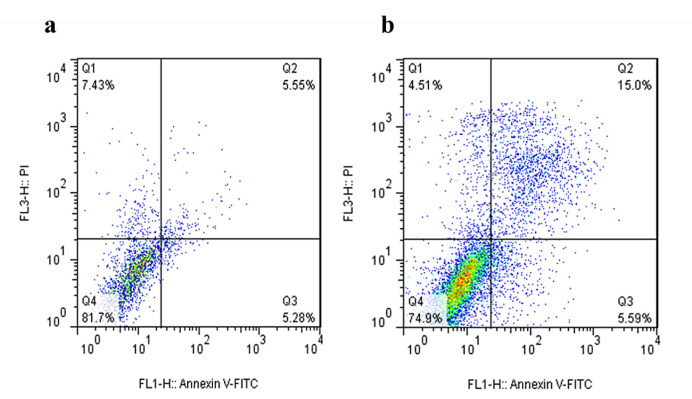
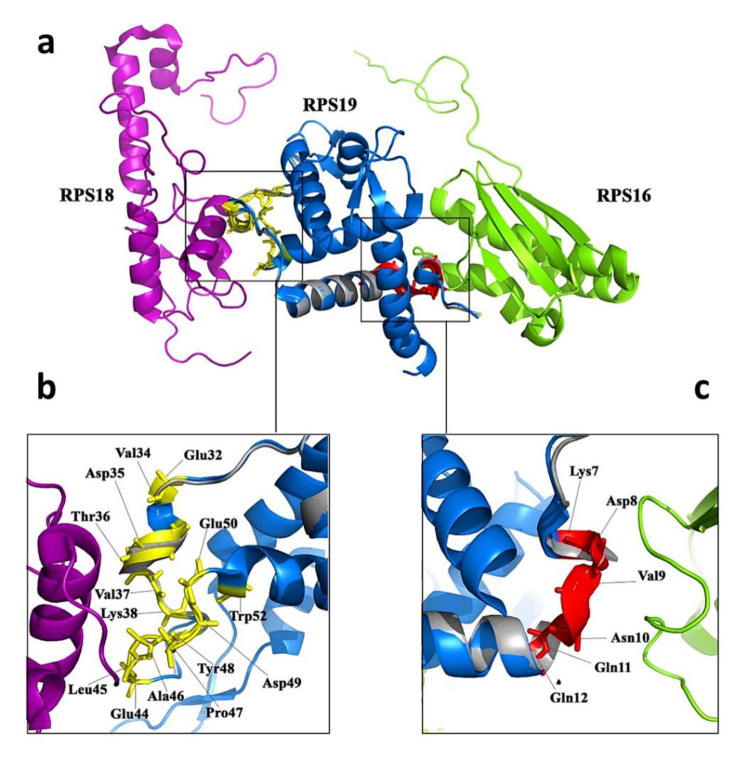
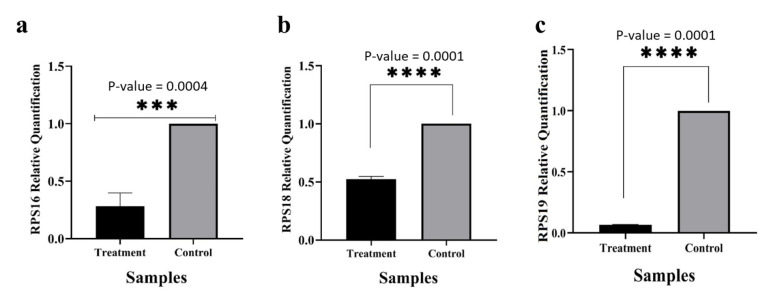
This research delves into the therapeutic implications of utilizing small interfering RNA (siRNA) to target the ribosomal protein S19 (RPS19) gene in chronic myeloid leukemia (CML) using the K562 cell line model. The primary objective was to investigate how gene silencing affects apoptosis promotion and cell cycle arrest. The study employed bioinformatics tools and databases to explore the interactions involving RPS19 and neighboring proteins. Subsequently, siRNA-mediated gene silencing was utilized to suppress RPS19 expression in K-562 cells, with assessments conducted on cell cycle progression and apoptosis through flow cytometry analysis. Furthermore, real-time PCR was employed to evaluate the expression levels of RPS19, along with the closely associated RPS16 and RPS18 genes. Silencing the RPS19 gene in siRNA-transfected K-562 cells led to an increase in apoptotic cells by over 20%, with a significant accumulation in the sub-G1 and G1 phases. Additionally, the knockdown of RPS19 resulted in a 75% decrease in RPS16 expression and a 50% decrease in RPS18 expression. These results demonstrate the therapeutic potential of targeting RPS19 in CML cells, suggesting a promising approach for precise treatment strategies in leukemia and potentially other types of cancer.
期刊介绍:
The International Journal of Molecular and Cellular Medicine (IJMCM) is a peer-reviewed, quarterly publication of Cellular and Molecular Biology Research Center (CMBRC), Babol University of Medical Sciences, Babol, Iran. The journal covers all cellular & molecular biology and medicine disciplines such as the genetic basis of disease, biomarker discovery in diagnosis and treatment, genomics and proteomics, bioinformatics, computer applications in human biology, stem cells and tissue engineering, medical biotechnology, nanomedicine, cellular processes related to growth, death and survival, clinical biochemistry, molecular & cellular immunology, molecular and cellular aspects of infectious disease and cancer research. IJMCM is a free access journal. All open access articles published in IJMCM are distributed under the terms of the Creative Commons Attribution CC BY. The journal doesn''t have any submission and article processing charges (APCs).




 京公网安备 11010802042870号
京ICP备2023020795号-1
京公网安备 11010802042870号
京ICP备2023020795号-1

 分享
分享
 求助内容:
求助内容: 应助结果提醒方式:
 扫码关注我们
