Jie Song , Aihemaitijiang Yusufu , Jiayu Sun , Hongyu Zhou , Hui Chen , Dun Liu , Qiyue Zhang , Li Li
{"title":"Dynamic changes of excitatory and inhibitory synapses in layer II/III of the primary motor cortex after peripheral nerve repair","authors":"Jie Song , Aihemaitijiang Yusufu , Jiayu Sun , Hongyu Zhou , Hui Chen , Dun Liu , Qiyue Zhang , Li Li","doi":"10.1016/j.neuroscience.2025.01.059","DOIUrl":null,"url":null,"abstract":"<div><div>Peripheral nerve injury disrupts communication between the primary motor cortex (M1) and the target muscle, leading to alterations in synaptic plasticity within the lesion projection zone (LPZ). While nerve repair holds the potential to restore this pathway and further modulate synaptic plasticity within the LPZ, the underlying mechanisms remain incompletely understood. In this study, 42 adult male Sprague Dawley rats underwent immediate repair following unilateral median nerve transection and categorized the functional recovery of the affected limb into three phases: the injury phase, recovery phase, and rehabilitation phase, corresponding to stages of muscle non-reinnervation, gradual reinnervation, and completed reinnervation, respectively. Another 12 rats were used as the control group. Our findings revealed that during these phases, excitatory synaptic transmission in M1 layer II/III pyramidal neurons initially decreases, then increases, and ultimately returns to baseline levels. Conversely, inhibitory synaptic transmission initially increases, then decreases, and remains reduced even after full peripheral recovery, accompanied by upregulation of inhibitory synaptic receptors. These findings suggest that excitatory and inhibitory synaptic plasticity play opposing roles in the nerve repair process, with excitatory plasticity primarily involved in short-term responses and inhibitory plasticity contributing to both short-term and long-term modulation.</div></div>","PeriodicalId":19142,"journal":{"name":"Neuroscience","volume":"572 ","pages":"Pages 204-213"},"PeriodicalIF":2.8000,"publicationDate":"2025-04-19","publicationTypes":"Journal Article","fieldsOfStudy":null,"isOpenAccess":false,"openAccessPdf":"","citationCount":"0","resultStr":null,"platform":"Semanticscholar","paperid":null,"PeriodicalName":"Neuroscience","FirstCategoryId":"3","ListUrlMain":"https://www.sciencedirect.com/science/article/pii/S0306452225000752","RegionNum":3,"RegionCategory":"医学","ArticlePicture":[],"TitleCN":null,"AbstractTextCN":null,"PMCID":null,"EPubDate":"2025/1/31 0:00:00","PubModel":"Epub","JCR":"Q2","JCRName":"NEUROSCIENCES","Score":null,"Total":0}
引用次数: 0
Abstract
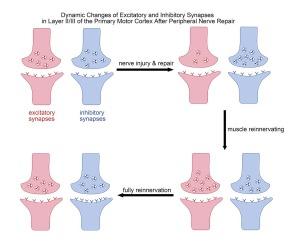
Peripheral nerve injury disrupts communication between the primary motor cortex (M1) and the target muscle, leading to alterations in synaptic plasticity within the lesion projection zone (LPZ). While nerve repair holds the potential to restore this pathway and further modulate synaptic plasticity within the LPZ, the underlying mechanisms remain incompletely understood. In this study, 42 adult male Sprague Dawley rats underwent immediate repair following unilateral median nerve transection and categorized the functional recovery of the affected limb into three phases: the injury phase, recovery phase, and rehabilitation phase, corresponding to stages of muscle non-reinnervation, gradual reinnervation, and completed reinnervation, respectively. Another 12 rats were used as the control group. Our findings revealed that during these phases, excitatory synaptic transmission in M1 layer II/III pyramidal neurons initially decreases, then increases, and ultimately returns to baseline levels. Conversely, inhibitory synaptic transmission initially increases, then decreases, and remains reduced even after full peripheral recovery, accompanied by upregulation of inhibitory synaptic receptors. These findings suggest that excitatory and inhibitory synaptic plasticity play opposing roles in the nerve repair process, with excitatory plasticity primarily involved in short-term responses and inhibitory plasticity contributing to both short-term and long-term modulation.
期刊介绍:
Neuroscience publishes papers describing the results of original research on any aspect of the scientific study of the nervous system. Any paper, however short, will be considered for publication provided that it reports significant, new and carefully confirmed findings with full experimental details.



 京公网安备 11010802042870号
京ICP备2023020795号-1
京公网安备 11010802042870号
京ICP备2023020795号-1

 分享
分享
 求助内容:
求助内容: 应助结果提醒方式:
 扫码关注我们
