Changho Han, Yun Jung Jung, Ji Eun Park, Wou Young Chung, Dukyong Yoon
{"title":"Artificial Intelligence-Based Early Prediction of Acute Respiratory Failure in the Emergency Department Using Biosignal and Clinical Data.","authors":"Changho Han, Yun Jung Jung, Ji Eun Park, Wou Young Chung, Dukyong Yoon","doi":"10.3349/ymj.2024.0126","DOIUrl":null,"url":null,"abstract":"<p><strong>Purpose: </strong>Early identification of patients at risk for acute respiratory failure (ARF) could help clinicians devise preventive strategies. Analyzing biosignals with artificial intelligence (AI) can uncover hidden information and variability within time series. We aimed to develop and validate AI models to predict ARF within 72 h after emergency department admission, primarily using high-resolution biosignals collected within 4 h of arrival.</p><p><strong>Materials and methods: </strong>Our AI model, built on convolutional recurrent neural networks, combines biosignal feature extraction and sequence modeling. The model was developed and internally validated with data from 5284 admissions [1085 (20.5%) positive for ARF], and externally validated using data from 144 admissions [7 (4.9%) positive for ARF] from another institution. We defined ARF as the application of advanced respiratory support devices.</p><p><strong>Results: </strong>Our AI model performed well in predicting ARF, achieving area under the receiver operating characteristic curve (AUROC) of 0.840 and 0.743 in internal and external validations, respectively. It outperformed the Modified Early Warning Score (MEWS) and XGBoost models built only with clinical variables. High predictive ability for mortality was observed, with AUROC up to 0.809. A 10% increase in AI prediction scores was associated with 1.44-fold and 1.42-fold increases in ARF risk and mortality risk, respectively, even after adjusting for MEWS and demographic variables.</p><p><strong>Conclusion: </strong>Our AI model demonstrates high predictive accuracy and significant associations with clinical outcomes. Our AI model has the potential to promptly aid in triage decisions. Our study shows that using AI to analyze biosignals advances disease detection and prediction.</p>","PeriodicalId":23765,"journal":{"name":"Yonsei Medical Journal","volume":"66 2","pages":"121-130"},"PeriodicalIF":2.8000,"publicationDate":"2025-02-01","publicationTypes":"Journal Article","fieldsOfStudy":null,"isOpenAccess":false,"openAccessPdf":"https://www.ncbi.nlm.nih.gov/pmc/articles/PMC11790410/pdf/","citationCount":"0","resultStr":null,"platform":"Semanticscholar","paperid":null,"PeriodicalName":"Yonsei Medical Journal","FirstCategoryId":"3","ListUrlMain":"https://doi.org/10.3349/ymj.2024.0126","RegionNum":4,"RegionCategory":"医学","ArticlePicture":[],"TitleCN":null,"AbstractTextCN":null,"PMCID":null,"EPubDate":"","PubModel":"","JCR":"Q1","JCRName":"MEDICINE, GENERAL & INTERNAL","Score":null,"Total":0}
引用次数: 0
Abstract
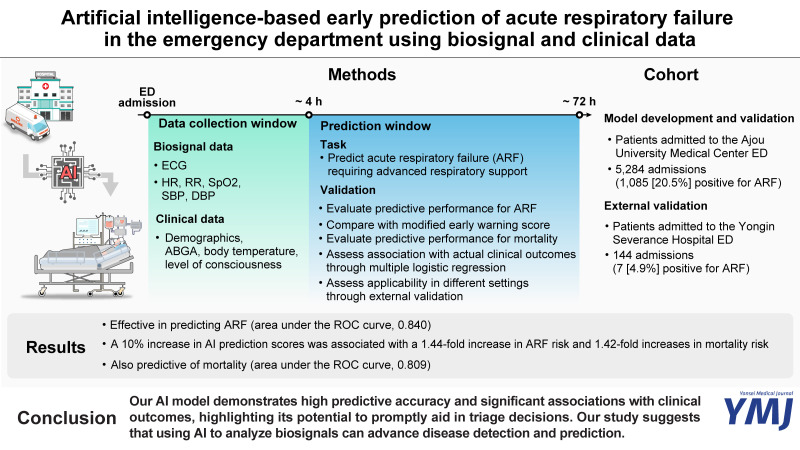
Purpose: Early identification of patients at risk for acute respiratory failure (ARF) could help clinicians devise preventive strategies. Analyzing biosignals with artificial intelligence (AI) can uncover hidden information and variability within time series. We aimed to develop and validate AI models to predict ARF within 72 h after emergency department admission, primarily using high-resolution biosignals collected within 4 h of arrival.
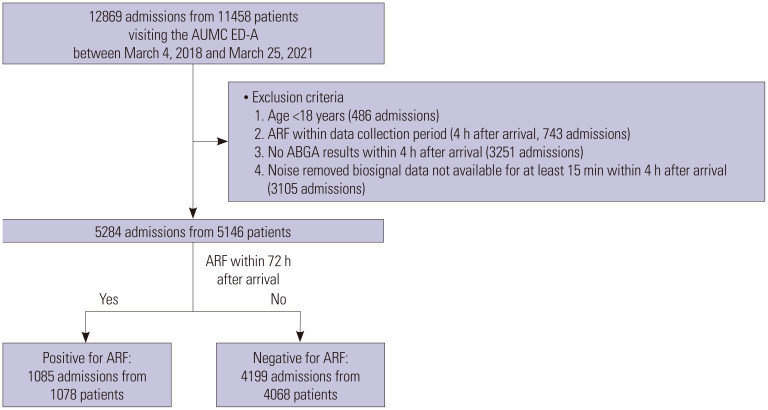
Materials and methods: Our AI model, built on convolutional recurrent neural networks, combines biosignal feature extraction and sequence modeling. The model was developed and internally validated with data from 5284 admissions [1085 (20.5%) positive for ARF], and externally validated using data from 144 admissions [7 (4.9%) positive for ARF] from another institution. We defined ARF as the application of advanced respiratory support devices.
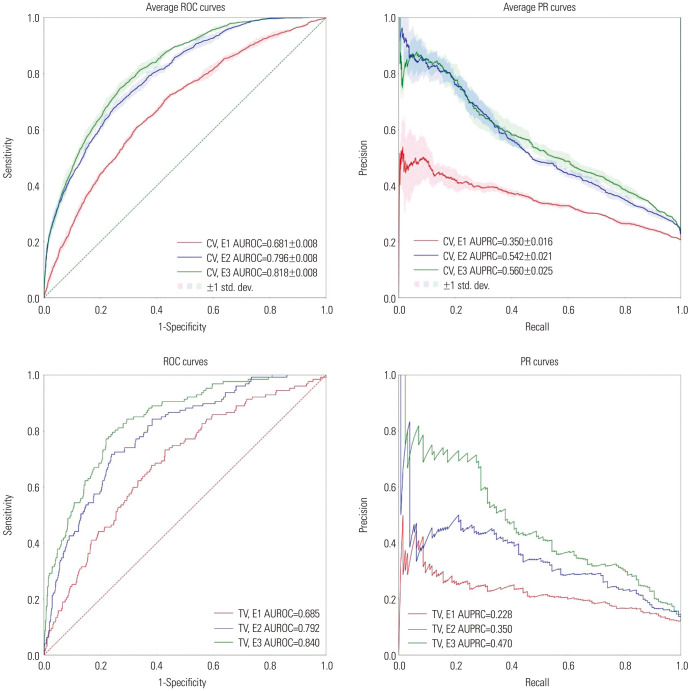
Results: Our AI model performed well in predicting ARF, achieving area under the receiver operating characteristic curve (AUROC) of 0.840 and 0.743 in internal and external validations, respectively. It outperformed the Modified Early Warning Score (MEWS) and XGBoost models built only with clinical variables. High predictive ability for mortality was observed, with AUROC up to 0.809. A 10% increase in AI prediction scores was associated with 1.44-fold and 1.42-fold increases in ARF risk and mortality risk, respectively, even after adjusting for MEWS and demographic variables.
Conclusion: Our AI model demonstrates high predictive accuracy and significant associations with clinical outcomes. Our AI model has the potential to promptly aid in triage decisions. Our study shows that using AI to analyze biosignals advances disease detection and prediction.
期刊介绍:
The goal of the Yonsei Medical Journal (YMJ) is to publish high quality manuscripts dedicated to clinical or basic research. Any authors affiliated with an accredited biomedical institution may submit manuscripts of original articles, review articles, case reports, brief communications, and letters to the Editor.



 京公网安备 11010802042870号
京ICP备2023020795号-1
京公网安备 11010802042870号
京ICP备2023020795号-1

 分享
分享
 求助内容:
求助内容: 应助结果提醒方式:
 扫码关注我们
