Lucila Álvarez-Barrera , Rodrigo Aníbal Mateos-Nava , Keyla Nahomi Hernández-Córdova , Eduardo Lezama-Sánchez , Víctor Alan Alcántara-Mejía , Juan José Rodríguez-Mercado
{"title":"Transplacental and genotoxicity effects of thallium(I) during organogenesis in mice","authors":"Lucila Álvarez-Barrera , Rodrigo Aníbal Mateos-Nava , Keyla Nahomi Hernández-Córdova , Eduardo Lezama-Sánchez , Víctor Alan Alcántara-Mejía , Juan José Rodríguez-Mercado","doi":"10.1016/j.toxrep.2025.101896","DOIUrl":null,"url":null,"abstract":"<div><div>The increased concentration of thallium (Tl) in the environment is a cause for concern because the entire population, including pregnant women, is exposed, and this metal crosses the placenta and reaches the conceptus during development. In biological models such as mice, some abnormalities and delays in ossification occur in the fetuses of mice administered Tl on day 7 of gestation, but exposure to environmental Tl is constant during fetal development; therefore, in this study, the effects of several administrations of TI during organogenesis on the external morphology, skeletal development and genotoxicity of fetuses were evaluated. Four groups of 10 pregnant mice were administered 5.28, 6.16, 7.4 or 9.25 mg/kg body weight Tl(I) acetate intraperitoneally during fetal organogenesis. Additionally, samples were taken from fetuses from pregnant mice treated with 5.28 and 6.16 mg/kg body weight to evaluate the transplacental genotoxicity. The results revealed that the 9.25 mg/kg body weight dose produced maternal and fetal toxicity, and all of the treatment groups presented relatively high percentages of fetuses with external abnormalities, reduced bone ossification, and an increased percentage of liver cells with structural chromosomal aberrations (SCAs) and micronuclei (MNs) in blood cells. These results show that Tl(I) acetate administered during organogenesis produces abnormalities, including a delay in ossification and transplacental genotoxicity, in mouse fetuses. These findings are important because Tl has negative effects on development and may affect the health of offspring in the future because it can damage genetic material.</div></div>","PeriodicalId":23129,"journal":{"name":"Toxicology Reports","volume":"14 ","pages":"Article 101896"},"PeriodicalIF":0.0000,"publicationDate":"2025-06-01","publicationTypes":"Journal Article","fieldsOfStudy":null,"isOpenAccess":false,"openAccessPdf":"https://www.ncbi.nlm.nih.gov/pmc/articles/PMC11783430/pdf/","citationCount":"0","resultStr":null,"platform":"Semanticscholar","paperid":null,"PeriodicalName":"Toxicology Reports","FirstCategoryId":"1085","ListUrlMain":"https://www.sciencedirect.com/science/article/pii/S2214750025000149","RegionNum":0,"RegionCategory":null,"ArticlePicture":[],"TitleCN":null,"AbstractTextCN":null,"PMCID":null,"EPubDate":"2025/1/6 0:00:00","PubModel":"Epub","JCR":"Q1","JCRName":"Environmental Science","Score":null,"Total":0}
引用次数: 0
Abstract
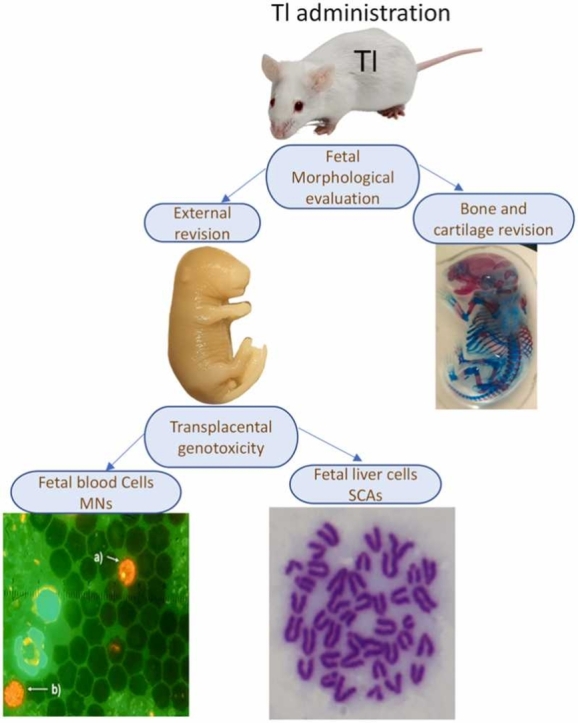
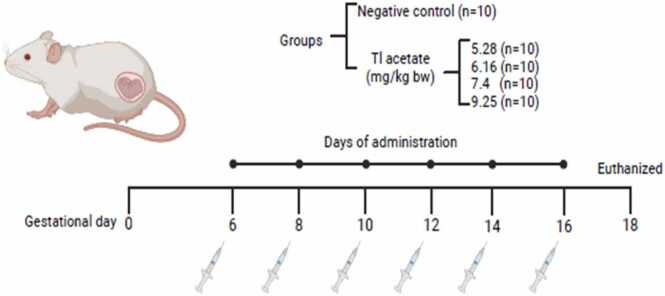
The increased concentration of thallium (Tl) in the environment is a cause for concern because the entire population, including pregnant women, is exposed, and this metal crosses the placenta and reaches the conceptus during development. In biological models such as mice, some abnormalities and delays in ossification occur in the fetuses of mice administered Tl on day 7 of gestation, but exposure to environmental Tl is constant during fetal development; therefore, in this study, the effects of several administrations of TI during organogenesis on the external morphology, skeletal development and genotoxicity of fetuses were evaluated. Four groups of 10 pregnant mice were administered 5.28, 6.16, 7.4 or 9.25 mg/kg body weight Tl(I) acetate intraperitoneally during fetal organogenesis. Additionally, samples were taken from fetuses from pregnant mice treated with 5.28 and 6.16 mg/kg body weight to evaluate the transplacental genotoxicity. The results revealed that the 9.25 mg/kg body weight dose produced maternal and fetal toxicity, and all of the treatment groups presented relatively high percentages of fetuses with external abnormalities, reduced bone ossification, and an increased percentage of liver cells with structural chromosomal aberrations (SCAs) and micronuclei (MNs) in blood cells. These results show that Tl(I) acetate administered during organogenesis produces abnormalities, including a delay in ossification and transplacental genotoxicity, in mouse fetuses. These findings are important because Tl has negative effects on development and may affect the health of offspring in the future because it can damage genetic material.




 京公网安备 11010802042870号
京ICP备2023020795号-1
京公网安备 11010802042870号
京ICP备2023020795号-1

 分享
分享
 求助内容:
求助内容: 应助结果提醒方式:
 扫码关注我们
