Effect of atrial high-rate episodes (AHREs) on functional status and quality of life (QoL) in heart failure-cardiac resynchronization therapy population.
Lamyaa Elsayed Allam, Youssef Abdel Moneim, Hayam Mohammad Eldamanhoury, Sherif Mohammad Aziz Eltoukhy
{"title":"Effect of atrial high-rate episodes (AHREs) on functional status and quality of life (QoL) in heart failure-cardiac resynchronization therapy population.","authors":"Lamyaa Elsayed Allam, Youssef Abdel Moneim, Hayam Mohammad Eldamanhoury, Sherif Mohammad Aziz Eltoukhy","doi":"10.1186/s43044-025-00613-7","DOIUrl":null,"url":null,"abstract":"<p><strong>Background: </strong>New type of arrhythmia called atrial high-rate episodes (AHREs) has been discovered thanks to the ability of cardiac electronic implantable devices to track, record, and analyze complex arrhythmias. The aim is to determine factors associated with AHRE in HFrEF/CRT patients and the effect of AHRE on functional capacity and quality of life (QoL).</p><p><strong>Results: </strong>We interrogated 100 patients' devices to gauge the incidence and burden of AHRE, then assessed their functional capacity using the standard 6-min walk test (6MWT), and evaluated their QoL using the Minnesota Living with HF questionnaire (MLHFQ) score. 34% of patients had AHRE, and 91.2% of them had AF. By multivariate logistic regression analysis, smoking (OR 9.426, 95% CI [1.33, 66.65], P 0.025), higher BMI (OR 1.336, 95% CI [1.09, 1.635], P 0.005), and increased LAVI (OR 1.16, 95% CI [1.063, 1.262], P < 0.001) are independent predictors for AHRE. There was a significant correlation between AHRE and the distance walked during 6MWT when compared to the distance expected for an equivalent healthy individual (82.02 ± 17.22% in the non-AHRE group vs. 75.15 ± 15.78% in the AHRE group, P < 0.001). It was found that AHRE was statistically linked to a higher total MLHFQ score (46.76 ± 9.82 in the AHRE group vs. 36.97 ± 7.76 in the non-AHRE group, P 0.032), with higher physical scores in the AHRE group.</p><p><strong>Conclusion: </strong>AHRE significantly reduces functional status and perceived quality of life in HFrEF patients receiving CRT. Longer than five minutes of AHRE was associated with a higher MLHFQ score and worse performance on the 6MWT. In that patient population, smoking, obesity, and elevated LAVI were independent predictors of AHRE.</p>","PeriodicalId":74993,"journal":{"name":"The Egyptian heart journal : (EHJ) : official bulletin of the Egyptian Society of Cardiology","volume":"77 1","pages":"19"},"PeriodicalIF":0.0000,"publicationDate":"2025-02-03","publicationTypes":"Journal Article","fieldsOfStudy":null,"isOpenAccess":false,"openAccessPdf":"https://www.ncbi.nlm.nih.gov/pmc/articles/PMC11790544/pdf/","citationCount":"0","resultStr":null,"platform":"Semanticscholar","paperid":null,"PeriodicalName":"The Egyptian heart journal : (EHJ) : official bulletin of the Egyptian Society of Cardiology","FirstCategoryId":"1085","ListUrlMain":"https://doi.org/10.1186/s43044-025-00613-7","RegionNum":0,"RegionCategory":null,"ArticlePicture":[],"TitleCN":null,"AbstractTextCN":null,"PMCID":null,"EPubDate":"","PubModel":"","JCR":"","JCRName":"","Score":null,"Total":0}
引用次数: 0
Abstract
Background: New type of arrhythmia called atrial high-rate episodes (AHREs) has been discovered thanks to the ability of cardiac electronic implantable devices to track, record, and analyze complex arrhythmias. The aim is to determine factors associated with AHRE in HFrEF/CRT patients and the effect of AHRE on functional capacity and quality of life (QoL).
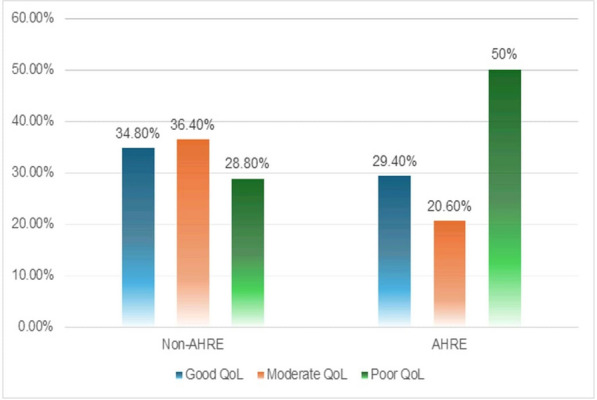
Results: We interrogated 100 patients' devices to gauge the incidence and burden of AHRE, then assessed their functional capacity using the standard 6-min walk test (6MWT), and evaluated their QoL using the Minnesota Living with HF questionnaire (MLHFQ) score. 34% of patients had AHRE, and 91.2% of them had AF. By multivariate logistic regression analysis, smoking (OR 9.426, 95% CI [1.33, 66.65], P 0.025), higher BMI (OR 1.336, 95% CI [1.09, 1.635], P 0.005), and increased LAVI (OR 1.16, 95% CI [1.063, 1.262], P < 0.001) are independent predictors for AHRE. There was a significant correlation between AHRE and the distance walked during 6MWT when compared to the distance expected for an equivalent healthy individual (82.02 ± 17.22% in the non-AHRE group vs. 75.15 ± 15.78% in the AHRE group, P < 0.001). It was found that AHRE was statistically linked to a higher total MLHFQ score (46.76 ± 9.82 in the AHRE group vs. 36.97 ± 7.76 in the non-AHRE group, P 0.032), with higher physical scores in the AHRE group.
Conclusion: AHRE significantly reduces functional status and perceived quality of life in HFrEF patients receiving CRT. Longer than five minutes of AHRE was associated with a higher MLHFQ score and worse performance on the 6MWT. In that patient population, smoking, obesity, and elevated LAVI were independent predictors of AHRE.
背景:由于心脏电子植入装置能够跟踪、记录和分析复杂的心律失常,已经发现了一种称为心房高速率发作(AHREs)的新型心律失常。目的是确定与HFrEF/CRT患者AHRE相关的因素,以及AHRE对功能能力和生活质量(QoL)的影响。结果:我们询问了100名患者的设备,以评估AHRE的发病率和负担,然后使用标准6分钟步行测试(6MWT)评估他们的功能能力,并使用明尼苏达州HF生活问卷(MLHFQ)评分评估他们的生活质量。经多因素logistic回归分析,吸烟(OR 9.426, 95% CI [1.33, 66.65], P 0.025)、BMI升高(OR 1.336, 95% CI [1.09, 1.635], P 0.005)、LAVI升高(OR 1.16, 95% CI [1.063, 1.262], P结论:AHRE显著降低接受CRT治疗的HFrEF患者的功能状态和感知生活质量。超过5分钟的AHRE与更高的MLHFQ评分和更差的6MWT表现相关。在该患者群体中,吸烟、肥胖和LAVI升高是AHRE的独立预测因素。




 京公网安备 11010802042870号
京ICP备2023020795号-1
京公网安备 11010802042870号
京ICP备2023020795号-1

 分享
分享

 求助内容:
求助内容: 应助结果提醒方式:
 扫码关注我们
