Ammu Surendran, Aswathi Thottungal, Harsha Enale, Ditty Dixon, Angelina Sarapulova, Michael Knapp, Alexander Missyul, Aiswarya Bhaskar
{"title":"Insights into the Redox Chemistry and Structural Evolution of a P2-Type Cathode Material in Sodium-Ion Batteries","authors":"Ammu Surendran, Aswathi Thottungal, Harsha Enale, Ditty Dixon, Angelina Sarapulova, Michael Knapp, Alexander Missyul, Aiswarya Bhaskar","doi":"10.1021/acs.chemmater.4c03201","DOIUrl":null,"url":null,"abstract":"In view of the tunable composition and higher theoretical capacity, layered transition metal oxide cathode materials (Na<sub><i>x</i></sub>TMO<sub>2</sub>, TM: transition metal) have attained substantial attention. In this work, a P2-type layered metal oxide with the nominal composition Na<sub>0.67</sub>Fe<sub>0.20</sub>Ni<sub>0.15</sub>Mn<sub>0.65</sub>O<sub>2</sub> (NFNM) was synthesized via a sol–gel method; electrochemical performance and the operating mechanism of the electrode material in half-cells were investigated. The material delivered an initial discharge capacity of 166 mA h g<sup>–1</sup> where the capacity retention after 50 cycles is 65% when cycled in the voltage range 1.50–4.30 V at a C-rate of C/20. At 1C, the capacity delivered by the material was 110 mA h g<sup>–1</sup> and the capacity retention noted after 80 cycles was 80%. A combination of <i>in operando</i> synchrotron diffraction and X-ray absorption spectroscopy (XAS) elucidates the electrochemical mechanism in a Na/NFNM half-cell. The structural evolution of the electrode material was analyzed using <i>in operando</i> XRD from which the evidence of reversible P2-Z phase transformations was obtained. Investigation of the charge-compensation mechanism and local structure changes in the electrode material during cycling were carried out via the XAS technique which revealed the coupled Fe migration, anionic activity, and phase transformations.","PeriodicalId":33,"journal":{"name":"Chemistry of Materials","volume":"13 1","pages":""},"PeriodicalIF":7.0000,"publicationDate":"2025-02-04","publicationTypes":"Journal Article","fieldsOfStudy":null,"isOpenAccess":false,"openAccessPdf":"","citationCount":"0","resultStr":null,"platform":"Semanticscholar","paperid":null,"PeriodicalName":"Chemistry of Materials","FirstCategoryId":"88","ListUrlMain":"https://doi.org/10.1021/acs.chemmater.4c03201","RegionNum":2,"RegionCategory":"材料科学","ArticlePicture":[],"TitleCN":null,"AbstractTextCN":null,"PMCID":null,"EPubDate":"","PubModel":"","JCR":"Q2","JCRName":"CHEMISTRY, PHYSICAL","Score":null,"Total":0}
引用次数: 0
Abstract
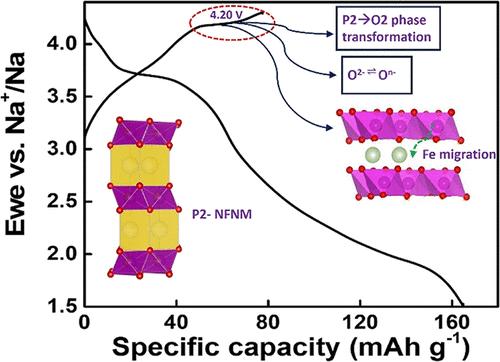
In view of the tunable composition and higher theoretical capacity, layered transition metal oxide cathode materials (NaxTMO2, TM: transition metal) have attained substantial attention. In this work, a P2-type layered metal oxide with the nominal composition Na0.67Fe0.20Ni0.15Mn0.65O2 (NFNM) was synthesized via a sol–gel method; electrochemical performance and the operating mechanism of the electrode material in half-cells were investigated. The material delivered an initial discharge capacity of 166 mA h g–1 where the capacity retention after 50 cycles is 65% when cycled in the voltage range 1.50–4.30 V at a C-rate of C/20. At 1C, the capacity delivered by the material was 110 mA h g–1 and the capacity retention noted after 80 cycles was 80%. A combination of in operando synchrotron diffraction and X-ray absorption spectroscopy (XAS) elucidates the electrochemical mechanism in a Na/NFNM half-cell. The structural evolution of the electrode material was analyzed using in operando XRD from which the evidence of reversible P2-Z phase transformations was obtained. Investigation of the charge-compensation mechanism and local structure changes in the electrode material during cycling were carried out via the XAS technique which revealed the coupled Fe migration, anionic activity, and phase transformations.
层状过渡金属氧化物正极材料(NaxTMO2, TM:过渡金属)由于其成分可调和较高的理论容量而受到广泛关注。本文采用溶胶-凝胶法制备了标称成分为Na0.67Fe0.20Ni0.15Mn0.65O2 (NFNM)的p2型层状金属氧化物;研究了该电极材料在半电池中的电化学性能和作用机理。该材料的初始放电容量为166 mA h g-1,当在1.50-4.30 V电压范围内,C-率为C/20时,50次循环后的容量保持率为65%。在1C下,材料提供的容量为110 mA h g-1,经过80次循环后的容量保持率为80%。结合同步加速器衍射和x射线吸收光谱(XAS),阐明了Na/NFNM半电池中的电化学机理。利用x射线衍射分析了电极材料的结构演变,得到了可逆P2-Z相变的证据。通过XAS技术研究了电极材料在循环过程中的电荷补偿机制和局部结构变化,揭示了铁迁移、阴离子活性和相变的耦合。
期刊介绍:
The journal Chemistry of Materials focuses on publishing original research at the intersection of materials science and chemistry. The studies published in the journal involve chemistry as a prominent component and explore topics such as the design, synthesis, characterization, processing, understanding, and application of functional or potentially functional materials. The journal covers various areas of interest, including inorganic and organic solid-state chemistry, nanomaterials, biomaterials, thin films and polymers, and composite/hybrid materials. The journal particularly seeks papers that highlight the creation or development of innovative materials with novel optical, electrical, magnetic, catalytic, or mechanical properties. It is essential that manuscripts on these topics have a primary focus on the chemistry of materials and represent a significant advancement compared to prior research. Before external reviews are sought, submitted manuscripts undergo a review process by a minimum of two editors to ensure their appropriateness for the journal and the presence of sufficient evidence of a significant advance that will be of broad interest to the materials chemistry community.



 京公网安备 11010802042870号
京ICP备2023020795号-1
京公网安备 11010802042870号
京ICP备2023020795号-1

 分享
分享
 求助内容:
求助内容: 应助结果提醒方式:
 扫码关注我们
