Ioannis Bounas, Alexey V. Verkhovtsev, Theodoros Pavloudis, Gennady B. Sushko, Joseph Kioseoglou, Richard E. Palmer and Andrey V. Solov'yov
{"title":"Atomistic modelling of electron beam induced structural transformations in deposited metal clusters†","authors":"Ioannis Bounas, Alexey V. Verkhovtsev, Theodoros Pavloudis, Gennady B. Sushko, Joseph Kioseoglou, Richard E. Palmer and Andrey V. Solov'yov","doi":"10.1039/D4NR04448G","DOIUrl":null,"url":null,"abstract":"<p >Structural transformations in gold clusters deposited on a graphite substrate induced by the focused electron beam of a scanning transmission electron microscope are investigated using the classical molecular dynamics (MD) approach. The particular case study concerns Au<small><sub>309</sub></small> clusters softly deposited on few-layer graphite and exposed to a 300 keV electron beam. Two mechanisms of energy transfer to the cluster during the irradiation are considered: (i) through the relaxation of collective electronic excitations and (ii) through the momentum transfer by the energetic primary electrons. A relativistic MD approach implemented in the MBN Explorer software package is used to simulate the collisions of energetic primary electrons with cluster atoms and to evaluate the amount of energy transferred to the cluster for different collision geometries. Characteristic times for the occurrence of these energy deposition events are estimated for realistic experimental irradiation conditions. The MD simulations of the cluster dynamics after irradiation show that the cluster temperature decreases rapidly during the first few tens of picoseconds, and the cluster cools down to a temperature close to its initial temperature within several hundred picoseconds. This time period is comparable to the characteristic time between two successive energy transfer events induced by plasmon excitations in the deposited cluster. A large number of successive energy transfer events (on the order of ∼10<small><sup>3</sup></small>–10<small><sup>4</sup></small>) during irradiation can cumulatively lead to substantial heating of the deposited cluster and induce its structural transformations.</p>","PeriodicalId":92,"journal":{"name":"Nanoscale","volume":" 10","pages":" 5895-5906"},"PeriodicalIF":5.1000,"publicationDate":"2025-02-04","publicationTypes":"Journal Article","fieldsOfStudy":null,"isOpenAccess":false,"openAccessPdf":"https://pubs.rsc.org/en/content/articlepdf/2025/nr/d4nr04448g?page=search","citationCount":"0","resultStr":null,"platform":"Semanticscholar","paperid":null,"PeriodicalName":"Nanoscale","FirstCategoryId":"88","ListUrlMain":"https://pubs.rsc.org/en/content/articlelanding/2025/nr/d4nr04448g","RegionNum":3,"RegionCategory":"材料科学","ArticlePicture":[],"TitleCN":null,"AbstractTextCN":null,"PMCID":null,"EPubDate":"","PubModel":"","JCR":"Q1","JCRName":"CHEMISTRY, MULTIDISCIPLINARY","Score":null,"Total":0}
引用次数: 0
Abstract
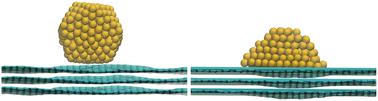
Structural transformations in gold clusters deposited on a graphite substrate induced by the focused electron beam of a scanning transmission electron microscope are investigated using the classical molecular dynamics (MD) approach. The particular case study concerns Au309 clusters softly deposited on few-layer graphite and exposed to a 300 keV electron beam. Two mechanisms of energy transfer to the cluster during the irradiation are considered: (i) through the relaxation of collective electronic excitations and (ii) through the momentum transfer by the energetic primary electrons. A relativistic MD approach implemented in the MBN Explorer software package is used to simulate the collisions of energetic primary electrons with cluster atoms and to evaluate the amount of energy transferred to the cluster for different collision geometries. Characteristic times for the occurrence of these energy deposition events are estimated for realistic experimental irradiation conditions. The MD simulations of the cluster dynamics after irradiation show that the cluster temperature decreases rapidly during the first few tens of picoseconds, and the cluster cools down to a temperature close to its initial temperature within several hundred picoseconds. This time period is comparable to the characteristic time between two successive energy transfer events induced by plasmon excitations in the deposited cluster. A large number of successive energy transfer events (on the order of ∼103–104) during irradiation can cumulatively lead to substantial heating of the deposited cluster and induce its structural transformations.
期刊介绍:
Nanoscale is a high-impact international journal, publishing high-quality research across nanoscience and nanotechnology. Nanoscale publishes a full mix of research articles on experimental and theoretical work, including reviews, communications, and full papers.Highly interdisciplinary, this journal appeals to scientists, researchers and professionals interested in nanoscience and nanotechnology, quantum materials and quantum technology, including the areas of physics, chemistry, biology, medicine, materials, energy/environment, information technology, detection science, healthcare and drug discovery, and electronics.




 京公网安备 11010802042870号
京ICP备2023020795号-1
京公网安备 11010802042870号
京ICP备2023020795号-1

 分享
分享
 求助内容:
求助内容: 应助结果提醒方式:
 扫码关注我们
