Wei-Peng Shao, Yunjian Ling, Hongru Peng, Jie Luo, Yunjun Cao, Yihua Ran, Jun Cai, Jiayu Lv, Bowen Zhu, Yun Liu, Yuxiang Chen, Na Li, Feng Jiao, Huiqi Chen, Yifeng Zhu, Xin Ou, Yuemin Wang, Christof Wöll, Qiang Fu, Xiulian Pan, Peijun Hu, Wei-Xue Li, Zhi Liu, Xinhe Bao, Fan Yang
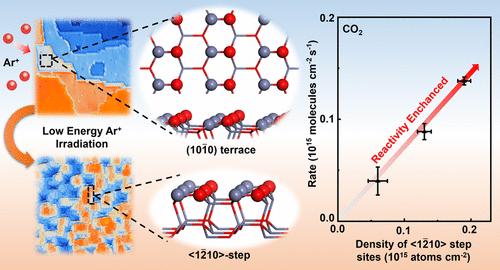
{"title":"Ion Irradiation-Induced Coordinatively Unsaturated Zn Sites for Enhanced CO Hydrogenation","authors":"Wei-Peng Shao, Yunjian Ling, Hongru Peng, Jie Luo, Yunjun Cao, Yihua Ran, Jun Cai, Jiayu Lv, Bowen Zhu, Yun Liu, Yuxiang Chen, Na Li, Feng Jiao, Huiqi Chen, Yifeng Zhu, Xin Ou, Yuemin Wang, Christof Wöll, Qiang Fu, Xiulian Pan, Peijun Hu, Wei-Xue Li, Zhi Liu, Xinhe Bao, Fan Yang","doi":"10.1021/jacs.4c13234","DOIUrl":null,"url":null,"abstract":"Defect engineering critically influences metal oxide catalysis, yet controlling coordinatively unsaturated metal sites remains challenging due to their inherent instability under reaction conditions. Here, we demonstrate that high-flux argon ion (Ar<sup>+</sup>) irradiation above recrystallization temperatures generated well-defined coordinatively unsaturated Zn (CUZ) sites on ZnO(101̅0) surfaces that exhibited enhanced stability and activity for CO hydrogenation. Combining low-temperature scanning probe microscopy, ambient pressure X-ray photoelectron spectroscopy, and surface–ligand infrared spectroscopy with density functional theory calculations, we identified <12̅10> step edges exposing CUZ sites as the dominant active sites. These sites facilitate hydrogen-assisted CO dissociation through a mechanism distinct from formate-mediated pathways on stoichiometric ZnO. The ion-irradiation approach effectively addressed instability of Zn species, a major problem in ZnO catalysis, enabling stable performance in syngas conversion when combined with zeolites. Our atomic scale investigation provided spectroscopic fingerprints for active sites on the ZnO catalyst and insights into the structure–activity relationships of ZnO for CO hydrogenation. Our approach for engineering thermally stable defect sites in oxide catalysts provided opportunities for rational catalyst design beyond traditional preparation methods.","PeriodicalId":49,"journal":{"name":"Journal of the American Chemical Society","volume":"30 1","pages":""},"PeriodicalIF":15.6000,"publicationDate":"2025-02-04","publicationTypes":"Journal Article","fieldsOfStudy":null,"isOpenAccess":false,"openAccessPdf":"","citationCount":"0","resultStr":null,"platform":"Semanticscholar","paperid":null,"PeriodicalName":"Journal of the American Chemical Society","FirstCategoryId":"92","ListUrlMain":"https://doi.org/10.1021/jacs.4c13234","RegionNum":1,"RegionCategory":"化学","ArticlePicture":[],"TitleCN":null,"AbstractTextCN":null,"PMCID":null,"EPubDate":"","PubModel":"","JCR":"Q1","JCRName":"CHEMISTRY, MULTIDISCIPLINARY","Score":null,"Total":0}
引用次数: 0
Abstract
Defect engineering critically influences metal oxide catalysis, yet controlling coordinatively unsaturated metal sites remains challenging due to their inherent instability under reaction conditions. Here, we demonstrate that high-flux argon ion (Ar+) irradiation above recrystallization temperatures generated well-defined coordinatively unsaturated Zn (CUZ) sites on ZnO(101̅0) surfaces that exhibited enhanced stability and activity for CO hydrogenation. Combining low-temperature scanning probe microscopy, ambient pressure X-ray photoelectron spectroscopy, and surface–ligand infrared spectroscopy with density functional theory calculations, we identified <12̅10> step edges exposing CUZ sites as the dominant active sites. These sites facilitate hydrogen-assisted CO dissociation through a mechanism distinct from formate-mediated pathways on stoichiometric ZnO. The ion-irradiation approach effectively addressed instability of Zn species, a major problem in ZnO catalysis, enabling stable performance in syngas conversion when combined with zeolites. Our atomic scale investigation provided spectroscopic fingerprints for active sites on the ZnO catalyst and insights into the structure–activity relationships of ZnO for CO hydrogenation. Our approach for engineering thermally stable defect sites in oxide catalysts provided opportunities for rational catalyst design beyond traditional preparation methods.
期刊介绍:
The flagship journal of the American Chemical Society, known as the Journal of the American Chemical Society (JACS), has been a prestigious publication since its establishment in 1879. It holds a preeminent position in the field of chemistry and related interdisciplinary sciences. JACS is committed to disseminating cutting-edge research papers, covering a wide range of topics, and encompasses approximately 19,000 pages of Articles, Communications, and Perspectives annually. With a weekly publication frequency, JACS plays a vital role in advancing the field of chemistry by providing essential research.



 京公网安备 11010802042870号
京ICP备2023020795号-1
京公网安备 11010802042870号
京ICP备2023020795号-1

 分享
分享
 求助内容:
求助内容: 应助结果提醒方式:
 扫码关注我们
