Ramya S. Pathuri, Nicholas A. Zosel, Aaron H. Shoemaker, Gerrit N. Christenson, Alexis Magaña, Christopher M. Nowak, Laura R. Perlmutter, Bryan M. Hunter
{"title":"Theoretical and Spectroscopic Analysis of Square-Planar Tellurium(II) and Selenium(II) Diphenyl Thiourea Complexes in p2 Electronic Configurations","authors":"Ramya S. Pathuri, Nicholas A. Zosel, Aaron H. Shoemaker, Gerrit N. Christenson, Alexis Magaña, Christopher M. Nowak, Laura R. Perlmutter, Bryan M. Hunter","doi":"10.1021/acs.inorgchem.4c04827","DOIUrl":null,"url":null,"abstract":"In this work, we performed a detailed mathematical ligand field theory analysis of square-planar (<i>D</i><sub>4h</sub>) main group complexes in p<sup>2</sup> electronic configurations, and the results were subsequently used to generate an energy-level correlation diagram. We synthesized the model p<sup>2</sup> tellurium(II) diphenyl thiourea coordination complex for further spectroscopic investigation. Dissolution of TeO<sub>2</sub> in concentrated HCl resulted in the formation of a [TeCl<sub>6</sub>]<sup>2–</sup> complex in acidic media, and subsequent addition of diphenyl thiourea resulted in the reduction of Te<sup>4+</sup> to Te<sup>2+</sup> (observed by <sup>125</sup>Te NMR spectroscopy) and the formation of a <i>cis</i>-Te(dptu)<sub>2</sub>Cl<sub>2</sub> complex, which was characterized by single-crystal X-ray diffraction (XRD). Using in situ optical/magnetic spectroscopy – specifically, UV–vis and magnetic circular dichroism (MCD) spectroscopy – we observed absorbance bands and polarized transitions consistent with the calculated p-orbital splitting in a square planar (<i>D</i><sub>4h</sub>) ligand field. Using the results of our spectroscopic investigation, we generated a molecular orbital (M.O.) diagram for the <i>cis</i>-Te(dptu)<sub>2</sub>Cl<sub>2</sub> complex. We then used the M.O. diagram, in conjunction with the energy level correlation diagram, to assign the electronic transitions observed in the spectra of the <i>cis</i>-Te(dptu)<sub>2</sub>Cl<sub>2</sub> complex. The analogous selenium(II) complex, <i>cis</i>-Se(dptu)<sub>2</sub>Cl<sub>2</sub>, was used to elucidate the observed transitions with minimal contribution from spin–orbit coupling. Our work examined how in situ spectroscopy and complementary ligand field theory analysis can be used to elucidate the electronic structures of main group coordination complexes.","PeriodicalId":40,"journal":{"name":"Inorganic Chemistry","volume":"40 1","pages":""},"PeriodicalIF":4.7000,"publicationDate":"2025-02-04","publicationTypes":"Journal Article","fieldsOfStudy":null,"isOpenAccess":false,"openAccessPdf":"","citationCount":"0","resultStr":null,"platform":"Semanticscholar","paperid":null,"PeriodicalName":"Inorganic Chemistry","FirstCategoryId":"92","ListUrlMain":"https://doi.org/10.1021/acs.inorgchem.4c04827","RegionNum":2,"RegionCategory":"化学","ArticlePicture":[],"TitleCN":null,"AbstractTextCN":null,"PMCID":null,"EPubDate":"","PubModel":"","JCR":"Q1","JCRName":"CHEMISTRY, INORGANIC & NUCLEAR","Score":null,"Total":0}
引用次数: 0
Abstract
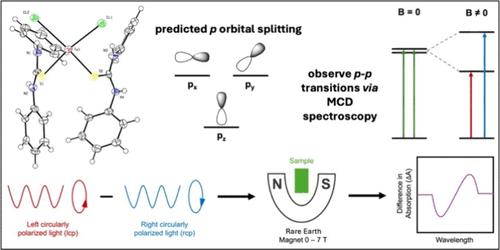
In this work, we performed a detailed mathematical ligand field theory analysis of square-planar (D4h) main group complexes in p2 electronic configurations, and the results were subsequently used to generate an energy-level correlation diagram. We synthesized the model p2 tellurium(II) diphenyl thiourea coordination complex for further spectroscopic investigation. Dissolution of TeO2 in concentrated HCl resulted in the formation of a [TeCl6]2– complex in acidic media, and subsequent addition of diphenyl thiourea resulted in the reduction of Te4+ to Te2+ (observed by 125Te NMR spectroscopy) and the formation of a cis-Te(dptu)2Cl2 complex, which was characterized by single-crystal X-ray diffraction (XRD). Using in situ optical/magnetic spectroscopy – specifically, UV–vis and magnetic circular dichroism (MCD) spectroscopy – we observed absorbance bands and polarized transitions consistent with the calculated p-orbital splitting in a square planar (D4h) ligand field. Using the results of our spectroscopic investigation, we generated a molecular orbital (M.O.) diagram for the cis-Te(dptu)2Cl2 complex. We then used the M.O. diagram, in conjunction with the energy level correlation diagram, to assign the electronic transitions observed in the spectra of the cis-Te(dptu)2Cl2 complex. The analogous selenium(II) complex, cis-Se(dptu)2Cl2, was used to elucidate the observed transitions with minimal contribution from spin–orbit coupling. Our work examined how in situ spectroscopy and complementary ligand field theory analysis can be used to elucidate the electronic structures of main group coordination complexes.
在这项工作中,我们对p2电子构型中的方形平面(D4h)主基团配合物进行了详细的数学配体场理论分析,并将结果用于生成能级相关图。我们合成了p2型碲(II)二苯基硫脲配合物,用于进一步的光谱研究。TeO2在浓HCl中溶解,在酸性介质中形成[TeCl6]2 -络合物,随后加入二苯基硫脲,使Te4+还原为Te2+(通过125Te核磁共振光谱观察),形成顺式- te (dptu)2Cl2络合物,通过单晶x射线衍射(XRD)对其进行表征。利用原位光学/磁光谱学-特别是紫外-可见和磁圆二色(MCD)光谱学-我们观察到在方形平面(D4h)配体场中与计算的p轨道分裂相一致的吸收带和极化跃迁。利用我们的光谱研究结果,我们生成了顺式- te (dptu)2Cl2配合物的分子轨道(mo)图。然后,我们使用mo图,结合能级相关图,来分配顺式- te (dptu)2Cl2配合物光谱中观察到的电子跃迁。用类似的硒(II)配合物顺式硒(dptu)2Cl2来解释观察到的跃迁,自旋轨道耦合的贡献最小。我们的工作研究了原位光谱和互补配体场论分析如何用于阐明主要基团配合物的电子结构。
期刊介绍:
Inorganic Chemistry publishes fundamental studies in all phases of inorganic chemistry. Coverage includes experimental and theoretical reports on quantitative studies of structure and thermodynamics, kinetics, mechanisms of inorganic reactions, bioinorganic chemistry, and relevant aspects of organometallic chemistry, solid-state phenomena, and chemical bonding theory. Emphasis is placed on the synthesis, structure, thermodynamics, reactivity, spectroscopy, and bonding properties of significant new and known compounds.



 京公网安备 11010802042870号
京ICP备2023020795号-1
京公网安备 11010802042870号
京ICP备2023020795号-1

 分享
分享
 求助内容:
求助内容: 应助结果提醒方式:
 扫码关注我们
