{"title":"Charge Transfer Modulation in g-C3N4/CeO2 Composites: Electrocatalytic Oxygen Reduction for H2O2 Production","authors":"Xueli Mei, Xueyang Zhao, Hongtao Xie, Nemanja Gavrilov, Qin Geng, Qin Li, Huawei Zhuo, Yali Cao, Yizhao Li, Fan Dong","doi":"10.1021/acs.inorgchem.4c05341","DOIUrl":null,"url":null,"abstract":"The electrocatalytic two-electron oxygen reduction reaction (2e-ORR) represents one of the most prospective avenues for the <i>in situ</i> synthesis of hydrogen peroxide (H<sub>2</sub>O<sub>2</sub>). However, the four-electron competition reaction constrains the efficiency of H<sub>2</sub>O<sub>2</sub> synthesis. Therefore, there is an urgent need to develop superior catalysts to facilitate the H<sub>2</sub>O<sub>2</sub> synthesis. In this study, graphite-phase carbon nitride and cerium dioxide composites (g-C<sub>3</sub>N<sub>4</sub>/CeO<sub>2</sub>) with varying CeO<sub>2</sub> loadings were prepared with favorable 2e-ORR electrocatalysts. The optimized composite, containing 20 wt % CeO<sub>2</sub> (g-C<sub>3</sub>N<sub>4</sub>/CeO<sub>2</sub>-20%) exhibited the highest Faradaic efficiency (FE) of 97% and notable H<sub>2</sub>O<sub>2</sub> yielding of 9.84 mol g<sub>cat.</sub><sup>–1</sup> h<sup>–1</sup> at the potential of 0.3 V (vs RHE) in a 0.1 M KOH electrolyte. Density functional theory calculations revealed that the improvement of the selectivity and yield of H<sub>2</sub>O<sub>2</sub> for the composites were attributed to the charge transfer between g-C<sub>3</sub>N<sub>4</sub> and CeO<sub>2</sub>, which causes the active site C atom donating electrons to form C<sup>+</sup>, thereby enhancing the adsorption and desorption of *OOH intermediates. Additionally, the g-C<sub>3</sub>N<sub>4</sub>/CeO<sub>2</sub>-20% composite exhibits excellent 2e-ORR performance in neutral and acidic electrolytes and demonstrates superior capability in electro-Fenton degradation of organic pollutants. This study not only provides new insights into the electrocatalytic mechanism of g-C<sub>3</sub>N<sub>4</sub>/CeO<sub>2</sub> composites but also demonstrates an effective method for designing 2e-ORR catalysts.","PeriodicalId":40,"journal":{"name":"Inorganic Chemistry","volume":"60 1","pages":""},"PeriodicalIF":4.7000,"publicationDate":"2025-02-04","publicationTypes":"Journal Article","fieldsOfStudy":null,"isOpenAccess":false,"openAccessPdf":"","citationCount":"0","resultStr":null,"platform":"Semanticscholar","paperid":null,"PeriodicalName":"Inorganic Chemistry","FirstCategoryId":"92","ListUrlMain":"https://doi.org/10.1021/acs.inorgchem.4c05341","RegionNum":2,"RegionCategory":"化学","ArticlePicture":[],"TitleCN":null,"AbstractTextCN":null,"PMCID":null,"EPubDate":"","PubModel":"","JCR":"Q1","JCRName":"CHEMISTRY, INORGANIC & NUCLEAR","Score":null,"Total":0}
引用次数: 0
Abstract
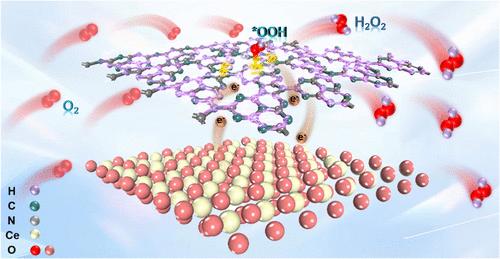
The electrocatalytic two-electron oxygen reduction reaction (2e-ORR) represents one of the most prospective avenues for the in situ synthesis of hydrogen peroxide (H2O2). However, the four-electron competition reaction constrains the efficiency of H2O2 synthesis. Therefore, there is an urgent need to develop superior catalysts to facilitate the H2O2 synthesis. In this study, graphite-phase carbon nitride and cerium dioxide composites (g-C3N4/CeO2) with varying CeO2 loadings were prepared with favorable 2e-ORR electrocatalysts. The optimized composite, containing 20 wt % CeO2 (g-C3N4/CeO2-20%) exhibited the highest Faradaic efficiency (FE) of 97% and notable H2O2 yielding of 9.84 mol gcat.–1 h–1 at the potential of 0.3 V (vs RHE) in a 0.1 M KOH electrolyte. Density functional theory calculations revealed that the improvement of the selectivity and yield of H2O2 for the composites were attributed to the charge transfer between g-C3N4 and CeO2, which causes the active site C atom donating electrons to form C+, thereby enhancing the adsorption and desorption of *OOH intermediates. Additionally, the g-C3N4/CeO2-20% composite exhibits excellent 2e-ORR performance in neutral and acidic electrolytes and demonstrates superior capability in electro-Fenton degradation of organic pollutants. This study not only provides new insights into the electrocatalytic mechanism of g-C3N4/CeO2 composites but also demonstrates an effective method for designing 2e-ORR catalysts.
期刊介绍:
Inorganic Chemistry publishes fundamental studies in all phases of inorganic chemistry. Coverage includes experimental and theoretical reports on quantitative studies of structure and thermodynamics, kinetics, mechanisms of inorganic reactions, bioinorganic chemistry, and relevant aspects of organometallic chemistry, solid-state phenomena, and chemical bonding theory. Emphasis is placed on the synthesis, structure, thermodynamics, reactivity, spectroscopy, and bonding properties of significant new and known compounds.



 京公网安备 11010802042870号
京ICP备2023020795号-1
京公网安备 11010802042870号
京ICP备2023020795号-1

 分享
分享
 求助内容:
求助内容: 应助结果提醒方式:
 扫码关注我们
