Do-Kyoung Lee, Kostas Fykouras, Tim Kodalle, Raphael F. Moral, Craig P. Schwartz, Nobumichi Tamura, Keith V. Lawler, Linn Leppert, Carolin M. Sutter-Fella
{"title":"Strain Engineering: Reduction of Microstrain at the Perovskite Surface via Alkali Metal Chloride Treatment Enhances Stability","authors":"Do-Kyoung Lee, Kostas Fykouras, Tim Kodalle, Raphael F. Moral, Craig P. Schwartz, Nobumichi Tamura, Keith V. Lawler, Linn Leppert, Carolin M. Sutter-Fella","doi":"10.1021/acsenergylett.4c03334","DOIUrl":null,"url":null,"abstract":"Degradation of halide perovskites under a humid atmosphere is the major challenge preventing widespread commercial deployment of this material class. Here it is shown that strain engineering via alkali metal chloride treatment at the FAPbI<sub>3</sub>/SnO<sub>2</sub> interface effectively improves moisture-related stability. CsCl and KCl treatments reduce microstrain at the perovskite surface and slow the α- to δ-phase transformation. Alkali metal treatments with LiCl, NaCl, and RbCl led to an increase in microstrain and faster degradation. The compressive strain at the perovskite surface was the smallest for CsCl and was linked to improved stability. First-principles density functional theory calculations confirm the preferential formation of alkali defects at interstitial positions at the perovskite surface. Particularly CsCl and KCl treatments lead to a release of compressive strain at the perovskite surface and local structural distortions that may favor passivation of surface defects. In contrast, the room-temperature dynamics of Li interstitials result in an overall expansion of lattice volume, which may be linked to more facile lattice degradation.","PeriodicalId":16,"journal":{"name":"ACS Energy Letters ","volume":"8 1","pages":""},"PeriodicalIF":18.2000,"publicationDate":"2025-02-03","publicationTypes":"Journal Article","fieldsOfStudy":null,"isOpenAccess":false,"openAccessPdf":"","citationCount":"0","resultStr":null,"platform":"Semanticscholar","paperid":null,"PeriodicalName":"ACS Energy Letters ","FirstCategoryId":"88","ListUrlMain":"https://doi.org/10.1021/acsenergylett.4c03334","RegionNum":1,"RegionCategory":"材料科学","ArticlePicture":[],"TitleCN":null,"AbstractTextCN":null,"PMCID":null,"EPubDate":"","PubModel":"","JCR":"Q1","JCRName":"CHEMISTRY, PHYSICAL","Score":null,"Total":0}
引用次数: 0
Abstract
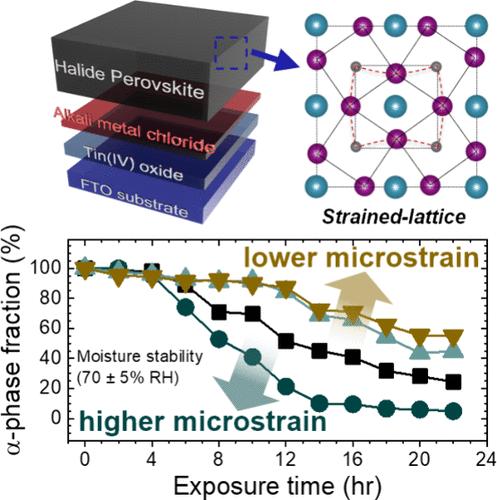
Degradation of halide perovskites under a humid atmosphere is the major challenge preventing widespread commercial deployment of this material class. Here it is shown that strain engineering via alkali metal chloride treatment at the FAPbI3/SnO2 interface effectively improves moisture-related stability. CsCl and KCl treatments reduce microstrain at the perovskite surface and slow the α- to δ-phase transformation. Alkali metal treatments with LiCl, NaCl, and RbCl led to an increase in microstrain and faster degradation. The compressive strain at the perovskite surface was the smallest for CsCl and was linked to improved stability. First-principles density functional theory calculations confirm the preferential formation of alkali defects at interstitial positions at the perovskite surface. Particularly CsCl and KCl treatments lead to a release of compressive strain at the perovskite surface and local structural distortions that may favor passivation of surface defects. In contrast, the room-temperature dynamics of Li interstitials result in an overall expansion of lattice volume, which may be linked to more facile lattice degradation.
ACS Energy Letters Energy-Renewable Energy, Sustainability and the Environment
CiteScore
31.20
自引率
5.00%
发文量
469
审稿时长
1 months
期刊介绍:
ACS Energy Letters is a monthly journal that publishes papers reporting new scientific advances in energy research. The journal focuses on topics that are of interest to scientists working in the fundamental and applied sciences. Rapid publication is a central criterion for acceptance, and the journal is known for its quick publication times, with an average of 4-6 weeks from submission to web publication in As Soon As Publishable format.
ACS Energy Letters is ranked as the number one journal in the Web of Science Electrochemistry category. It also ranks within the top 10 journals for Physical Chemistry, Energy & Fuels, and Nanoscience & Nanotechnology.
The journal offers several types of articles, including Letters, Energy Express, Perspectives, Reviews, Editorials, Viewpoints and Energy Focus. Additionally, authors have the option to submit videos that summarize or support the information presented in a Perspective or Review article, which can be highlighted on the journal's website. ACS Energy Letters is abstracted and indexed in Chemical Abstracts Service/SciFinder, EBSCO-summon, PubMed, Web of Science, Scopus and Portico.



 京公网安备 11010802042870号
京ICP备2023020795号-1
京公网安备 11010802042870号
京ICP备2023020795号-1

 分享
分享
 求助内容:
求助内容: 应助结果提醒方式:
 扫码关注我们
