{"title":"Seeds of Excellence: Review on impact of seed quality enhancement on babygreens biomass production","authors":"Arvind Gopalsamy , Eevera Tamilmani , Kumaran Shanmugam , Nelson Navamaniraj Koilpitchai , Vidhya Durairaj , Preethi Mylsamy , Anandhan Jaganathavarma , Umarani Ranganathan","doi":"10.1016/j.jafr.2024.101597","DOIUrl":null,"url":null,"abstract":"<div><div>The high nutrient content of baby greens has increased their demand in worldwide markets, putting pressure on farmers and producers to expand production. Enhancing the quality of seeds before sowing has been identified as a key component in increasing the volume of baby greens. The current seed treatment techniques used for baby greens are chemical-based and have extensive negative effects on the environment and human health. Consequently, alternative seed treatment methods, such as organic and physical methods, use less fertilizer and have negligible effects on the environment and public health. A range of treatments, including shock wave, radiation, plasma, magnetic, and hot water treatments, have been found to promote crop development. These techniques have been shown to improve seed germination, the seed vigor index, root development, shoot development, and biomass production because organic seed formulation makes growth regulators available directly to seeds and helps to address issues related to the unraveling of the seed coat in some species. In addition to these seed treatment approaches, a number of seed priming, seed pelleting and seed coating techniques, such as microbial, biopolymer-based, and protective coatings, have been shown to increase sustainability and efficacy while being more environmentally friendly. Advanced seed treatment techniques that employ nanoparticles, such as nanosuspensions, nanoemulsions, and nanopriming, have emerged as viable options for both the environment and the economy. These techniques enhance crop development and seed vigor by utilizing mechanisms such as seed coat penetration and cellular signaling stimulation. For the optimal production of baby greens, including lettuce, Chinese cabbage, pak choi, and radish, certain characteristics, such as substrate, growing conditions, and appropriate parameters, must be maintained in addition to seed treatment procedures. This article provides a thorough evaluation of these methods, explaining their mechanisms of action and addressing the relative benefits of various substrates and parameters for encouraging the growth of roots and plants.</div></div>","PeriodicalId":34393,"journal":{"name":"Journal of Agriculture and Food Research","volume":"19 ","pages":"Article 101597"},"PeriodicalIF":6.2000,"publicationDate":"2025-03-01","publicationTypes":"Journal Article","fieldsOfStudy":null,"isOpenAccess":false,"openAccessPdf":"","citationCount":"0","resultStr":null,"platform":"Semanticscholar","paperid":null,"PeriodicalName":"Journal of Agriculture and Food Research","FirstCategoryId":"1085","ListUrlMain":"https://www.sciencedirect.com/science/article/pii/S2666154324006343","RegionNum":0,"RegionCategory":null,"ArticlePicture":[],"TitleCN":null,"AbstractTextCN":null,"PMCID":null,"EPubDate":"2024/12/25 0:00:00","PubModel":"Epub","JCR":"Q1","JCRName":"AGRICULTURE, MULTIDISCIPLINARY","Score":null,"Total":0}
引用次数: 0
Abstract
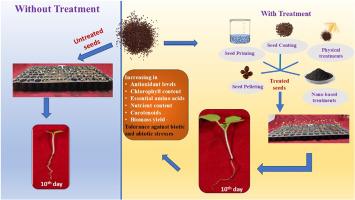
The high nutrient content of baby greens has increased their demand in worldwide markets, putting pressure on farmers and producers to expand production. Enhancing the quality of seeds before sowing has been identified as a key component in increasing the volume of baby greens. The current seed treatment techniques used for baby greens are chemical-based and have extensive negative effects on the environment and human health. Consequently, alternative seed treatment methods, such as organic and physical methods, use less fertilizer and have negligible effects on the environment and public health. A range of treatments, including shock wave, radiation, plasma, magnetic, and hot water treatments, have been found to promote crop development. These techniques have been shown to improve seed germination, the seed vigor index, root development, shoot development, and biomass production because organic seed formulation makes growth regulators available directly to seeds and helps to address issues related to the unraveling of the seed coat in some species. In addition to these seed treatment approaches, a number of seed priming, seed pelleting and seed coating techniques, such as microbial, biopolymer-based, and protective coatings, have been shown to increase sustainability and efficacy while being more environmentally friendly. Advanced seed treatment techniques that employ nanoparticles, such as nanosuspensions, nanoemulsions, and nanopriming, have emerged as viable options for both the environment and the economy. These techniques enhance crop development and seed vigor by utilizing mechanisms such as seed coat penetration and cellular signaling stimulation. For the optimal production of baby greens, including lettuce, Chinese cabbage, pak choi, and radish, certain characteristics, such as substrate, growing conditions, and appropriate parameters, must be maintained in addition to seed treatment procedures. This article provides a thorough evaluation of these methods, explaining their mechanisms of action and addressing the relative benefits of various substrates and parameters for encouraging the growth of roots and plants.





 京公网安备 11010802042870号
京ICP备2023020795号-1
京公网安备 11010802042870号
京ICP备2023020795号-1

 分享
分享
 求助内容:
求助内容: 应助结果提醒方式:
 扫码关注我们
