Vera I. Isaeva, Andrei L. Tarasov, Olga P. Tkachenko, Sergei V. Savilov, Nikolai A. Davshan, Vladimir V. Chernyshev, Leonid M. Kustov
{"title":"Novel Rh catalytic systems based on microporous metal-organic framework MIL-53(Al) for “green” ethylene hydroformylation","authors":"Vera I. Isaeva, Andrei L. Tarasov, Olga P. Tkachenko, Sergei V. Savilov, Nikolai A. Davshan, Vladimir V. Chernyshev, Leonid M. Kustov","doi":"10.1007/s10934-024-01695-5","DOIUrl":null,"url":null,"abstract":"<div><p>Novel hybrid nanomaterials were synthesized using microporous metal-organic framework MIL-53(Al) as a support for rhodium nanoparticles (Rh NPs). In order to elucidate the factors that govern the dispersion and location of Rh, MIL-53(Al) samples were synthesized using two alternative strategies: conventional solvothermal procedure and microwave (MW) activation of the reaction mass. It was established that the use of different preparation conditions for the synthesis of the MIL-53(Al) carrier results in the spatial manipulation of the structural characteristics of the Rh@MIL-53(Al) nanohybrids. The structural study revealed also a pronounced confinement effect of the MIL-53(Al) porous matrix for the Rh nanoparticles. The novel Rh@MIL-53(Al) nanohybrids show high efficiency in “green” ethylene hydroformylation into propionic aldehyde (propanal) using syngas produced by CO<sub>2</sub> hydrogenation. Carbon dioxide hydrogenation (atmospheric pressure, 500<sup>o</sup>C) was performed over cobalt nanoparticles deposited on the MIL-53(Al) nanomaterial obtained in MW fields. Exceptionally high thermal stability of the MIL-53(Al) matrix under conditions of the two-stage catalytic process was found. This work results demonstrate the new potential of the nanostructured catalysts based on the MIL-53(Al) carrier in the carbon dioxide conversion into value-added products.</p></div>","PeriodicalId":660,"journal":{"name":"Journal of Porous Materials","volume":"32 1","pages":"263 - 273"},"PeriodicalIF":3.2000,"publicationDate":"2024-10-23","publicationTypes":"Journal Article","fieldsOfStudy":null,"isOpenAccess":false,"openAccessPdf":"","citationCount":"0","resultStr":null,"platform":"Semanticscholar","paperid":null,"PeriodicalName":"Journal of Porous Materials","FirstCategoryId":"88","ListUrlMain":"https://link.springer.com/article/10.1007/s10934-024-01695-5","RegionNum":4,"RegionCategory":"材料科学","ArticlePicture":[],"TitleCN":null,"AbstractTextCN":null,"PMCID":null,"EPubDate":"","PubModel":"","JCR":"Q2","JCRName":"CHEMISTRY, APPLIED","Score":null,"Total":0}
引用次数: 0
Abstract
Novel hybrid nanomaterials were synthesized using microporous metal-organic framework MIL-53(Al) as a support for rhodium nanoparticles (Rh NPs). In order to elucidate the factors that govern the dispersion and location of Rh, MIL-53(Al) samples were synthesized using two alternative strategies: conventional solvothermal procedure and microwave (MW) activation of the reaction mass. It was established that the use of different preparation conditions for the synthesis of the MIL-53(Al) carrier results in the spatial manipulation of the structural characteristics of the Rh@MIL-53(Al) nanohybrids. The structural study revealed also a pronounced confinement effect of the MIL-53(Al) porous matrix for the Rh nanoparticles. The novel Rh@MIL-53(Al) nanohybrids show high efficiency in “green” ethylene hydroformylation into propionic aldehyde (propanal) using syngas produced by CO2 hydrogenation. Carbon dioxide hydrogenation (atmospheric pressure, 500oC) was performed over cobalt nanoparticles deposited on the MIL-53(Al) nanomaterial obtained in MW fields. Exceptionally high thermal stability of the MIL-53(Al) matrix under conditions of the two-stage catalytic process was found. This work results demonstrate the new potential of the nanostructured catalysts based on the MIL-53(Al) carrier in the carbon dioxide conversion into value-added products.
期刊介绍:
The Journal of Porous Materials is an interdisciplinary and international periodical devoted to all types of porous materials. Its aim is the rapid publication
of high quality, peer-reviewed papers focused on the synthesis, processing, characterization and property evaluation of all porous materials. The objective is to
establish a unique journal that will serve as a principal means of communication for the growing interdisciplinary field of porous materials.
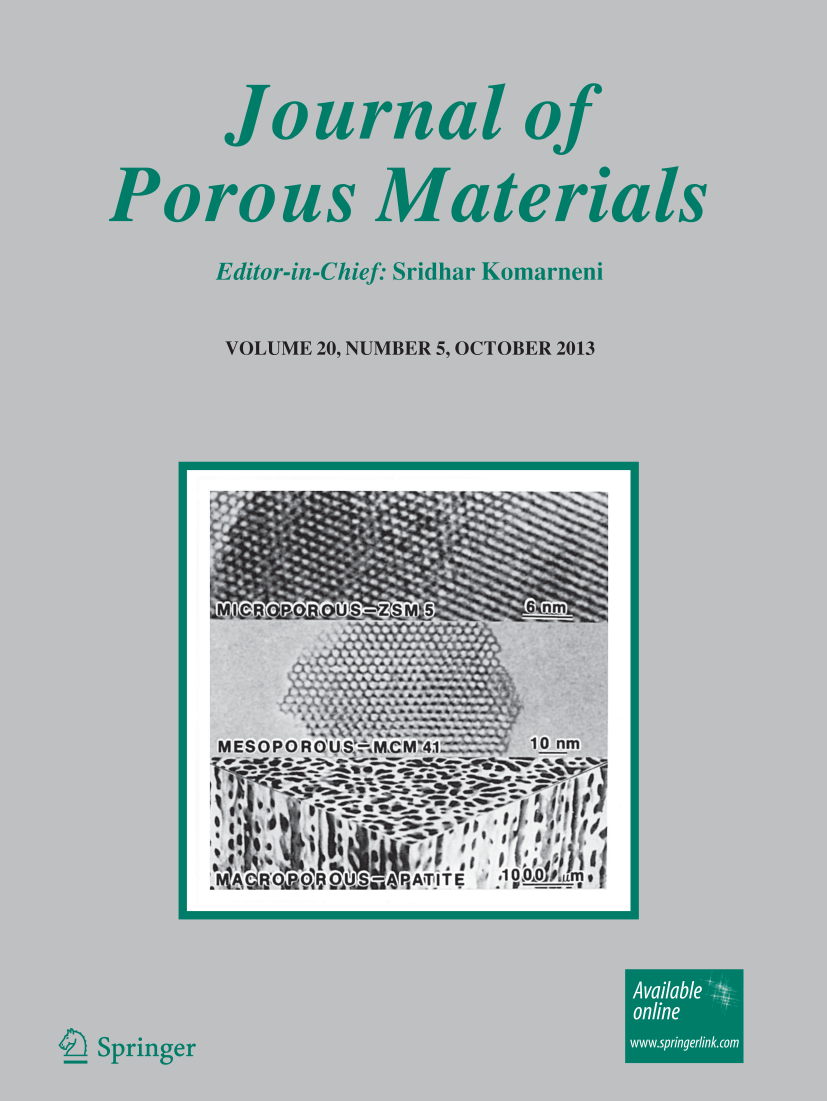
Porous materials include microporous materials with 50 nm pores.
Examples of microporous materials are natural and synthetic molecular sieves, cationic and anionic clays, pillared clays, tobermorites, pillared Zr and Ti
phosphates, spherosilicates, carbons, porous polymers, xerogels, etc. Mesoporous materials include synthetic molecular sieves, xerogels, aerogels, glasses, glass
ceramics, porous polymers, etc.; while macroporous materials include ceramics, glass ceramics, porous polymers, aerogels, cement, etc. The porous materials
can be crystalline, semicrystalline or noncrystalline, or combinations thereof. They can also be either organic, inorganic, or their composites. The overall
objective of the journal is the establishment of one main forum covering the basic and applied aspects of all porous materials.




 京公网安备 11010802042870号
京ICP备2023020795号-1
京公网安备 11010802042870号
京ICP备2023020795号-1

 分享
分享
 求助内容:
求助内容: 应助结果提醒方式:
 扫码关注我们
