{"title":"Pitch-based spherical activated carbons with small mesopores for CO2 capture","authors":"Dongdong Zhang, Kaixi Li","doi":"10.1007/s10934-024-01687-5","DOIUrl":null,"url":null,"abstract":"<div><p>A simple suspension polymerization coupling with oxidative stabilization, carbonization, and H<sub>2</sub>O steam activation are applied to synthesize a series of hierarchical porous millimeter-sized pitch-based spherical activated carbons (PSAC). The as-obtained PSAC possess a tunable specific surface area from 975 m<sup>2</sup> g<sup>− 1</sup> to 1761 m<sup>2</sup> g<sup>− 1</sup>, a pore volume of 0.44 ~ 0.82 cm<sup>3</sup> g<sup>− 1</sup>, and spherical morphology via regulation of H<sub>2</sub>O activation time. The CO<sub>2</sub> adsorption capacity is closely related to the ultramicroporous volumes below 0.2 bar. The introduction of rich micropores has a positively influence on CO<sub>2</sub> adsorption capacity that can reach 2.59 mmol g<sup>− 1</sup> at 1.0 bar. When the pressure increasing to 5.0 bar, the micro-mesoporous PSAC shows higher CO<sub>2</sub> adsorption capacity of 7.23 mmol g<sup>− 1</sup> at 5 bar than microporous PSAC, indicating that the introduction of moderate mesopores can accelerate CO<sub>2</sub> diffusion rate and improve the utilization of micropores active adsorption sites. Based on the ideal adsorption solution theory (IAST), the CO<sub>2</sub>/N<sub>2</sub> and CO<sub>2</sub>/H<sub>2</sub>O adsorption selection factors <i>S</i><sub><i>ads</i></sub> of PSAC are as high as 49.9 and 8.29, respectively. Therefore, PSAC with high adsorption/desorption rate, good selectivity for CO<sub>2</sub>/N<sub>2</sub> and CO<sub>2</sub>/H<sub>2</sub>O, excellent renewability, and easy mass production provide potential options for industrial application of CO<sub>2</sub> capture.</p></div>","PeriodicalId":660,"journal":{"name":"Journal of Porous Materials","volume":"32 1","pages":"117 - 127"},"PeriodicalIF":3.2000,"publicationDate":"2024-09-24","publicationTypes":"Journal Article","fieldsOfStudy":null,"isOpenAccess":false,"openAccessPdf":"","citationCount":"0","resultStr":null,"platform":"Semanticscholar","paperid":null,"PeriodicalName":"Journal of Porous Materials","FirstCategoryId":"88","ListUrlMain":"https://link.springer.com/article/10.1007/s10934-024-01687-5","RegionNum":4,"RegionCategory":"材料科学","ArticlePicture":[],"TitleCN":null,"AbstractTextCN":null,"PMCID":null,"EPubDate":"","PubModel":"","JCR":"Q2","JCRName":"CHEMISTRY, APPLIED","Score":null,"Total":0}
引用次数: 0
Abstract
A simple suspension polymerization coupling with oxidative stabilization, carbonization, and H2O steam activation are applied to synthesize a series of hierarchical porous millimeter-sized pitch-based spherical activated carbons (PSAC). The as-obtained PSAC possess a tunable specific surface area from 975 m2 g− 1 to 1761 m2 g− 1, a pore volume of 0.44 ~ 0.82 cm3 g− 1, and spherical morphology via regulation of H2O activation time. The CO2 adsorption capacity is closely related to the ultramicroporous volumes below 0.2 bar. The introduction of rich micropores has a positively influence on CO2 adsorption capacity that can reach 2.59 mmol g− 1 at 1.0 bar. When the pressure increasing to 5.0 bar, the micro-mesoporous PSAC shows higher CO2 adsorption capacity of 7.23 mmol g− 1 at 5 bar than microporous PSAC, indicating that the introduction of moderate mesopores can accelerate CO2 diffusion rate and improve the utilization of micropores active adsorption sites. Based on the ideal adsorption solution theory (IAST), the CO2/N2 and CO2/H2O adsorption selection factors Sads of PSAC are as high as 49.9 and 8.29, respectively. Therefore, PSAC with high adsorption/desorption rate, good selectivity for CO2/N2 and CO2/H2O, excellent renewability, and easy mass production provide potential options for industrial application of CO2 capture.
期刊介绍:
The Journal of Porous Materials is an interdisciplinary and international periodical devoted to all types of porous materials. Its aim is the rapid publication
of high quality, peer-reviewed papers focused on the synthesis, processing, characterization and property evaluation of all porous materials. The objective is to
establish a unique journal that will serve as a principal means of communication for the growing interdisciplinary field of porous materials.
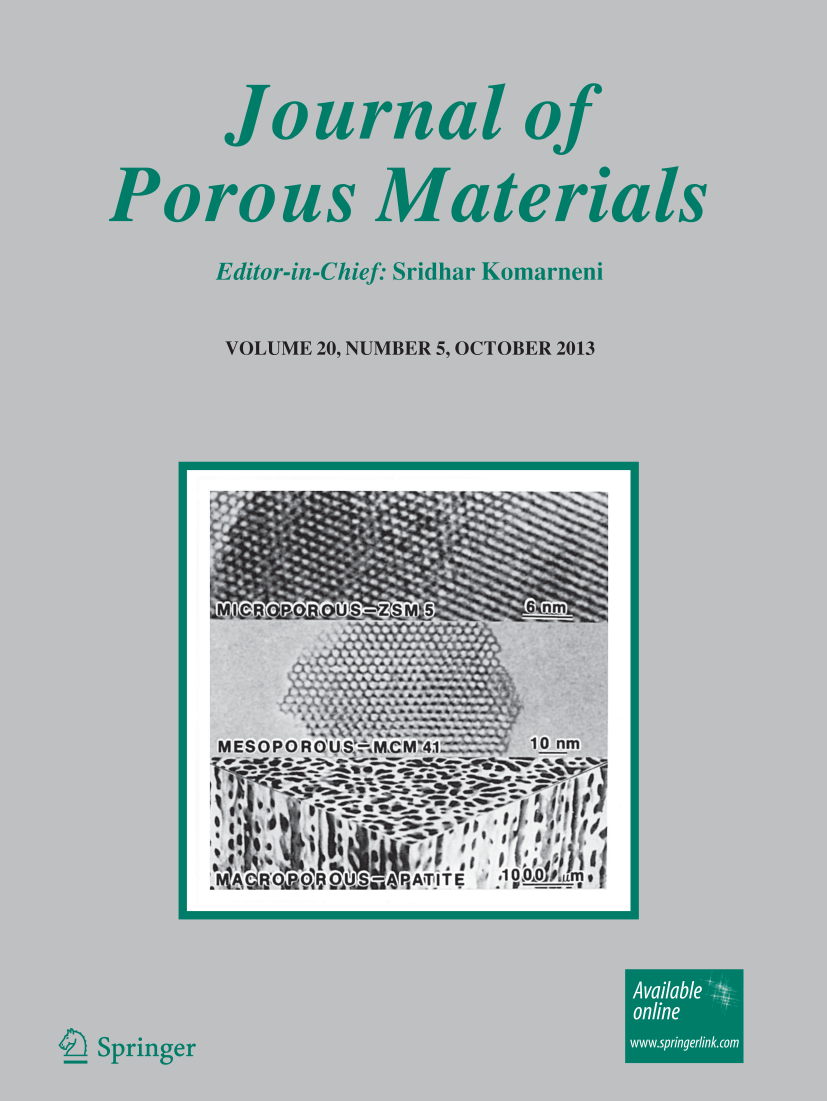
Porous materials include microporous materials with 50 nm pores.
Examples of microporous materials are natural and synthetic molecular sieves, cationic and anionic clays, pillared clays, tobermorites, pillared Zr and Ti
phosphates, spherosilicates, carbons, porous polymers, xerogels, etc. Mesoporous materials include synthetic molecular sieves, xerogels, aerogels, glasses, glass
ceramics, porous polymers, etc.; while macroporous materials include ceramics, glass ceramics, porous polymers, aerogels, cement, etc. The porous materials
can be crystalline, semicrystalline or noncrystalline, or combinations thereof. They can also be either organic, inorganic, or their composites. The overall
objective of the journal is the establishment of one main forum covering the basic and applied aspects of all porous materials.



 京公网安备 11010802042870号
京ICP备2023020795号-1
京公网安备 11010802042870号
京ICP备2023020795号-1

 分享
分享
 求助内容:
求助内容: 应助结果提醒方式:
 扫码关注我们
