Desiree Mae S. Prado, Guangfu Li, Julie Anne D. del Rosario, Joey D. Ocon, Po-Ya Abel Chuang
{"title":"Improved Oxygen Reduction Reaction Activity of Graphene via Mechanochemical Activation and Halogen-Doping","authors":"Desiree Mae S. Prado, Guangfu Li, Julie Anne D. del Rosario, Joey D. Ocon, Po-Ya Abel Chuang","doi":"10.1002/celc.202400494","DOIUrl":null,"url":null,"abstract":"<p>There has been an increased effort to replace the expensive and rare platinum and platinum group metals to speed up the sluggish oxygen reduction reaction (ORR) kinetics, which limits the efficiency of fuel cells. One class of promising Pt-alternative catalysts for ORR is metal-free halogen-doped carbon materials. Herein, bromine-doped and iodine-doped graphene were synthesized via mechanochemical activation. The synthesized samples exhibited sub-rounded particles. Mechanical activation via ball milling increased the specific surface area of graphene by reducing particle size. Ball milling also enhanced dopant dispersibility and increased surface roughness, though it reduced surface area compared to ball-milled graphene, likely due to the size difference between carbon and halogen atoms. Among the synthesized catalysts, iodine-doped graphene exhibits the highest limiting current density of 1.806 mA cm<sup>−2</sup> with the highest ORR onset potential of 0.74 V vs reversible hydrogen electrode (RHE). The iodine-doped graphene also showed good stability after 1000 cycles of accelerated degradation test. The enhanced ORR performance of iodine-doped graphene was reached using the optimized iodine-to-graphene mass ratio of 4 : 1 after 48 h ball milling time.</p>","PeriodicalId":142,"journal":{"name":"ChemElectroChem","volume":"12 1","pages":""},"PeriodicalIF":3.5000,"publicationDate":"2024-11-19","publicationTypes":"Journal Article","fieldsOfStudy":null,"isOpenAccess":false,"openAccessPdf":"https://onlinelibrary.wiley.com/doi/epdf/10.1002/celc.202400494","citationCount":"0","resultStr":null,"platform":"Semanticscholar","paperid":null,"PeriodicalName":"ChemElectroChem","FirstCategoryId":"92","ListUrlMain":"https://chemistry-europe.onlinelibrary.wiley.com/doi/10.1002/celc.202400494","RegionNum":4,"RegionCategory":"化学","ArticlePicture":[],"TitleCN":null,"AbstractTextCN":null,"PMCID":null,"EPubDate":"","PubModel":"","JCR":"Q2","JCRName":"ELECTROCHEMISTRY","Score":null,"Total":0}
引用次数: 0
Abstract
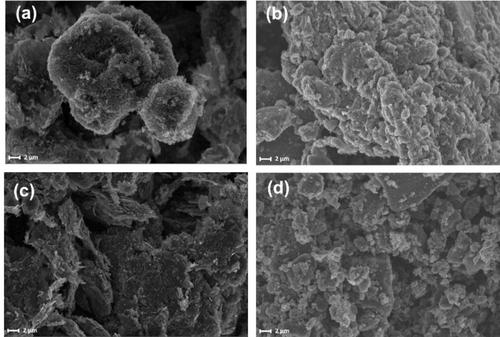
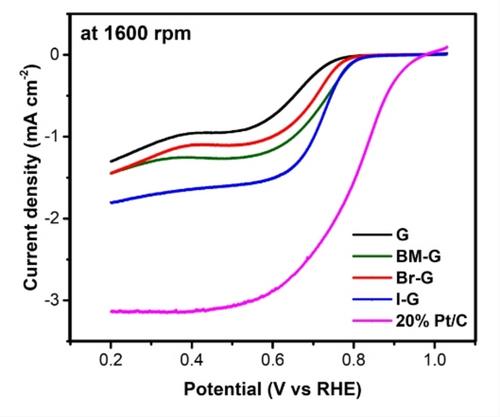
There has been an increased effort to replace the expensive and rare platinum and platinum group metals to speed up the sluggish oxygen reduction reaction (ORR) kinetics, which limits the efficiency of fuel cells. One class of promising Pt-alternative catalysts for ORR is metal-free halogen-doped carbon materials. Herein, bromine-doped and iodine-doped graphene were synthesized via mechanochemical activation. The synthesized samples exhibited sub-rounded particles. Mechanical activation via ball milling increased the specific surface area of graphene by reducing particle size. Ball milling also enhanced dopant dispersibility and increased surface roughness, though it reduced surface area compared to ball-milled graphene, likely due to the size difference between carbon and halogen atoms. Among the synthesized catalysts, iodine-doped graphene exhibits the highest limiting current density of 1.806 mA cm−2 with the highest ORR onset potential of 0.74 V vs reversible hydrogen electrode (RHE). The iodine-doped graphene also showed good stability after 1000 cycles of accelerated degradation test. The enhanced ORR performance of iodine-doped graphene was reached using the optimized iodine-to-graphene mass ratio of 4 : 1 after 48 h ball milling time.
人们一直在努力替代昂贵而稀有的铂和铂族金属,以加快缓慢的氧还原反应(ORR)动力学,这限制了燃料电池的效率。无金属卤素掺杂碳材料是一类很有前途的铂替代ORR催化剂。本文采用机械化学活化法制备了掺杂溴和掺杂碘的石墨烯。合成的样品呈现亚圆形颗粒。通过球磨的机械活化通过减小颗粒尺寸来增加石墨烯的比表面积。球磨还增强了掺杂剂的分散性,增加了表面粗糙度,尽管与球磨石墨烯相比,它减少了表面积,这可能是由于碳原子和卤素原子之间的尺寸差异。在所合成的催化剂中,碘掺杂石墨烯在可逆氢电极(RHE)上的最高极限电流密度为1.806 mA cm−2,ORR起始电位最高为0.74 V。经过1000次加速降解试验,碘掺杂石墨烯也表现出良好的稳定性。采用优化后的碘与石墨烯的质量比为4:1,经48 h球磨后,碘掺杂石墨烯的ORR性能得到了提高。
期刊介绍:
ChemElectroChem is aimed to become a top-ranking electrochemistry journal for primary research papers and critical secondary information from authors across the world. The journal covers the entire scope of pure and applied electrochemistry, the latter encompassing (among others) energy applications, electrochemistry at interfaces (including surfaces), photoelectrochemistry and bioelectrochemistry.




 京公网安备 11010802042870号
京ICP备2023020795号-1
京公网安备 11010802042870号
京ICP备2023020795号-1

 分享
分享
 求助内容:
求助内容: 应助结果提醒方式:
 扫码关注我们
