{"title":"Two-Dimensional Janus p-n Heterojunction of Co3O4 and CoMoO4 for Boosting Photocatalytic Oxidative Desulfurization","authors":"Dongxiao Wang, Zheng Lan, Yue Li, Ying Huang, Kun Yin, Lixia Yang, Liangjiu Bai, Donglei Wei, Huawei Yang, Hou Chen, Mingchuan Luo","doi":"10.1002/cjoc.202400848","DOIUrl":null,"url":null,"abstract":"<div>\n \n <p>Photocatalytic aerobic oxidative desulfurization (PAODS) is a sustainable alternative technology to traditional, energy-intensive fuel desulfurization methods. Nonetheless, its advancement is hindered by the notable challenge of inadequate electron-hole separation efficiency within the existing catalytic systems. Herein, a Janus 2D/2D heterostructure composed of Co<sub>3</sub>O<sub>4</sub> and CoMoO<sub>4</sub> is reported for the PAODS of thiophenic sulfides. Through a combination of detailed experimental characterizations and density functional theory (DFT) calculations, we elucidate the formation of a type II p-n heterojunction in the catalyst, significantly enhancing electron-hole separation through electric field force and reducing the possibility of electron-hole recombination due to the spatial separation of redox centres. The photocatalyst exhibits exceptional activity and demonstrates an impressive performance of 10.4 mmol·g<sup>–1</sup>·h<sup>–1</sup> in the oxidation of dibenzothiophene (DBT). Moreover, the photocatalyst demonstrates profound desulfurization capabilities in real diesel, reinforcing its promising prospects for industrial application. These discoveries provide invaluable insights, both scientifically and practically, towards the development of advanced photocatalysts for PAODS processes.</p>\n <p>\n </p>\n </div>","PeriodicalId":151,"journal":{"name":"Chinese Journal of Chemistry","volume":"43 3","pages":"308-314"},"PeriodicalIF":5.5000,"publicationDate":"2024-11-20","publicationTypes":"Journal Article","fieldsOfStudy":null,"isOpenAccess":false,"openAccessPdf":"","citationCount":"0","resultStr":null,"platform":"Semanticscholar","paperid":null,"PeriodicalName":"Chinese Journal of Chemistry","FirstCategoryId":"92","ListUrlMain":"https://onlinelibrary.wiley.com/doi/10.1002/cjoc.202400848","RegionNum":1,"RegionCategory":"化学","ArticlePicture":[],"TitleCN":null,"AbstractTextCN":null,"PMCID":null,"EPubDate":"","PubModel":"","JCR":"Q2","JCRName":"CHEMISTRY, MULTIDISCIPLINARY","Score":null,"Total":0}
引用次数: 0
Abstract
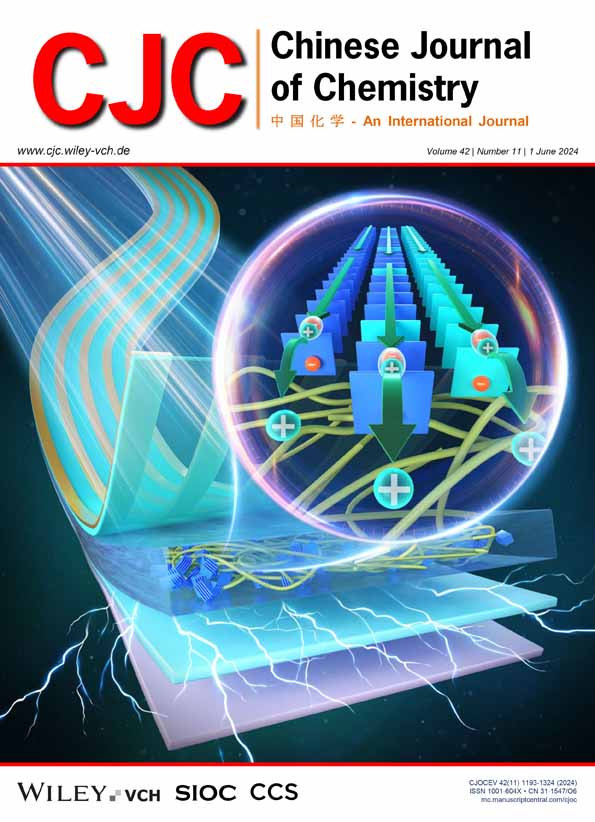
Photocatalytic aerobic oxidative desulfurization (PAODS) is a sustainable alternative technology to traditional, energy-intensive fuel desulfurization methods. Nonetheless, its advancement is hindered by the notable challenge of inadequate electron-hole separation efficiency within the existing catalytic systems. Herein, a Janus 2D/2D heterostructure composed of Co3O4 and CoMoO4 is reported for the PAODS of thiophenic sulfides. Through a combination of detailed experimental characterizations and density functional theory (DFT) calculations, we elucidate the formation of a type II p-n heterojunction in the catalyst, significantly enhancing electron-hole separation through electric field force and reducing the possibility of electron-hole recombination due to the spatial separation of redox centres. The photocatalyst exhibits exceptional activity and demonstrates an impressive performance of 10.4 mmol·g–1·h–1 in the oxidation of dibenzothiophene (DBT). Moreover, the photocatalyst demonstrates profound desulfurization capabilities in real diesel, reinforcing its promising prospects for industrial application. These discoveries provide invaluable insights, both scientifically and practically, towards the development of advanced photocatalysts for PAODS processes.
期刊介绍:
The Chinese Journal of Chemistry is an international forum for peer-reviewed original research results in all fields of chemistry. Founded in 1983 under the name Acta Chimica Sinica English Edition and renamed in 1990 as Chinese Journal of Chemistry, the journal publishes a stimulating mixture of Accounts, Full Papers, Notes and Communications in English.




 京公网安备 11010802042870号
京ICP备2023020795号-1
京公网安备 11010802042870号
京ICP备2023020795号-1

 分享
分享
 求助内容:
求助内容: 应助结果提醒方式:
 扫码关注我们
