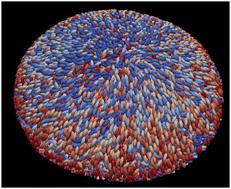
{"title":"Morphogenesis of confined biofilms: how mechanical interactions determine cellular patterning and global geometry","authors":"Kee-Myoung Nam and Jing Yan","doi":"10.1039/D4SM01180E","DOIUrl":null,"url":null,"abstract":"<p >Biofilms are surface-attached bacterial communities encased within extracellular matrices that play significant roles in health and society and serve as prototypical examples of proliferating active nematics. Recent advances in fluorescence microscopy have facilitated an unprecedented view of biofilm development at the single-cell level, thus providing the opportunity to develop a mechanistic understanding of how biofilm development is influenced by mechanical interactions with the environment. Here, we review recent studies that examined the morphogenesis of <em>Vibrio cholerae</em> biofilms under confinement at both single-cell and continuum levels. We describe how biofilms under different confinement modes—embedded and interstitial—can acquire various global geometries and forms of cell orientational ordering different from those in unconfined biofilms, and we demonstrate how these properties arise from the mechanical interplay between the biofilm and its confining medium. We also discuss how this interplay is fundamentally governed by the extracellular matrix, which facilitates the transmission of mechanical stress from the medium into the biofilm <em>via</em> adhesion and friction, and serves as the key feature that distinguishes biofilms from classical bacterial colonies. These studies lay the groundwork for many potential future directions, all of which will contribute to the establishment of a new “developmental biology” of biofilms.</p>","PeriodicalId":103,"journal":{"name":"Soft Matter","volume":" 8","pages":" 1436-1450"},"PeriodicalIF":2.8000,"publicationDate":"2025-01-27","publicationTypes":"Journal Article","fieldsOfStudy":null,"isOpenAccess":false,"openAccessPdf":"https://www.ncbi.nlm.nih.gov/pmc/articles/PMC11791476/pdf/","citationCount":"0","resultStr":null,"platform":"Semanticscholar","paperid":null,"PeriodicalName":"Soft Matter","FirstCategoryId":"92","ListUrlMain":"https://pubs.rsc.org/en/content/articlelanding/2025/sm/d4sm01180e","RegionNum":3,"RegionCategory":"化学","ArticlePicture":[],"TitleCN":null,"AbstractTextCN":null,"PMCID":null,"EPubDate":"","PubModel":"","JCR":"Q3","JCRName":"CHEMISTRY, PHYSICAL","Score":null,"Total":0}
引用次数: 0
Abstract
Biofilms are surface-attached bacterial communities encased within extracellular matrices that play significant roles in health and society and serve as prototypical examples of proliferating active nematics. Recent advances in fluorescence microscopy have facilitated an unprecedented view of biofilm development at the single-cell level, thus providing the opportunity to develop a mechanistic understanding of how biofilm development is influenced by mechanical interactions with the environment. Here, we review recent studies that examined the morphogenesis of Vibrio cholerae biofilms under confinement at both single-cell and continuum levels. We describe how biofilms under different confinement modes—embedded and interstitial—can acquire various global geometries and forms of cell orientational ordering different from those in unconfined biofilms, and we demonstrate how these properties arise from the mechanical interplay between the biofilm and its confining medium. We also discuss how this interplay is fundamentally governed by the extracellular matrix, which facilitates the transmission of mechanical stress from the medium into the biofilm via adhesion and friction, and serves as the key feature that distinguishes biofilms from classical bacterial colonies. These studies lay the groundwork for many potential future directions, all of which will contribute to the establishment of a new “developmental biology” of biofilms.
期刊介绍:
Soft Matter is an international journal published by the Royal Society of Chemistry using Engineering-Materials Science: A Synthesis as its research focus. It publishes original research articles, review articles, and synthesis articles related to this field, reporting the latest discoveries in the relevant theoretical, practical, and applied disciplines in a timely manner, and aims to promote the rapid exchange of scientific information in this subject area. The journal is an open access journal. The journal is an open access journal and has not been placed on the alert list in the last three years.



 京公网安备 11010802042870号
京ICP备2023020795号-1
京公网安备 11010802042870号
京ICP备2023020795号-1

 分享
分享
 求助内容:
求助内容: 应助结果提醒方式:
 扫码关注我们
