Yutao Li, Xuejiao Wang, Ye Jiang, Qun Lv, Yi Zhang, Yu Wang
{"title":"Positive hepatitis B surface antigen leads to a decrease in ovarian reserve in infertile patients receiving first in vitro fertilization treatment.","authors":"Yutao Li, Xuejiao Wang, Ye Jiang, Qun Lv, Yi Zhang, Yu Wang","doi":"10.1186/s12916-025-03905-6","DOIUrl":null,"url":null,"abstract":"<p><strong>Background: </strong>This study assessed the impact of chronic hepatitis B virus (HBV) infection on ovarian reserve in women.</p><p><strong>Methods: </strong>We analyzed data from 38,861 infertile women undergoing their first in vitro fertilization (IVF) treatment (2016-2022), including 1574 HBsAg-positive cases. A control group of 1574 HBsAg-negative women was matched by age and body mass index (BMI). Comparison of clinical characteristics, antral follicle count (AFC), follicle-stimulating hormone (FSH), luteinizing hormone (LH)/FSH ratio, anti-Müllerian hormone (AMH), gonadotropins (Gn) days, total Gn dosage, number of retrieved oocytes, number of mature metaphase II (MII) oocytes, and the proportion of patients with diminished ovarian reserve (DOR; AMH < 1.1 ng/ml) between two groups.</p><p><strong>Results: </strong>HBsAg-positive women showed lower basal AFC and AMH, higher basal FSH, received more Gn, and had fewer retrieved and MII oocytes than HBsAg-negative women. No significant differences in ovarian reserve or stimulation outcomes were found between e antigen-positive and e antigen-negative HBV-infected groups. DOR was less prevalent in HBsAg-negative women, and logistic regression indicated a higher DOR risk with HBV infection.</p><p><strong>Conclusions: </strong>HBsAg positivity significantly impairs ovarian reserve in women, but e antigen status does not notably affect it among HBV-infected individuals.</p>","PeriodicalId":9188,"journal":{"name":"BMC Medicine","volume":"23 1","pages":"58"},"PeriodicalIF":8.3000,"publicationDate":"2025-02-04","publicationTypes":"Journal Article","fieldsOfStudy":null,"isOpenAccess":false,"openAccessPdf":"https://www.ncbi.nlm.nih.gov/pmc/articles/PMC11792308/pdf/","citationCount":"0","resultStr":null,"platform":"Semanticscholar","paperid":null,"PeriodicalName":"BMC Medicine","FirstCategoryId":"3","ListUrlMain":"https://doi.org/10.1186/s12916-025-03905-6","RegionNum":1,"RegionCategory":"医学","ArticlePicture":[],"TitleCN":null,"AbstractTextCN":null,"PMCID":null,"EPubDate":"","PubModel":"","JCR":"Q1","JCRName":"MEDICINE, GENERAL & INTERNAL","Score":null,"Total":0}
引用次数: 0
Abstract
Background: This study assessed the impact of chronic hepatitis B virus (HBV) infection on ovarian reserve in women.
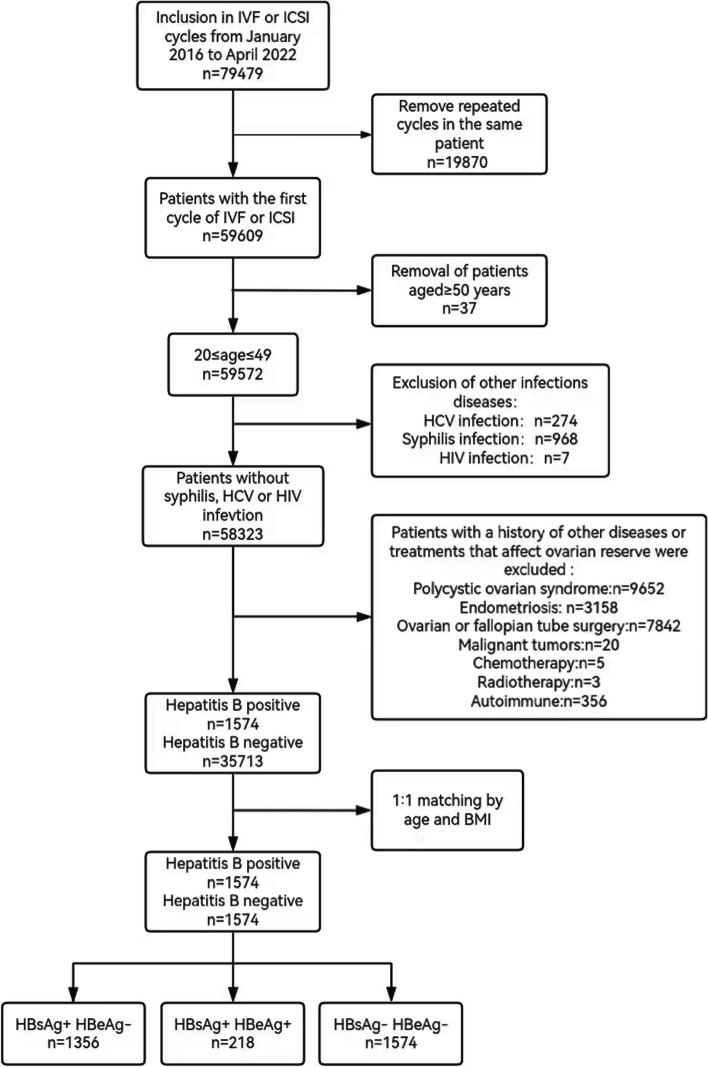
Methods: We analyzed data from 38,861 infertile women undergoing their first in vitro fertilization (IVF) treatment (2016-2022), including 1574 HBsAg-positive cases. A control group of 1574 HBsAg-negative women was matched by age and body mass index (BMI). Comparison of clinical characteristics, antral follicle count (AFC), follicle-stimulating hormone (FSH), luteinizing hormone (LH)/FSH ratio, anti-Müllerian hormone (AMH), gonadotropins (Gn) days, total Gn dosage, number of retrieved oocytes, number of mature metaphase II (MII) oocytes, and the proportion of patients with diminished ovarian reserve (DOR; AMH < 1.1 ng/ml) between two groups.
Results: HBsAg-positive women showed lower basal AFC and AMH, higher basal FSH, received more Gn, and had fewer retrieved and MII oocytes than HBsAg-negative women. No significant differences in ovarian reserve or stimulation outcomes were found between e antigen-positive and e antigen-negative HBV-infected groups. DOR was less prevalent in HBsAg-negative women, and logistic regression indicated a higher DOR risk with HBV infection.
Conclusions: HBsAg positivity significantly impairs ovarian reserve in women, but e antigen status does not notably affect it among HBV-infected individuals.
期刊介绍:
BMC Medicine is an open access, transparent peer-reviewed general medical journal. It is the flagship journal of the BMC series and publishes outstanding and influential research in various areas including clinical practice, translational medicine, medical and health advances, public health, global health, policy, and general topics of interest to the biomedical and sociomedical professional communities. In addition to research articles, the journal also publishes stimulating debates, reviews, unique forum articles, and concise tutorials. All articles published in BMC Medicine are included in various databases such as Biological Abstracts, BIOSIS, CAS, Citebase, Current contents, DOAJ, Embase, MEDLINE, PubMed, Science Citation Index Expanded, OAIster, SCImago, Scopus, SOCOLAR, and Zetoc.



 京公网安备 11010802042870号
京ICP备2023020795号-1
京公网安备 11010802042870号
京ICP备2023020795号-1

 分享
分享
 求助内容:
求助内容: 应助结果提醒方式:
 扫码关注我们
