Anthony A Sochet, Amy Kiskaddon, Neil A Goldenberg
{"title":"How I approach pharmacological thromboprophylaxis in children.","authors":"Anthony A Sochet, Amy Kiskaddon, Neil A Goldenberg","doi":"10.1182/blood.2024026327","DOIUrl":null,"url":null,"abstract":"<p><strong>Abstract: </strong>The incidence of venous thromboembolism in children continues to rise, with the most recent analysis from the Pediatric Hospital Information Systems database in the United States reporting a 200-fold increase in pediatric hospitalization-related venous thromboembolism diagnoses over the past 2 decades. In the past decade, several pediatric venous thromboembolism risk prediction models have been published, in some cases derived from multi-institutional data, and multicenter randomized clinical trials of thromboembolism prevention in specific pediatric subpopulations have been conducted. Yet, apart from children hospitalized for COVID-19, guidelines for thromboprophylaxis (TP) in children that address several distinct at-risk subpopulations and settings for venous thromboembolism are presently lacking. It is becoming increasingly apparent that approaches to pharmacological TP for hospitalized children should be risk-stratified regarding a priori risks of both venous thromboembolism and clinically relevant bleeding. In this manuscript, we present model cases of common inpatient clinical scenarios and review the evidence related to venous thromboembolism risk models and pharmacological TP clinical trials in children, describing a pragmatic approach to pharmacological TP for each scenario. We then conclude by describing our evidence-informed, subpopulation- and setting-specific approach to pharmacological TP for the clinical scenarios and reviewing critical knowledge gaps well-suited for future pediatric trials to inform TP in children.</p>","PeriodicalId":9102,"journal":{"name":"Blood","volume":" ","pages":"2439-2446"},"PeriodicalIF":23.1000,"publicationDate":"2025-05-22","publicationTypes":"Journal Article","fieldsOfStudy":null,"isOpenAccess":false,"openAccessPdf":"","citationCount":"0","resultStr":null,"platform":"Semanticscholar","paperid":null,"PeriodicalName":"Blood","FirstCategoryId":"3","ListUrlMain":"https://doi.org/10.1182/blood.2024026327","RegionNum":1,"RegionCategory":"医学","ArticlePicture":[],"TitleCN":null,"AbstractTextCN":null,"PMCID":null,"EPubDate":"","PubModel":"","JCR":"Q1","JCRName":"HEMATOLOGY","Score":null,"Total":0}
引用次数: 0
Abstract
Abstract: The incidence of venous thromboembolism in children continues to rise, with the most recent analysis from the Pediatric Hospital Information Systems database in the United States reporting a 200-fold increase in pediatric hospitalization-related venous thromboembolism diagnoses over the past 2 decades. In the past decade, several pediatric venous thromboembolism risk prediction models have been published, in some cases derived from multi-institutional data, and multicenter randomized clinical trials of thromboembolism prevention in specific pediatric subpopulations have been conducted. Yet, apart from children hospitalized for COVID-19, guidelines for thromboprophylaxis (TP) in children that address several distinct at-risk subpopulations and settings for venous thromboembolism are presently lacking. It is becoming increasingly apparent that approaches to pharmacological TP for hospitalized children should be risk-stratified regarding a priori risks of both venous thromboembolism and clinically relevant bleeding. In this manuscript, we present model cases of common inpatient clinical scenarios and review the evidence related to venous thromboembolism risk models and pharmacological TP clinical trials in children, describing a pragmatic approach to pharmacological TP for each scenario. We then conclude by describing our evidence-informed, subpopulation- and setting-specific approach to pharmacological TP for the clinical scenarios and reviewing critical knowledge gaps well-suited for future pediatric trials to inform TP in children.
期刊介绍:
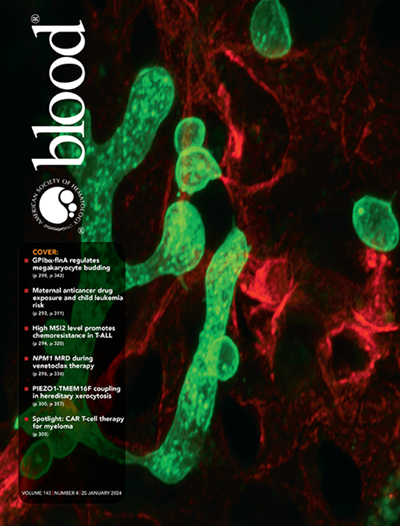
Blood, the official journal of the American Society of Hematology, published online and in print, provides an international forum for the publication of original articles describing basic laboratory, translational, and clinical investigations in hematology. Primary research articles will be published under the following scientific categories: Clinical Trials and Observations; Gene Therapy; Hematopoiesis and Stem Cells; Immunobiology and Immunotherapy scope; Myeloid Neoplasia; Lymphoid Neoplasia; Phagocytes, Granulocytes and Myelopoiesis; Platelets and Thrombopoiesis; Red Cells, Iron and Erythropoiesis; Thrombosis and Hemostasis; Transfusion Medicine; Transplantation; and Vascular Biology. Papers can be listed under more than one category as appropriate.



 京公网安备 11010802042870号
京ICP备2023020795号-1
京公网安备 11010802042870号
京ICP备2023020795号-1

 分享
分享
 求助内容:
求助内容: 应助结果提醒方式:
 扫码关注我们
