Connor J Holdback, Rony Ibrahim, David S Haydon, Paul Grimshaw, Richard Kelso, Ross A Pinder
{"title":"The dynamics of seated shot put: a case study example of pole grip optimisation.","authors":"Connor J Holdback, Rony Ibrahim, David S Haydon, Paul Grimshaw, Richard Kelso, Ross A Pinder","doi":"10.3389/fspor.2025.1509435","DOIUrl":null,"url":null,"abstract":"<p><p>The impact of pole position in seated shot put has been a key research question both in the previous literature and for coaches in the field. The aims of this research were to understand the dynamics of seated shot put and to investigate the impact of changing pole grip height on trunk parameters. Three grip heights are compared: the athlete's standard grip, 75 mm higher than standard, and 75 mm lower than standard, to determine which grip produced greater angular velocity and power at the trunk. In addition, a post-analysis intervention was implemented following this investigation where the athlete completed four weeks of training (8 sessions) with a grip height that was indicated to be superior. The trunk was found to provide the largest contribution to the movement, with a 64% of the total velocity contribution. A lower grip height was found to generate greater power and velocity in trunk rotation and flexion when compared to higher grip heights. When assessed over the intervention period, the lower grip height showed an increased rate of improvement throughout, and a performance advantage over the standard grip after just four sessions. This research demonstrates that pole grip height can impact athlete biomechanical parameters and may improve overall performance given sufficient time.</p>","PeriodicalId":12716,"journal":{"name":"Frontiers in Sports and Active Living","volume":"7 ","pages":"1509435"},"PeriodicalIF":2.6000,"publicationDate":"2025-01-20","publicationTypes":"Journal Article","fieldsOfStudy":null,"isOpenAccess":false,"openAccessPdf":"https://www.ncbi.nlm.nih.gov/pmc/articles/PMC11788405/pdf/","citationCount":"0","resultStr":null,"platform":"Semanticscholar","paperid":null,"PeriodicalName":"Frontiers in Sports and Active Living","FirstCategoryId":"1085","ListUrlMain":"https://doi.org/10.3389/fspor.2025.1509435","RegionNum":0,"RegionCategory":null,"ArticlePicture":[],"TitleCN":null,"AbstractTextCN":null,"PMCID":null,"EPubDate":"2025/1/1 0:00:00","PubModel":"eCollection","JCR":"Q2","JCRName":"SPORT SCIENCES","Score":null,"Total":0}
引用次数: 0
Abstract
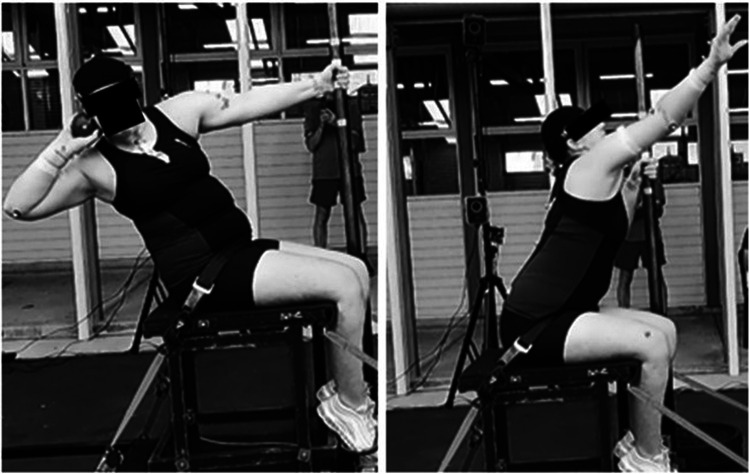
The impact of pole position in seated shot put has been a key research question both in the previous literature and for coaches in the field. The aims of this research were to understand the dynamics of seated shot put and to investigate the impact of changing pole grip height on trunk parameters. Three grip heights are compared: the athlete's standard grip, 75 mm higher than standard, and 75 mm lower than standard, to determine which grip produced greater angular velocity and power at the trunk. In addition, a post-analysis intervention was implemented following this investigation where the athlete completed four weeks of training (8 sessions) with a grip height that was indicated to be superior. The trunk was found to provide the largest contribution to the movement, with a 64% of the total velocity contribution. A lower grip height was found to generate greater power and velocity in trunk rotation and flexion when compared to higher grip heights. When assessed over the intervention period, the lower grip height showed an increased rate of improvement throughout, and a performance advantage over the standard grip after just four sessions. This research demonstrates that pole grip height can impact athlete biomechanical parameters and may improve overall performance given sufficient time.






 京公网安备 11010802042870号
京ICP备2023020795号-1
京公网安备 11010802042870号
京ICP备2023020795号-1

 分享
分享
 求助内容:
求助内容: 应助结果提醒方式:
 扫码关注我们
