Nathan A Shlobin, Jimmy Li, Josemir W Sander, Mark Robert Keezer, Roland D Thijs
{"title":"Cardiac Conduction Delay for Sodium Channel Antagonist Antiseizure Medications: An Analysis of the Canadian Longitudinal Study on Aging.","authors":"Nathan A Shlobin, Jimmy Li, Josemir W Sander, Mark Robert Keezer, Roland D Thijs","doi":"10.1212/WNL.0000000000210302","DOIUrl":null,"url":null,"abstract":"<p><strong>Background and objectives: </strong>People with epilepsy are at risk of cardiac arrhythmias. Whether this association results from epilepsy, antiseizure medications (ASMs) such as sodium channel blockers (NABs), or other factors has not been systematically assessed. The aims of this study were to quantify the odds of cardiac conduction delays (CCDs) on electrocardiogram in older people with active epilepsy using vs not using NABs, to determine the prevalence of CCDs by NABs, and to examine the association of demographic and clinical factors with CCDs.</p><p><strong>Methods: </strong>This was a cross-sectional study of the Canadian Longitudinal Study on Aging. We defined active epilepsy as self-reported epilepsy and taking ASM. Sodium channel blockers (NABs) were phenytoin, lamotrigine, carbamazepine, oxcarbazepine, or lacosamide. We compared CCDs between people with epilepsy using NABs and those not using NABs; determined the prevalence of CCDs by NAB type; and fitted a logistic regression model for each abnormal ECG outcome as a function of active epilepsy and NAB use while adjusting for demographics and clinical factors. Multiple imputations handled missing data (200 iterations).</p><p><strong>Results: </strong>In total, 30,077 people, with mean age 63.0 (10.25) years and 50.9% female, were studied, including 141 people with active epilepsy who used NABs, 68 who did not use NABs, and 29,868 who did not have active epilepsy. Demographics between groups and relative to people without epilepsy were similar. People with active epilepsy taking NABs were more likely to have prolonged QRS (odds ratio [OR] = 2.85 [95% CI 1.09-7.43]) and any CCD (1.94 [1.03-3.63]) compared with those with active epilepsy without NAB. After adjusting for Framingham score and heart rate-lowering medications, NAB use was associated with prolonged QTc (OR = 1.52 [95% CI 1.06-2.18]) and any CCD (1.78 [1.16, 2.74]). The prevalence of any CCD was 36.1% [95% CI 24.2%-49.4%] for carbamazepine, 45.5% [31.7%-58.5%] for phenytoin, and 54.7% [28.9%-75.6%] lamotrigine. Epilepsy was not associated with any CCD.</p><p><strong>Discussion: </strong>People with active epilepsy using NABs more commonly have CCDs. NAB use is associated with CCD, whereas active epilepsy is not.</p>","PeriodicalId":19256,"journal":{"name":"Neurology","volume":"104 4","pages":"e210302"},"PeriodicalIF":8.5000,"publicationDate":"2025-02-25","publicationTypes":"Journal Article","fieldsOfStudy":null,"isOpenAccess":false,"openAccessPdf":"https://www.ncbi.nlm.nih.gov/pmc/articles/PMC11793923/pdf/","citationCount":"0","resultStr":null,"platform":"Semanticscholar","paperid":null,"PeriodicalName":"Neurology","FirstCategoryId":"3","ListUrlMain":"https://doi.org/10.1212/WNL.0000000000210302","RegionNum":1,"RegionCategory":"医学","ArticlePicture":[],"TitleCN":null,"AbstractTextCN":null,"PMCID":null,"EPubDate":"2025/2/3 0:00:00","PubModel":"Epub","JCR":"Q1","JCRName":"CLINICAL NEUROLOGY","Score":null,"Total":0}
引用次数: 0
Abstract
Background and objectives: People with epilepsy are at risk of cardiac arrhythmias. Whether this association results from epilepsy, antiseizure medications (ASMs) such as sodium channel blockers (NABs), or other factors has not been systematically assessed. The aims of this study were to quantify the odds of cardiac conduction delays (CCDs) on electrocardiogram in older people with active epilepsy using vs not using NABs, to determine the prevalence of CCDs by NABs, and to examine the association of demographic and clinical factors with CCDs.
Methods: This was a cross-sectional study of the Canadian Longitudinal Study on Aging. We defined active epilepsy as self-reported epilepsy and taking ASM. Sodium channel blockers (NABs) were phenytoin, lamotrigine, carbamazepine, oxcarbazepine, or lacosamide. We compared CCDs between people with epilepsy using NABs and those not using NABs; determined the prevalence of CCDs by NAB type; and fitted a logistic regression model for each abnormal ECG outcome as a function of active epilepsy and NAB use while adjusting for demographics and clinical factors. Multiple imputations handled missing data (200 iterations).
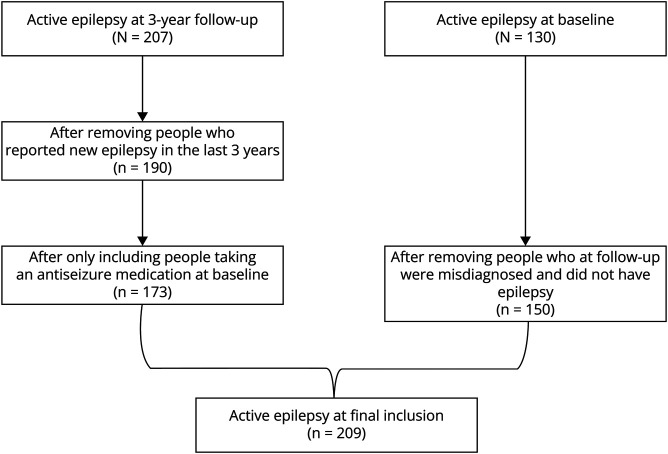
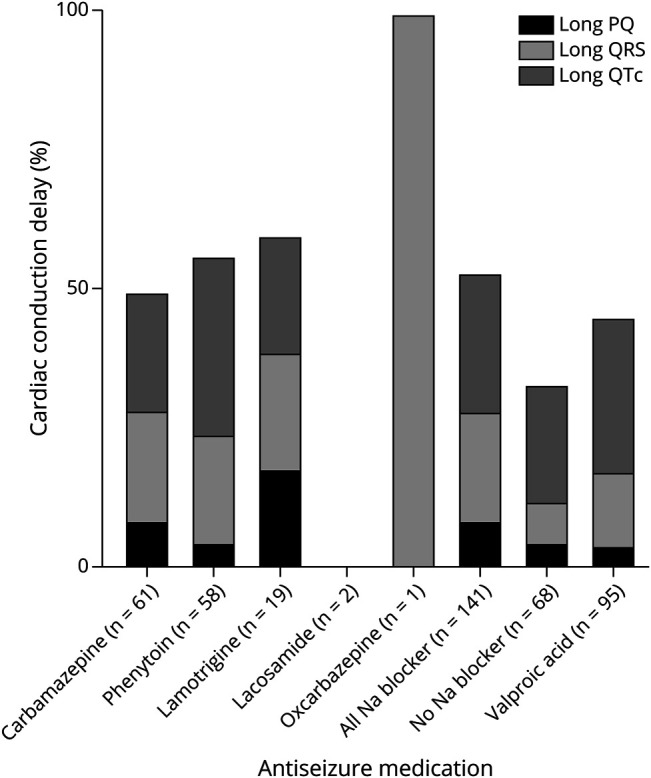
Results: In total, 30,077 people, with mean age 63.0 (10.25) years and 50.9% female, were studied, including 141 people with active epilepsy who used NABs, 68 who did not use NABs, and 29,868 who did not have active epilepsy. Demographics between groups and relative to people without epilepsy were similar. People with active epilepsy taking NABs were more likely to have prolonged QRS (odds ratio [OR] = 2.85 [95% CI 1.09-7.43]) and any CCD (1.94 [1.03-3.63]) compared with those with active epilepsy without NAB. After adjusting for Framingham score and heart rate-lowering medications, NAB use was associated with prolonged QTc (OR = 1.52 [95% CI 1.06-2.18]) and any CCD (1.78 [1.16, 2.74]). The prevalence of any CCD was 36.1% [95% CI 24.2%-49.4%] for carbamazepine, 45.5% [31.7%-58.5%] for phenytoin, and 54.7% [28.9%-75.6%] lamotrigine. Epilepsy was not associated with any CCD.
Discussion: People with active epilepsy using NABs more commonly have CCDs. NAB use is associated with CCD, whereas active epilepsy is not.
期刊介绍:
Neurology, the official journal of the American Academy of Neurology, aspires to be the premier peer-reviewed journal for clinical neurology research. Its mission is to publish exceptional peer-reviewed original research articles, editorials, and reviews to improve patient care, education, clinical research, and professionalism in neurology.
As the leading clinical neurology journal worldwide, Neurology targets physicians specializing in nervous system diseases and conditions. It aims to advance the field by presenting new basic and clinical research that influences neurological practice. The journal is a leading source of cutting-edge, peer-reviewed information for the neurology community worldwide. Editorial content includes Research, Clinical/Scientific Notes, Views, Historical Neurology, NeuroImages, Humanities, Letters, and position papers from the American Academy of Neurology. The online version is considered the definitive version, encompassing all available content.
Neurology is indexed in prestigious databases such as MEDLINE/PubMed, Embase, Scopus, Biological Abstracts®, PsycINFO®, Current Contents®, Web of Science®, CrossRef, and Google Scholar.



 京公网安备 11010802042870号
京ICP备2023020795号-1
京公网安备 11010802042870号
京ICP备2023020795号-1

 分享
分享
 求助内容:
求助内容: 应助结果提醒方式:
 扫码关注我们
