Isaac Maestro-Gaitán, Miguel Redondo-Nieto, Sara González-Bodí, Laura Rodríguez-Casillas, Javier Matías, Luis Bolaños, María Reguera
{"title":"Insights into quinoa endophytes: core bacterial communities reveal high stability to water stress and genotypic variation.","authors":"Isaac Maestro-Gaitán, Miguel Redondo-Nieto, Sara González-Bodí, Laura Rodríguez-Casillas, Javier Matías, Luis Bolaños, María Reguera","doi":"10.1186/s40793-025-00673-x","DOIUrl":null,"url":null,"abstract":"<p><strong>Background: </strong>Plant endophytes, comprising non-pathogenic bacteria, fungi, and archaea, inhabit various plant parts, including roots, stems, leaves, and seeds. These microorganisms play a crucial role in plant development by enhancing germination, growth, and stress resilience. Seed endophytes, in particular, represent the most adapted and conserved segment of plant microbiota, significantly influencing the initial stages of plant growth and microbial community establishment. This study investigates the impact of environmental and genotypic factors on the endophytic communities of Chenopodium quinoa Willd. (quinoa), a crop notable for its adaptability and nutritional value.</p><p><strong>Results: </strong>We aimed to characterize the core endophytic communities in quinoa seeds and roots from two distinct genotypes under well-watered (WW) and water-deficit (WD) conditions, utilizing various soil infusions as inoculants to explore potential changes in these endophytes. Our findings reveal distinct changes with quinoa seeds exhibiting a high degree of conservation in their endophytic microbiome, even between maternal and offspring seeds, with specific bacterial taxa showing only minor differences. Tissue specificity emerged as a key factor, with seeds maintaining a stable microbial community, while roots exhibited more pronounced shifts, highlighting the tissue-dependent patterns of microbial enrichment.</p><p><strong>Conclusions: </strong>The results highlight the stability and conservation of endophytic communities in quinoa seeds, even under varying water conditions and across different genotypes, emphasizing the role of tissue specificity in shaping microbial associations. These findings suggest that quinoa-associated endophytes, particularly those conserved in seeds, may play a crucial role in enhancing drought resilience. Understanding the dynamics of plant-microbe interactions in quinoa is vital for developing stress-resilient crop varieties, supporting sustainable agricultural practices, and ensuring food security in the face of climate change and environmental challenges.</p>","PeriodicalId":48553,"journal":{"name":"Environmental Microbiome","volume":"20 1","pages":"16"},"PeriodicalIF":5.4000,"publicationDate":"2025-02-03","publicationTypes":"Journal Article","fieldsOfStudy":null,"isOpenAccess":false,"openAccessPdf":"https://www.ncbi.nlm.nih.gov/pmc/articles/PMC11789408/pdf/","citationCount":"0","resultStr":null,"platform":"Semanticscholar","paperid":null,"PeriodicalName":"Environmental Microbiome","FirstCategoryId":"93","ListUrlMain":"https://doi.org/10.1186/s40793-025-00673-x","RegionNum":2,"RegionCategory":"环境科学与生态学","ArticlePicture":[],"TitleCN":null,"AbstractTextCN":null,"PMCID":null,"EPubDate":"","PubModel":"","JCR":"Q1","JCRName":"GENETICS & HEREDITY","Score":null,"Total":0}
引用次数: 0
Abstract
Background: Plant endophytes, comprising non-pathogenic bacteria, fungi, and archaea, inhabit various plant parts, including roots, stems, leaves, and seeds. These microorganisms play a crucial role in plant development by enhancing germination, growth, and stress resilience. Seed endophytes, in particular, represent the most adapted and conserved segment of plant microbiota, significantly influencing the initial stages of plant growth and microbial community establishment. This study investigates the impact of environmental and genotypic factors on the endophytic communities of Chenopodium quinoa Willd. (quinoa), a crop notable for its adaptability and nutritional value.
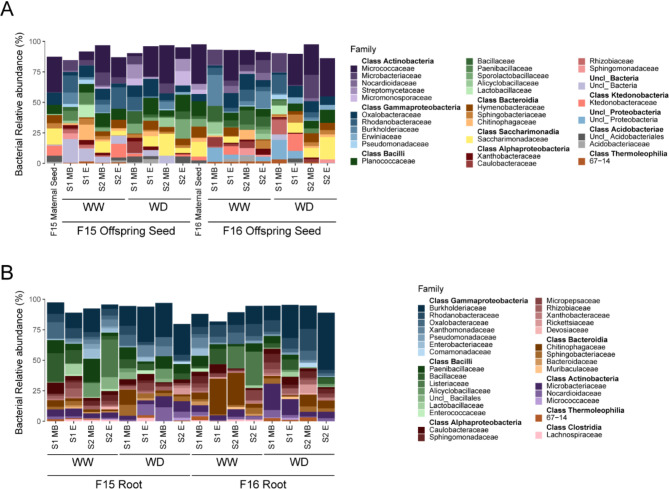
Results: We aimed to characterize the core endophytic communities in quinoa seeds and roots from two distinct genotypes under well-watered (WW) and water-deficit (WD) conditions, utilizing various soil infusions as inoculants to explore potential changes in these endophytes. Our findings reveal distinct changes with quinoa seeds exhibiting a high degree of conservation in their endophytic microbiome, even between maternal and offspring seeds, with specific bacterial taxa showing only minor differences. Tissue specificity emerged as a key factor, with seeds maintaining a stable microbial community, while roots exhibited more pronounced shifts, highlighting the tissue-dependent patterns of microbial enrichment.
Conclusions: The results highlight the stability and conservation of endophytic communities in quinoa seeds, even under varying water conditions and across different genotypes, emphasizing the role of tissue specificity in shaping microbial associations. These findings suggest that quinoa-associated endophytes, particularly those conserved in seeds, may play a crucial role in enhancing drought resilience. Understanding the dynamics of plant-microbe interactions in quinoa is vital for developing stress-resilient crop varieties, supporting sustainable agricultural practices, and ensuring food security in the face of climate change and environmental challenges.
期刊介绍:
Microorganisms, omnipresent across Earth's diverse environments, play a crucial role in adapting to external changes, influencing Earth's systems and cycles, and contributing significantly to agricultural practices. Through applied microbiology, they offer solutions to various everyday needs. Environmental Microbiome recognizes the universal presence and significance of microorganisms, inviting submissions that explore the diverse facets of environmental and applied microbiological research.





 京公网安备 11010802042870号
京ICP备2023020795号-1
京公网安备 11010802042870号
京ICP备2023020795号-1

 分享
分享
 求助内容:
求助内容: 应助结果提醒方式:
 扫码关注我们
