{"title":"Dual-targeting Aggregation-induced emission polymer micelles mediate immunogenic sonodynamic therapy for Tumor cell growth inhibition and macrophage reprogramming","authors":"Haiheng Peng , Dandan Wang , Shiwen Huang , Aixi Yu","doi":"10.1016/j.actbio.2025.01.065","DOIUrl":null,"url":null,"abstract":"<div><div>Sonodynamic therapy (SDT) is a promising cancer treatment known for its deep tumor penetration and high efficacy. However, developing highly efficient sonosensitizers remains a significant challenge. Reports on SDT using aggregation-induced emission luminogens (AIEgens) are rare, highlighting the urgent need for novel AIE-active sonosensitizers. For the first time, we have developed tumor- and macrophage-targeting nano micelles, AIE/Biotin/Mannose-M (ABM-M), utilizing aggregation-induced emission polymers. The ABM-M mediate immunogenic cell death through SDT. By reprogramming tumor-associated macrophages (TAMs), they promote the conversion of M2 macrophages into M1 macrophages, reversing the tumor's immunosuppressive environment. We optimized the ratio of functional molecules to achieve maximum fluorescence intensity and reactive oxygen species (ROS) generation. The multi-targeting nature of ABM-M enables them to bind to relevant antibodies or other molecules, enhancing the capture and presentation of tumor antigens. This, in turn, activates the immune responses of dendritic cells and T cells while inhibiting angiogenesis, creating a more favorable microenvironment for antitumor therapy. Furthermore, ABM-M can be combined with immune checkpoint inhibitors, such as anti-PD-L1 antibodies, to achieve promising outcomes in cancer immunotherapy. The ABM-M nanomaterials offer multi-layered and multi-targeting immune regulation. This study provides a blueprint for developing next-generation cancer diagnostic and therapeutic strategies.</div></div><div><h3>Statement of significance</h3><div>Our research pioneers the use of nanomicelles to simultaneously target both tumor cells and tumor-associated macrophages (TAMs), integrated with sonodynamic therapy. Through precise ratio adjustments, we engineered nanomicelles capable of multi-target regulation. These micelles uniquely induce immunogenic cell death (ICD) and repolarize macrophages from an immunosuppressive M2 phenotype to an immunostimulatory M1 phenotype, reversing the tumor's immunosuppressive microenvironment. This dual mechanism can be enhanced by combining with immune checkpoint inhibitors, such as anti-PD-L1 antibodies, offering a promising strategy to treat refractory cancers. Extensive <em>in vitro</em> and <em>in vivo</em> validation confirms their therapeutic potential, providing a solid foundation for clinical application. This innovative approach shows significant promise for revolutionizing cancer treatment and improving patient outcomes.</div></div>","PeriodicalId":237,"journal":{"name":"Acta Biomaterialia","volume":"195 ","pages":"Pages 321-337"},"PeriodicalIF":9.6000,"publicationDate":"2025-03-15","publicationTypes":"Journal Article","fieldsOfStudy":null,"isOpenAccess":false,"openAccessPdf":"","citationCount":"0","resultStr":null,"platform":"Semanticscholar","paperid":null,"PeriodicalName":"Acta Biomaterialia","FirstCategoryId":"5","ListUrlMain":"https://www.sciencedirect.com/science/article/pii/S1742706125000856","RegionNum":1,"RegionCategory":"医学","ArticlePicture":[],"TitleCN":null,"AbstractTextCN":null,"PMCID":null,"EPubDate":"2025/2/1 0:00:00","PubModel":"Epub","JCR":"Q1","JCRName":"ENGINEERING, BIOMEDICAL","Score":null,"Total":0}
引用次数: 0
Abstract
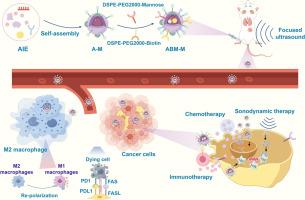
Sonodynamic therapy (SDT) is a promising cancer treatment known for its deep tumor penetration and high efficacy. However, developing highly efficient sonosensitizers remains a significant challenge. Reports on SDT using aggregation-induced emission luminogens (AIEgens) are rare, highlighting the urgent need for novel AIE-active sonosensitizers. For the first time, we have developed tumor- and macrophage-targeting nano micelles, AIE/Biotin/Mannose-M (ABM-M), utilizing aggregation-induced emission polymers. The ABM-M mediate immunogenic cell death through SDT. By reprogramming tumor-associated macrophages (TAMs), they promote the conversion of M2 macrophages into M1 macrophages, reversing the tumor's immunosuppressive environment. We optimized the ratio of functional molecules to achieve maximum fluorescence intensity and reactive oxygen species (ROS) generation. The multi-targeting nature of ABM-M enables them to bind to relevant antibodies or other molecules, enhancing the capture and presentation of tumor antigens. This, in turn, activates the immune responses of dendritic cells and T cells while inhibiting angiogenesis, creating a more favorable microenvironment for antitumor therapy. Furthermore, ABM-M can be combined with immune checkpoint inhibitors, such as anti-PD-L1 antibodies, to achieve promising outcomes in cancer immunotherapy. The ABM-M nanomaterials offer multi-layered and multi-targeting immune regulation. This study provides a blueprint for developing next-generation cancer diagnostic and therapeutic strategies.
Statement of significance
Our research pioneers the use of nanomicelles to simultaneously target both tumor cells and tumor-associated macrophages (TAMs), integrated with sonodynamic therapy. Through precise ratio adjustments, we engineered nanomicelles capable of multi-target regulation. These micelles uniquely induce immunogenic cell death (ICD) and repolarize macrophages from an immunosuppressive M2 phenotype to an immunostimulatory M1 phenotype, reversing the tumor's immunosuppressive microenvironment. This dual mechanism can be enhanced by combining with immune checkpoint inhibitors, such as anti-PD-L1 antibodies, offering a promising strategy to treat refractory cancers. Extensive in vitro and in vivo validation confirms their therapeutic potential, providing a solid foundation for clinical application. This innovative approach shows significant promise for revolutionizing cancer treatment and improving patient outcomes.
期刊介绍:
Acta Biomaterialia is a monthly peer-reviewed scientific journal published by Elsevier. The journal was established in January 2005. The editor-in-chief is W.R. Wagner (University of Pittsburgh). The journal covers research in biomaterials science, including the interrelationship of biomaterial structure and function from macroscale to nanoscale. Topical coverage includes biomedical and biocompatible materials.



 京公网安备 11010802042870号
京ICP备2023020795号-1
京公网安备 11010802042870号
京ICP备2023020795号-1

 分享
分享
 求助内容:
求助内容: 应助结果提醒方式:
 扫码关注我们
